.svg)


For years, traditional SEO trained us to think in a straight line: pick a keyword, build a page around it, optimise the title, headings, and internal links, and try to rank for that exact search. That approach still matters in classic search. But when a user asks an AI engine a layered question, the system often does not stay loyal to the original wording. It expands the request, rewrites it into related sub-queries, and retrieves evidence from multiple angles before producing one final answer.
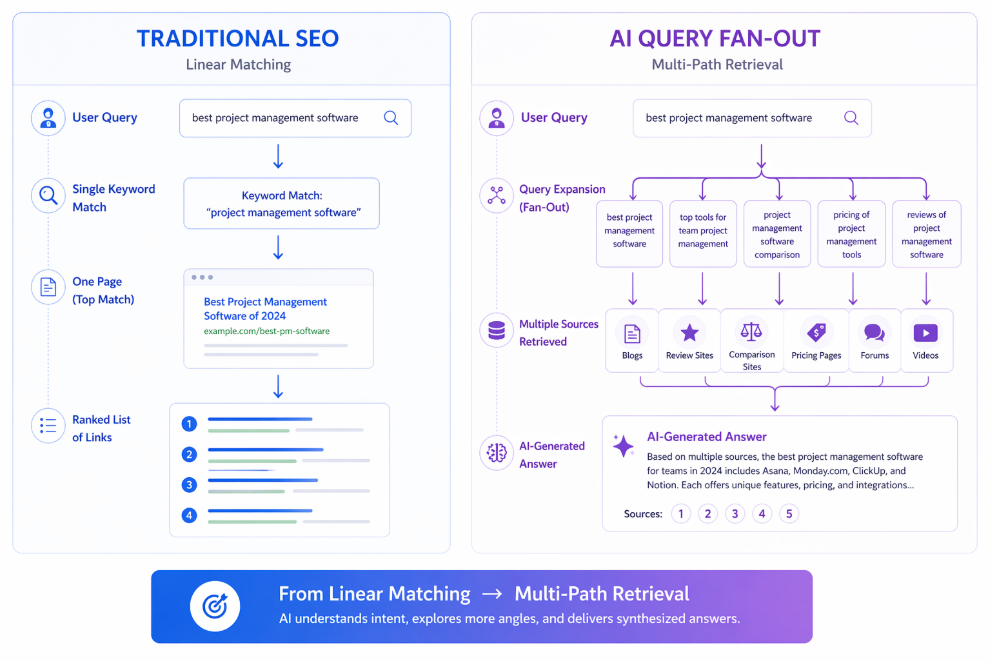
That is why pages that look perfectly optimised for one keyword can still miss AI visibility. The system is no longer asking only, “Does this page mention the phrase?” It is asking, “Does this content help me answer the user from every useful angle?” The difference sounds subtle. In practice, it changes how content is discovered, compared, and cited.
This article explains that shift in plain language: how traditional SEO matches keywords, how AI uses fan-out retrieval, where the two systems differ structurally, and what that means for modern content strategy.
How Traditional SEO Matches Keywords
Traditional SEO works by helping search engines understand what a page is about and how relevant that page is to a query. In classic search, matching begins with language patterns: the query terms, close variants, page titles, headings, anchor text, body copy, and the overall topical signals around the page. Google has long said that its ranking systems use many signals, but relevance still starts with understanding the words on the page and how well the content seems to satisfy the searcher’s intent. Google’s ranking systems guide explains that ranking relies on multiple systems working together to surface relevant, useful results.
In this model, the page is usually optimised around a primary keyword or a close set of keyword variants. You might build one article for “AI SEO strategy,” another for “how to rank in AI Overviews,” and another for “what is generative engine optimisation.” The logic is page-to-query alignment. The stronger the relevance and authority signals, the better the chance of ranking for that search pattern.
That does not mean keyword matching is crude or outdated. Modern search engines can recognise synonyms, context, entities, and related meaning. But the workflow is still recognisable: one query enters the system, and the engine returns a ranked list of results that it believes best match that request. Even where semantic understanding is involved, the destination is still a results page, not a synthesised answer assembled from many micro-retrieval paths.
This is also why so much traditional SEO advice focuses on keyword research, search intent, on-page optimisation, and crawlability. Google’s SEO Starter Guide and people-first content guidance both reinforce the same practical idea: create helpful pages that are clear, discoverable, and aligned with what people are actually searching for.
How AI Uses Fan-Out Retrieval
AI search systems often behave differently. Instead of relying on the original query alone, they can expand that query into several variants and sub-questions before they retrieve content. This is the foundation of fan-out retrieval. A single prompt can become a cluster of searches: one definitional, one comparative, one practical, one evaluative, and sometimes one tailored to freshness, geography, or product context.
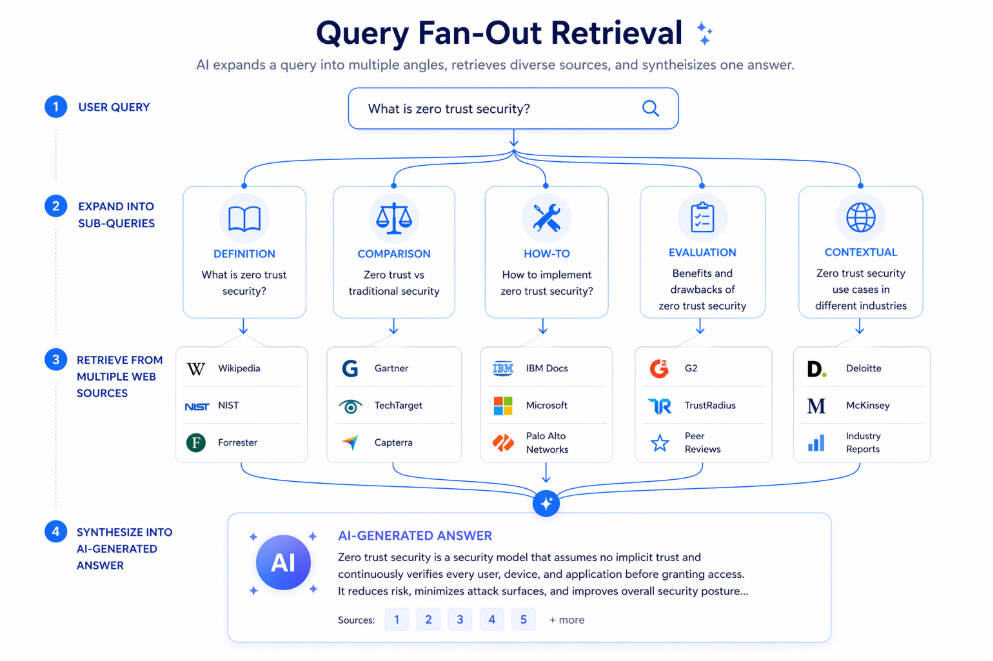
Google has publicly described AI Mode as using a fan-out technique to explore broader and more diverse information pathways, and the same broad retrieval principle appears in Google’s official AI guidance for site owners. Google’s AI features documentation reflects this new environment where content may be surfaced inside AI-generated experiences rather than only as a blue link.
At the technical level, the idea of generating multiple query variants is not guesswork. Google Patent US11663201B2 describes “query variant generation” using a trained generative model. In simple terms, the system can take one input and generate related variants that help it search more effectively. That matters because the AI is no longer trying to find only the best page for the typed phrase. It is trying to find the best evidence for each related angle of the question.
Imagine someone searches, “Is traditional SEO enough for AI search visibility?” A fan-out system may break that into hidden follow-up paths such as: what traditional SEO does well, how AI retrieves evidence, whether freshness matters, how citations are selected, and what content structure improves extractability. If your page addresses only the head phrase and ignores those supporting questions, you may look relevant in classic search but incomplete in AI retrieval.
This is why fan-out rewards topic coverage more than phrase repetition. The winning page is often the one that gives clean answers to the sub-questions the system silently created, not the one that merely repeats the root keyword more often.
Structural Differences in Ranking
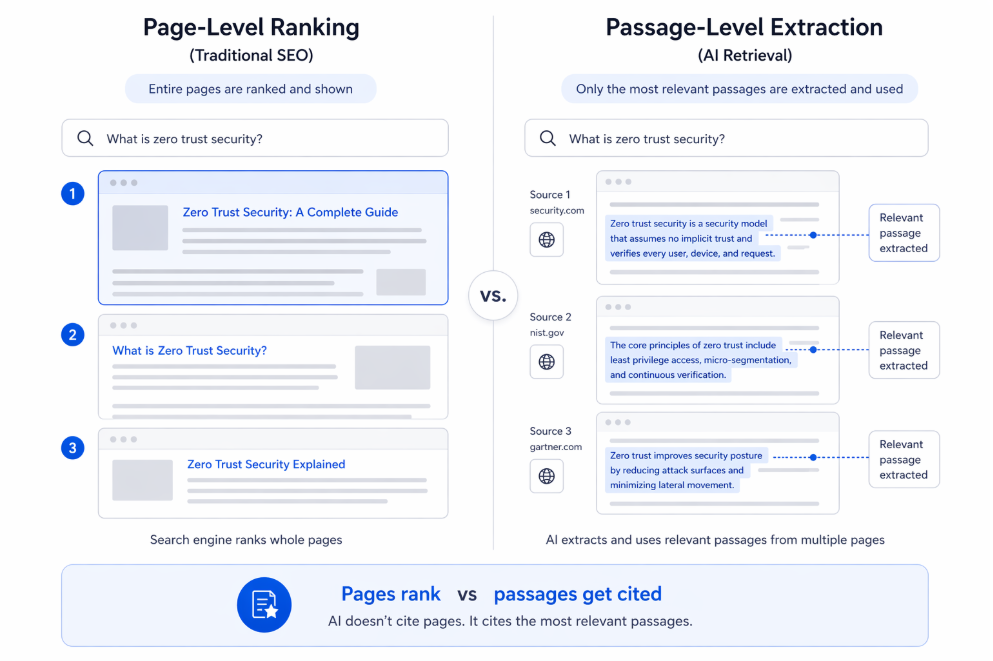
The real difference between traditional keyword matching and query fan-out is structural. Traditional SEO tends to evaluate pages within a ranked results framework. AI fan-out systems behave more like research assistants: they decompose the question, gather evidence from several retrieval routes, and then synthesise an answer. That changes the unit of competition from page-level ranking alone to passage-level usefulness.
In a classic search flow, your page competes for a position in a list. In a fan-out flow, your page may win one sub-query, lose three others, and still appear as a citation because one paragraph answered one hidden question exceptionally well. That makes content design more granular. A strong introduction helps, but strong sections help more because the system may extract a passage instead of rewarding the page.
Freshness is another structural divider. In a 2025 Ahrefs study, AI assistants were found to cite pages that were 25.7% fresher than traditional search results on average. That does not mean old content cannot perform. It means stale content is easier to displace when AI systems are selecting support material for live answers.
The practical reading is simple: traditional SEO asks whether your page deserves to rank for a query, while AI retrieval often asks whether your content contains an extractable, current, trustworthy answer for one branch of a larger question. Those are related goals, but they are not identical goals.
Practical Impact on Content Strategy
For content teams, this shift changes both planning and writing. Under a traditional model, it was acceptable to build a page around one main term and support it with semantically related wording. Under a fan-out model, the stronger move is to anticipate the sub-questions an AI system is likely to generate and make sure your article answers them directly.
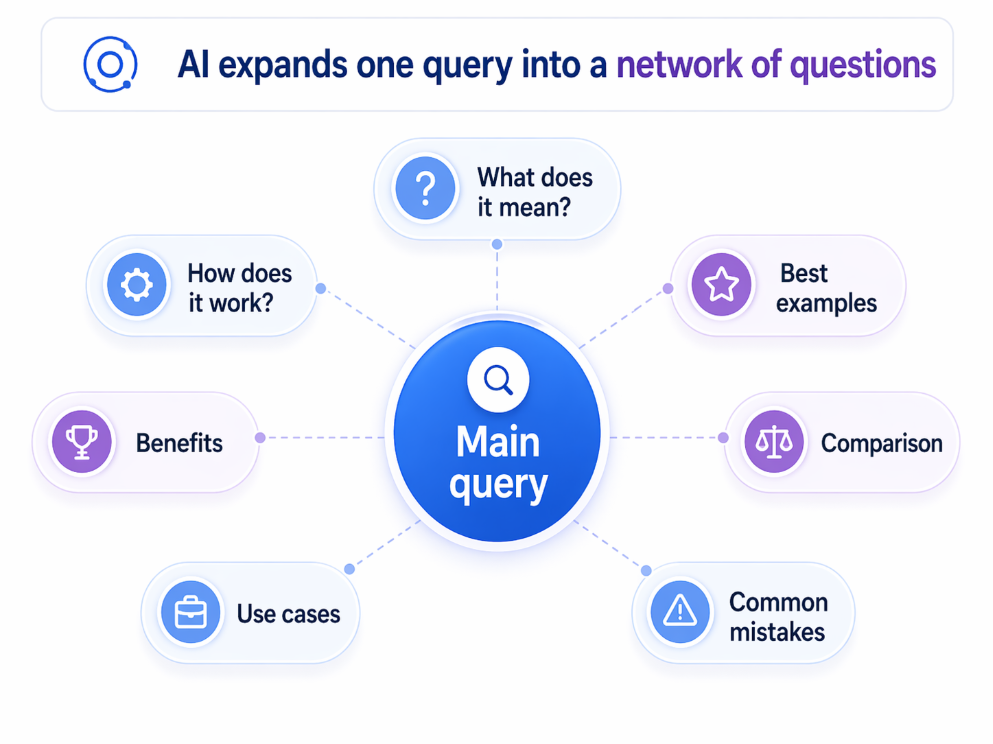
That does not mean producing thin pages for every imaginable variation. In fact, that usually creates noise. A better strategy is to build one strong article that covers the root topic clearly, then organise the page so each section answers a distinct follow-on intent. This is where structured subheadings, concise opening answers, comparison blocks, and evidence-backed statements become more valuable than keyword density.
It also changes how you think about authority. In classic SEO, backlinks and domain strength often dominate the conversation. In AI retrieval, authority still matters, but so do clarity, chunkability, and citation readiness. If a system has to assemble an answer quickly, it will prefer sections that are easy to extract, easy to attribute, and easy to trust.
So the content question becomes broader: are you writing for a rankable page or for a retrievable answer unit? The best modern content does both. It still respects SEO fundamentals, but it is also structured for synthesis. That means clear definitions, direct comparisons, fresh supporting evidence, and sections that can stand on their own when lifted into an AI-generated answer.
In other words, traditional SEO is still the floor, not the ceiling. If your site cannot be crawled, understood, or trusted, fan-out will not save it. But once those basics are in place, the next layer of advantage comes from covering the question behind the query, not only the query itself.
Comparison Table
The important takeaway is not that traditional SEO is obsolete. It is that the retrieval environment has widened. Keyword matching still helps search engines understand relevance, but fan-out retrieval decides whether your content can support a synthesised answer across multiple intent paths. Brands that optimise only for the typed phrase may still rank. Brands that optimise for the question ecosystem around that phrase are more likely to be cited, surfaced, and remembered.
When you build content for both systems at once, the strategy becomes clearer: keep the technical SEO foundations, write for people first, structure for extractability, and answer the next likely question before the AI has to look elsewhere.
Reference note: This article follows the structure of the user-provided example document while using fresh, relevant source links for anchor text.



.png)