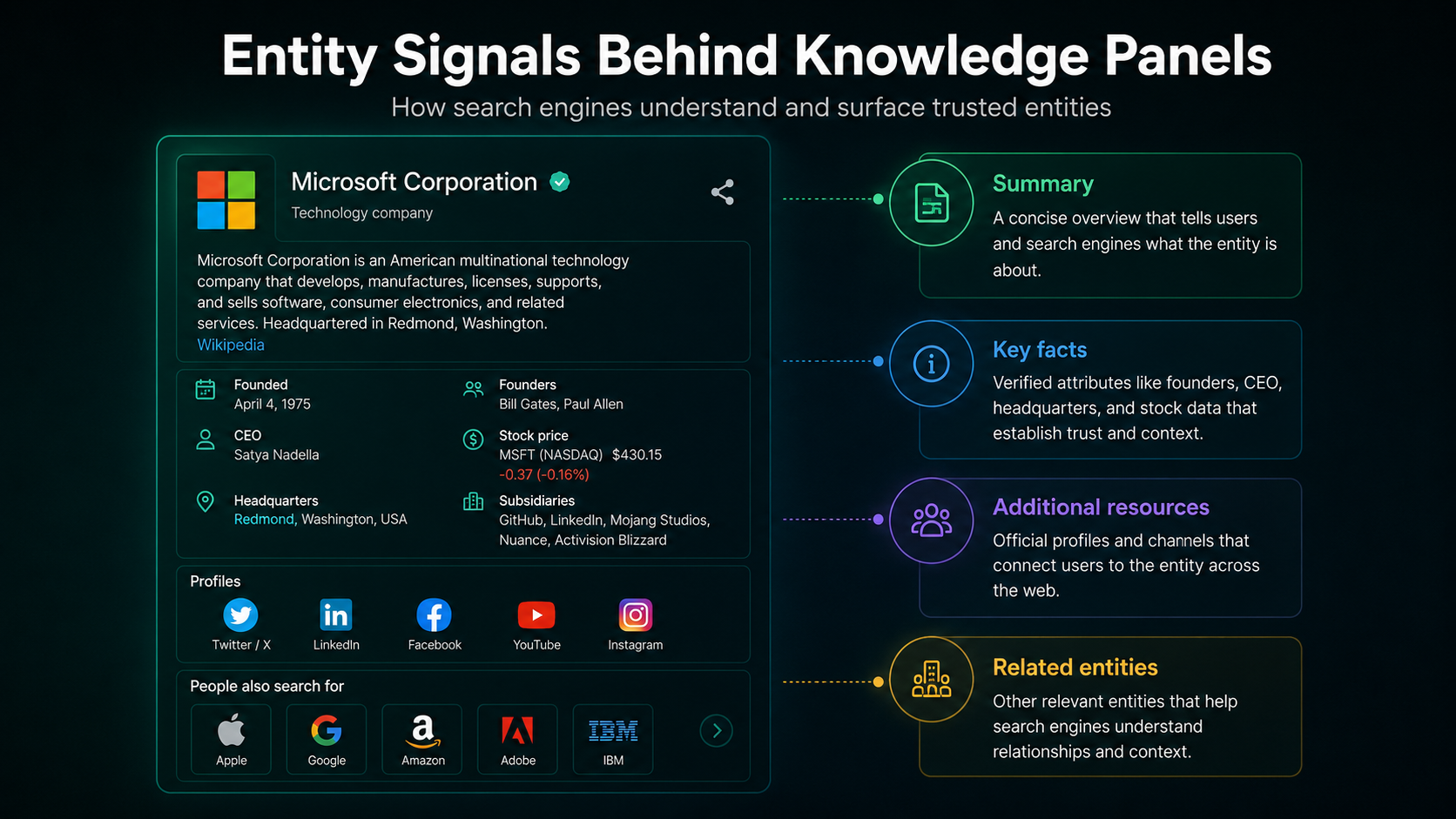
The Complete Guide to Getting Cited by AI Search
Ranking number one on Google used to guarantee visibility. In 2026, it no longer does. Approximately 60% of all Google searches now end without any click—and for queries that trigger AI Overviews, that figure reaches 93%. Buyers are getting their answers directly from ChatGPT, Google AI Overviews, voice assistants, and Perplexity without ever visiting a website. The brands appearing in those answers are building compounding authority. The brands that are not are invisible now. Decisions get made.
This is the problem Answer Engine Optimization (AEO) was built to solve.
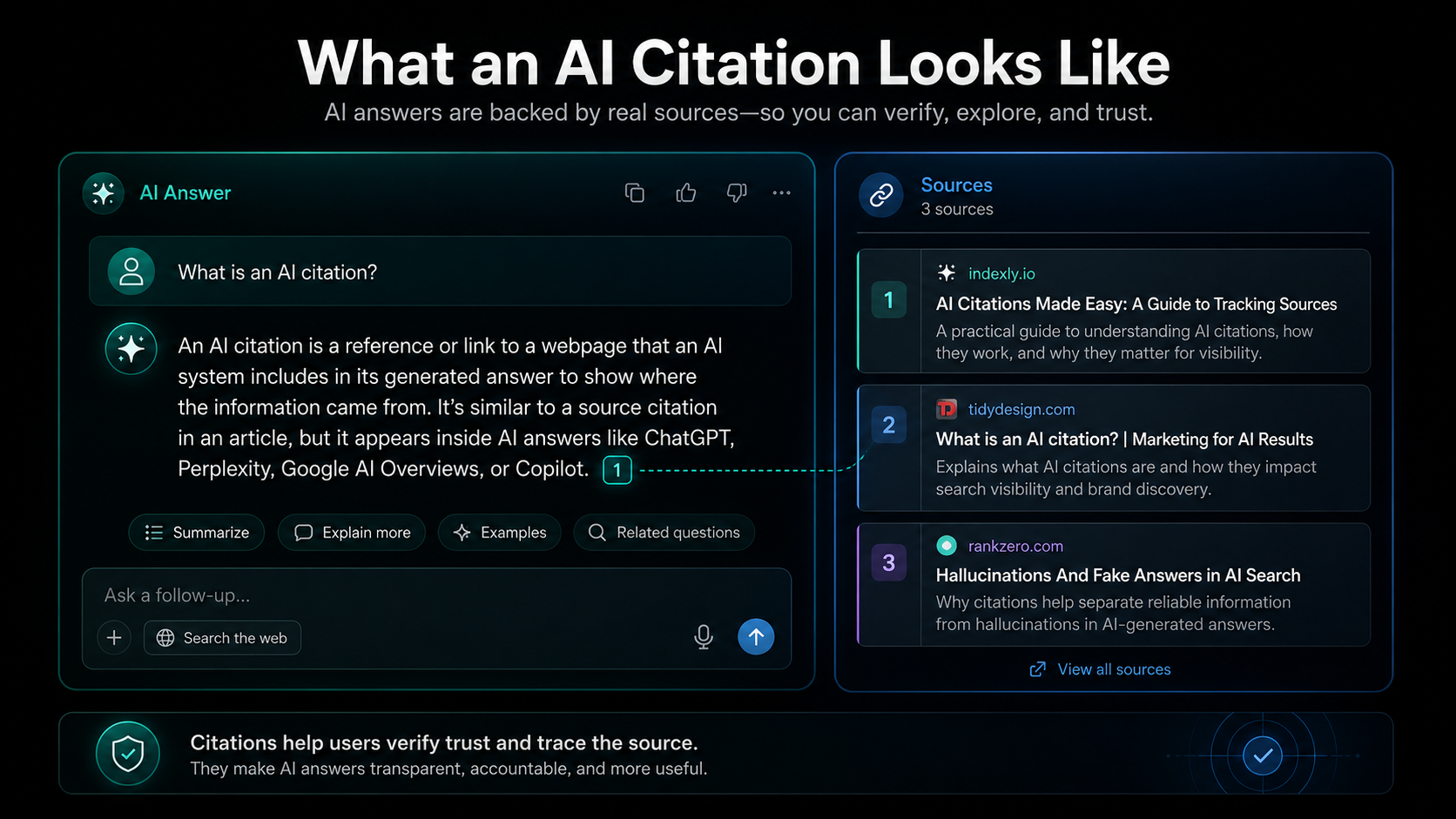
AEO is the practice of structuring and optimizing content so that AI-powered answer engines select it as a direct, cited response—across featured snippets, Google AI Overviews, voice assistants, People Also Ask boxes, and AI chat platforms. According to Frase’s 2026 complete AEO guide, ChatGPT alone now handles over 2 billion queries daily, and AI-referred sessions to websites grew 527% year-over-year through mid-2026. Your content no longer just needs to rank. It needs to get cited.
This complete guide covers everything you need to understand and implement AEO: what it is, how answer engines select sources, which schema types drive the highest citation rates, how to structure content for AI extraction, voice search optimization, platform-specific strategies, proven case studies, and the tools that track your AEO performance across all major platforms.
What Is Answer Engine Optimization (AEO)?
Answer Engine Optimization (AEO) is the discipline of structuring and enhancing your content so that search platforms and AI systems select it as the direct answer to user queries—delivering your brand's response inside featured snippets, AI Overviews, voice assistant answers, People Also Ask boxes, and AI chatbot citations.
AEO treats the search engine as a question-answering machine rather than a ranking machine. Where traditional SEO asks, “how do I rank higher in the results list?”, AEO asks, "How do I become the answer the AI gives?” These are structurally different goals. A page can rank first in Google and still lose 58% of potential clicks to an AI overview, according to Ahrefs’ December 2025 study of 300,000 keywords. AEO is the discipline that recovers that lost visibility by ensuring your brand appears inside the answer itself.
From a lineage perspective, AEO evolved from featured snippet optimization and semantic SEO in the early 2010s, extended through the voice search era, and now encompasses the full ecosystem of AI answer surfaces. It sits between traditional SEO and full GEO in the search optimization stack:
• SEO — ensures your pages are indexed, authoritative, and discoverable in traditional search
• AEO—structures your content so AI extract and attribute it as a direct answer to specific questions
• GEO — extends scope to maximise brand share voice across the entire generative AI landscape
All three are required. None replace the others. AEO is the practical bridge that connects an existing SEO investment to full AI search visibility.
Why AEO Matters Right Now
The numbers behind the AEO imperative are unambiguous. ChatGPT surged from 300 million weekly active users in December 2024 to 800 million by October 2025. Google AI Overviews now appear in approximately 47% of all Google searches. Gartner predicts traditional search engine volume will drop 25% by the end of 2026. Voice assistant users in the US are projected to reach 170.3 million by 2028.
Despite this, only 20% of organizations have begun implementing AEO, according to Acquia’s research, while 70% believe it will significantly impact their digital strategy within one to three years. As Gen Optima’s 2026 AEO techniques guide notes, ChatGPT processes queries from 700 million weekly users, and Google AI Overviews reach 2 billion monthly users. The adoption gap is the opportunity. Brands that implement AEO now are building first-mover advantages that compound as AI platforms mature.
How AEO Differs from SEO and GEO
The three disciplines of modern search optimization—SEO, AEO, and GEO—share a common foundation but target different retrieval mechanisms, measure success by different metrics, and require different execution strategies. Understanding how they differ is the prerequisite for allocating effort correctly.
The most important nuance in this table is the relationship column: GEO does not replace AEO, and AEO does not replace SEO. They layer. As Similarweb’s 2026 AEO guide explains, "AEO is the practical bridge between SEO fundamentals and full GEO strategy. If you have never run structured data, optimised for featured snippets, or written direct-answer content, AEO is where you start. GEO extends the scope to the entire generative AI ecosystem, including prompts that never touch a traditional search engine.”

The distinction between AEO and GEO in practice comes down to scope. AEO is optimized for specific answer surfaces—featured snippets, PAA boxes, AI Overviews, and voice. GEO optimizes for the entire AI citation landscape, including multi-source synthesized responses where no single featured snippet applies. In 2026, most enterprise content strategies treat both as simultaneous disciplines because the content signals that earn AEO visibility are structurally identical to those that earn GEO citation rates.
How Answer Engines Select and Cite Sources
To optimize effectively for AEO, you need to understand how answer engines actually choose which sources to surface. The mechanism differs by platform—Google AI Overviews operate differently from ChatGPT, which operates differently from Perplexity—but a consistent set of selection factors apply across all of them.
The indexability and organic ranking rows deserve particular emphasis. Google AI Overviews do not operate on independent retrieval. They draw primarily from Google's existing search index. BrightEdge's 16-month study found that AI Overview citation overlap with organic rankings grew from 32% to 54% between May 2024 and September 2025. This means organic SEO is not in competition with AEO—it is the prerequisite for Google AI Overview inclusion. A page that does not rank cannot be selected as an AI overview source, regardless of how well it is structured.

ChatGPT and Perplexity operate differently. ChatGPT uses Bing as a starting point for retrieval but applies its own evaluation layer. Perplexity continuously retrieves from the live web with a strong bias toward recent, community-validated content. Neither platform is constrained to the organic top 10 in the way Google AI Overviews are. This creates a different opportunity: Only 274,455 domains have ever appeared in Google AI Overviews out of 18.4 million in Google’s index. For ChatGPT and Perplexity, the pool is far broader—and the distinguishing factor is content structure and entity clarity rather than pure domain authority.
Schema Types That Drive AEO Visibility
Structured data is the technical mechanism through which your content communicates its meaning, structure, and credibility to AI systems in machine-readable form. Without it, AI engines infer, and inference introduces uncertainty that reduces citation confidence. With it, they know, and knowledge enables consistent citation.
The citation impact is unambiguous. Sites with structured data see up to 30% higher visibility in AI Overviews. Pages with schema markup are 33% more likely to appear in voice results. Only 12.4% of websites currently implement structured data, according to Averi’s AEO beginner’s guide, meaning the majority of your competitors have not yet built this baseline. The following table maps the schema types most directly relevant to AEO performance:
[fs-toc-omit]Implementation: The graph Approach
The correct implementation for AEO in 2026 is JSON-LD—the only format explicitly recommended by Google for AI-optimized content. Microdata and RDFa embed schema inside visible HTML, creating parsing conflicts when page designs change. JSON-LD is isolated in a script tag, cleanly parsable by AI crawlers, and supports the @graph array that allows multiple schema types to be combined in a single block.
The recommended structure for a B2B service or content page:
• @graph containing: Organisation (brand entity), Article (content type and author), Person (author entity with sameAs), FAQPage (Q&A section), and BreadcrumbList (site hierarchy)
• sameAs properties: on both organization and person entities, linking to LinkedIn, Wikidata, and Crunchbase profiles
• dateModified: on Article schema, updated time the content is refreshed—this is the machine-readable freshness signal AI systems evaluate
• Validation: every implementation checked Google's Rich Results Test before publishing; re-validated after every content update
Schema is the packaging. Content quality is the product. Without both, you are either invisible or untrustworthy. Schema on thin content produces no citation benefit. Deep content without schema is harder for AI to extract and attribute.
How to Structure Content for AEO
Content structure for AEO is fundamentally different from content structure for traditional SEO. Where SEO rewards comprehensive, keyword-dense pages that cover a topic thoroughly, AEO rewards modular, extractable sections where each unit of content directly answers a specific question in a self-contained way.
The BLUF Principle: Bottom Line Up Front

The single most important structural principle for AEO is BLUF—Bottom Line Up Front. Every section of AEO-optimized content should open with a direct answer in the first 40-60 words. Not context. Not background. The answer. The reasoning: 55% of AI overview citations come from the first 30% of page content, according to Search Engine Land's 2025 research. AI systems scan for extraction points. A section that opens with the answer is immediately extractable. A section that builds toward the answer after four sentences of context is structurally uncitable.
[fs-toc-omit]Question-Phrased Headings
Every H2 and H3 heading in an AEO-optimized page should be written as the specific question it answers—mirroring exactly how a user would phrase that query to a voice assistant or AI chatbot. "Key Features" tells a human what the section covers. "What are the key features of X for remote teams?" maps directly to the subquery AI generates when retrieving an answer about X. The heading is a retrieval target. Write it as one.
[fs-toc-omit]Optimal Answer Length by Format
• Featured snippets (paragraph): 40-60 words —complete, standalone, no qualifying clauses at the start
• Voice search answers: 20-30 words—shorter, conversational, sounds natural when read aloud
• People Also Ask boxes: 50-80 words—slightly more context than voice, but still direct
• AI Overview passages: 40-80 words—factual, attributed, extractable without surrounding context
• AI chatbot citations (ChatGPT/Perplexity): 100-167 100-167 words — the optimal chunk size for passage-level retrieval
[fs-toc-omit]Content Formatting That Earns Answers
Beyond answer length, specific content formats consistently outperform in AEO contexts. Surmado’s 2026 AEO implementation guide identifies the Princeton GEO research finding that adding expert quotes boosts visibility by roughly 41%, adding statistics by about 30%, and adding source citations by around 30%. The practical implementation: one verified, named-source statistic every 150-200 words; comparison tables for evaluative queries; numbered lists for procedural queries; FAQ sections at the end of every key page.
Comparison tables are particularly high-performing for commercial and evaluative queries. AI models extracttabular data more reliably than prose for side-by-side evaluations. A well-structured comparison table—columns representing options, rows representing evaluation criteria, and cells containing specific facts—earns citation across across multiple sub-query types simultaneously: the comparison query, the individual product queries, and the evaluation criteria queries.
AEO Ranking Factors
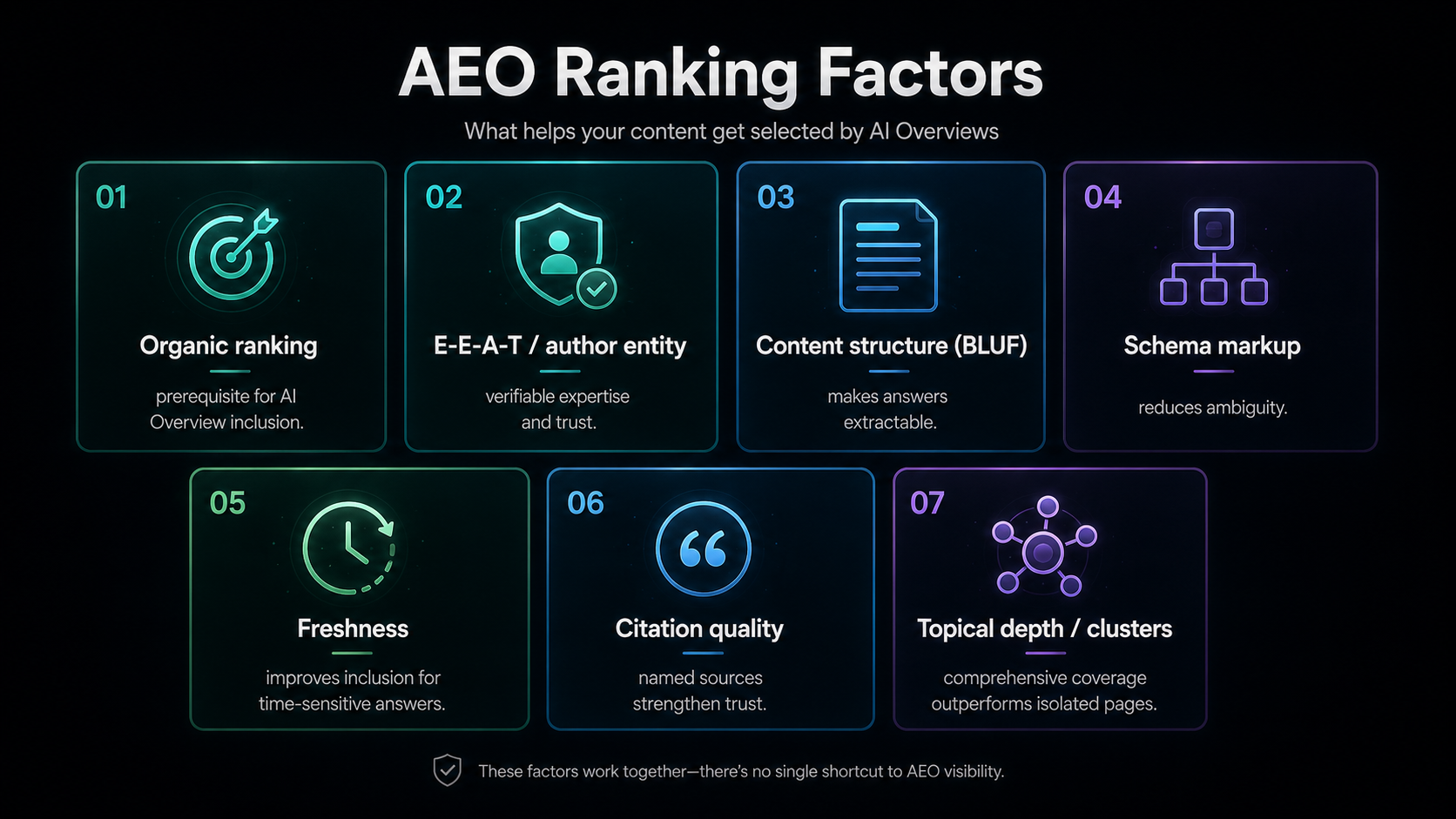
The following table consolidates the primary AEO ranking factors drawn from academic research, large-scale citation analysis, and platform-specific optimization data as of early 2026:
The E-E-A-T row deserves specific attention. The February 2026 addition of an author section to Google Search Central documentation marked the most explicit signal yet that author entity verification is a direct quality filter for AI source selection, not just a helpful addition. OutsideTheBox’s 2026 AEO guide confirms the mechanism: “Authority comes from brand entity recognition—is your brand a recognized entity in knowledge graphs?" — Citation quality — Do credible sources reference you? —and track record—do you have a history of accurate, helpful answers? "All three are AEO ranking signals, not just the content of a specific page.
Platform-Specific AEO Strategies
While core AEO principles apply across all answer platforms, each major platform has distinct citation preferences, source hierarchies, and content format biases. A strategy that addresses only Google AI Overviews leaves the majority of AI search opportunities uncaptured.
[fs-toc-omit]Google AI Overviews
Google AI Overviews select content using Google's existing search index—not independent real-time retrieval. A page must already rank organically for the query or a closely related query before Google will consider it an AI overview source. This makes organic SEO the non-negotiable prerequisite for Google AEO. BrightEdge's research showing the citation overlap grew from 32% to 54% in 16 months confirms that this correlation is strengthening, not weakening.
Once index-eligible, Google selects passages that directly answer the query in 40-80 words, are concisely stated, and are supported by authoritative page-level signals. Implementing FAQPage and HowToschema on already-ranking pages is the most direct implementation lever for Google AI Overview inclusion.
[fs-toc-omit]ChatGPT and Microsoft Copilot
ChatGPT uses Bing for real-time retrieval but applies its own relevance and credibility evaluation layer. It favors encyclopedic, definitional content with strong entity signals. Microsoft Copilot has a specific and underused optimization pathway: it draws heavily from LinkedIn for B2B queries. Brands with well-maintained LinkedIn company pages, active thought leadership posts, and consistent brand descriptions on LinkedIn are structurally advantaged in Copilot citations for B2B commercial queries—a fact that most B2B marketing teams have not yet acted on.
[fs-toc-omit]Perplexity
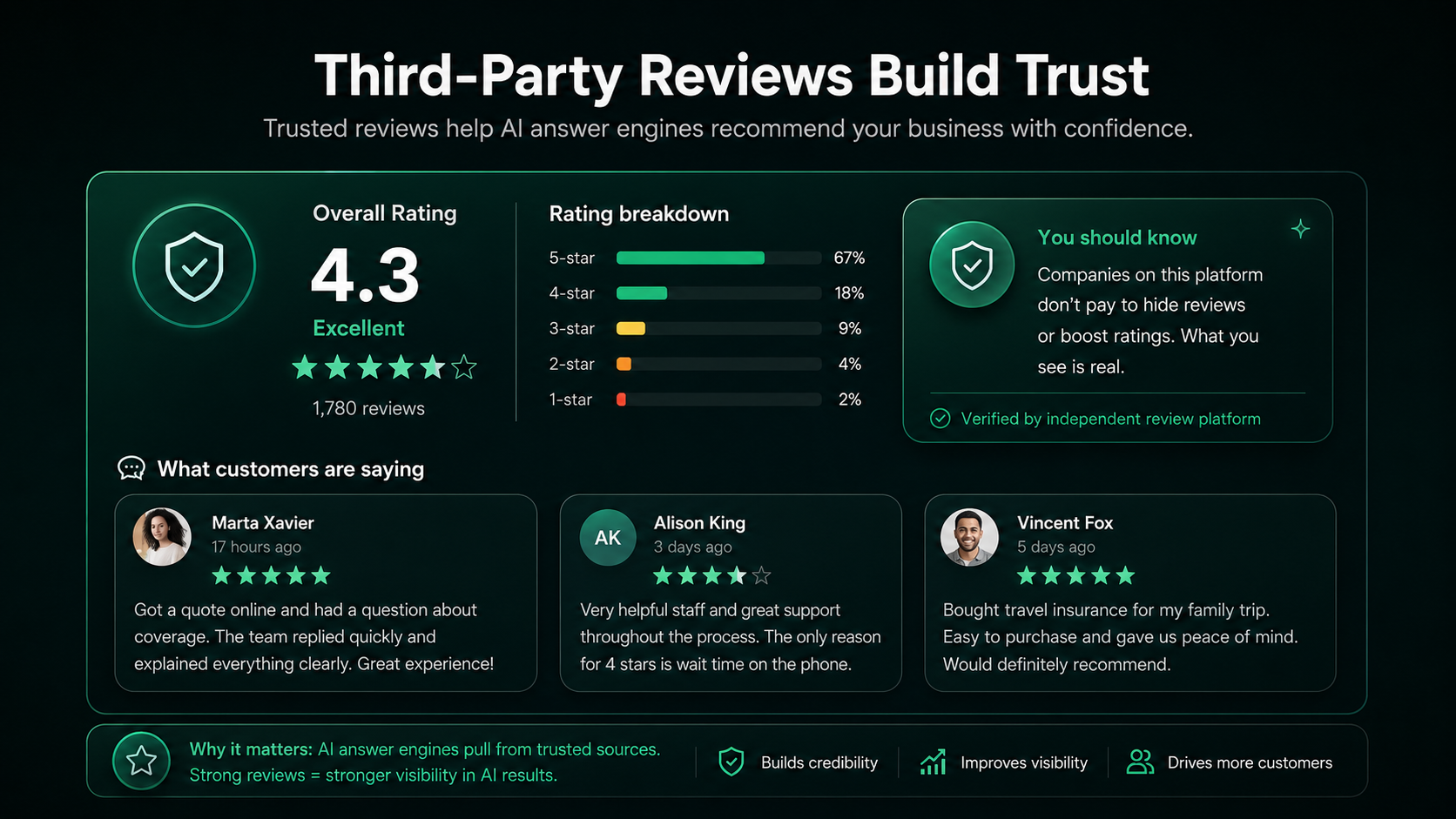
Perplexity prioritizes recency heavily and draws extensively from Reddit, review platforms, community forums, and news publications. It makes its intermediate retrieval steps visible to users—showing the multiple searches it executes before assembling a response. Brands appearing consistently in the communities their buyers inhabit are significantly more likely to be cited by Perplexity than brands whose presence is limited to their own website. Building genuine, substantive presence on Reddit threads and LinkedIn community discussions is a direct Perplexity optimization tactic.
[fs-toc-omit]Voice Assistants
Voice search is the most immediate and high-stakes AEO application. Voice assistants return one answer per query—there is no position two. 40.7% of voice answers come from featured snippets. Speakable schema explicitly flags content for voice reading. LocalBusinessSchema is essential given that 76% of voice searches carry local intent. Voice answers must be 20-30 words maximum—short enough to sound natural when read aloud and complete enough to answer the question fully.
Voice Search Optimization for AEO
Voice search represents the most concentrated form of AEO competition. Traditional search offers ten results per page; voice search offers one answer per query. The brands that earn that single-answer position earn 100% of the voice search visibility for that query. The brands that do not earn zero. Understanding how voice search differs from text search is the prerequisite for optimizing for it.
How to Optimise Specifically for Voice
Write conversational answers. Voice answers must sound natural when read aloud by an AI assistant. That means complete sentences, no bullet points, no lists—pure flowing prose that answers the question fully in 20-30 words. Test your answers by reading them aloud. If they sound awkward when spoken, they will sound awkward via voice assistant.
Target question-based long-tail queries. Voice queries average 29 words and are almost always phrased as complete questions. Content targeting “best CRM software” misses voice queries. Content targeting "What is the best CRM software for a small business with a team of under ten people?" is structurally aligned with how voice search works.
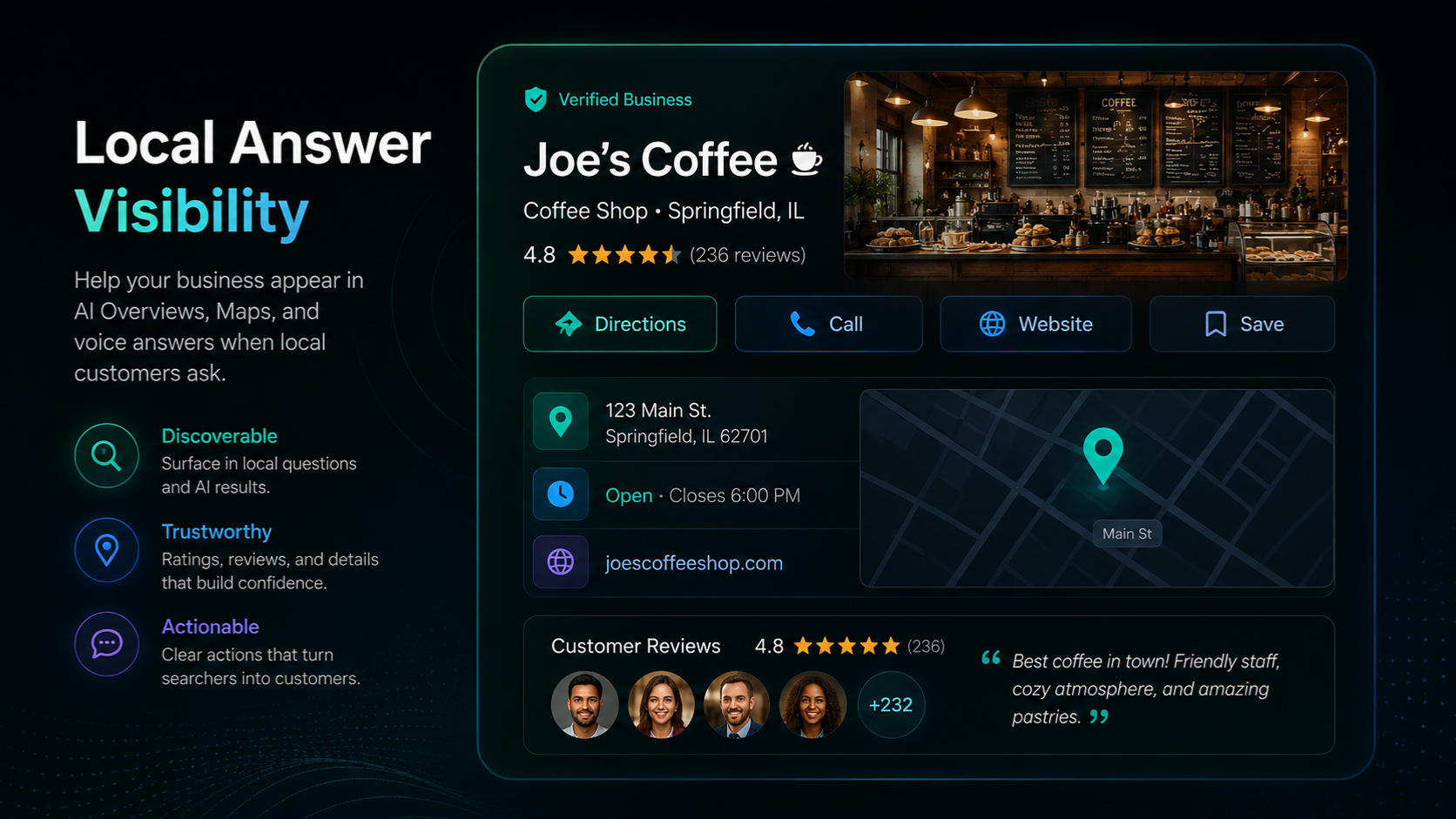
Optimize Google Business Profile rigorously. 76% of voice searches have local intent. When a user asks a voice assistant about a local service—"Where is the nearest accountant?” or "What are the opening hours of X?”—the answer comes from Google Business Profile data. Accurate, complete, regularly updated GBP information is non-negotiable for local voice AEO.
Implement the speakable schema. Speakable Schema (type Speakable Specification) explicitly marks sections of your content as suitable for text-to-speech delivery. Without it, voice AI must infer which passage to read—introducing uncertainty that reduces accuracy and increases the chance of a competitor’s content being selected instead.
Voice search is winner-take-all. There is no consolation prize for being the second-best answer. AEO for voice means being the single most directly answerable source for the question—or being absent entirely.
Featured Snippet Optimization
Featured snippets—the highlighted answer boxes at the top of Google search results—are the original answer engine surface and remain one of the highest-impact AEO opportunities available. A featured snippet position earns a 42.9% click-through rate, higher than the standard first organic result at 39.8%, according to Averi's 2026 research. Andcritically: pages appearing in featured snippets have significantly higher probability of AI Overview inclusion.
[fs-toc-omit]Types of Featured Snippets
Paragraph snippets — 40-60 word direct answer for definitional and explanatory queries. Most common type. Target with a clear one-sentence definition followed by a brief explanation.
List snippets — numbered or bulleted lists for process-based and "best of" queries. Target with a numbered list under a clear question heading, with each item in the list completing theimplied sentence from the heading.
Table snippets — comparison datapresented in table format. Target with a properly formatted HTML table withclear column headers and specific data in each cell.
Video snippets — for instructional queries where video is the preferred format. Target with Video Object schema, clear titles, and a text transcript that contains direct answer text.
[fs-toc-omit]The Prerequisite: Organic Ranking
The most important fact about featured snippets is that you must already rank in the top 10 organic results to be eligible. Featured snippet optimisation for a page that does not rank is a wasted effort. The correct sequence is: achieve organic top-10 ranking first, then apply featured snippet structural optimisation. BrightEdge's research confirms that as of September 2025, 54% of AI Overview citations come from organic top-10 results — meaning the SEO-AEO connection has only strengthened over time.
[fs-toc-omit]People Also Ask (PAA) Optimisation
People Also Ask boxes appear in 96% of Google search queries, according to Young Urban Project’s 2026 AEO guide. Each PAA question is a direct AEO opportunity. The optimisation strategy: identify the PAA questions associated with your target queries using AlsoAsked.com or Google Search Console, write specific 50-80 word answers for each question, structure each as a question-and-answer pair with FAQ Page schema. PAA inclusion creates a compounding visibility effect: appearing in one PAA box often triggers additional related PAA questions to surface, each a further citation opportunity.
AEO Content Strategy: The Question Tree Framework
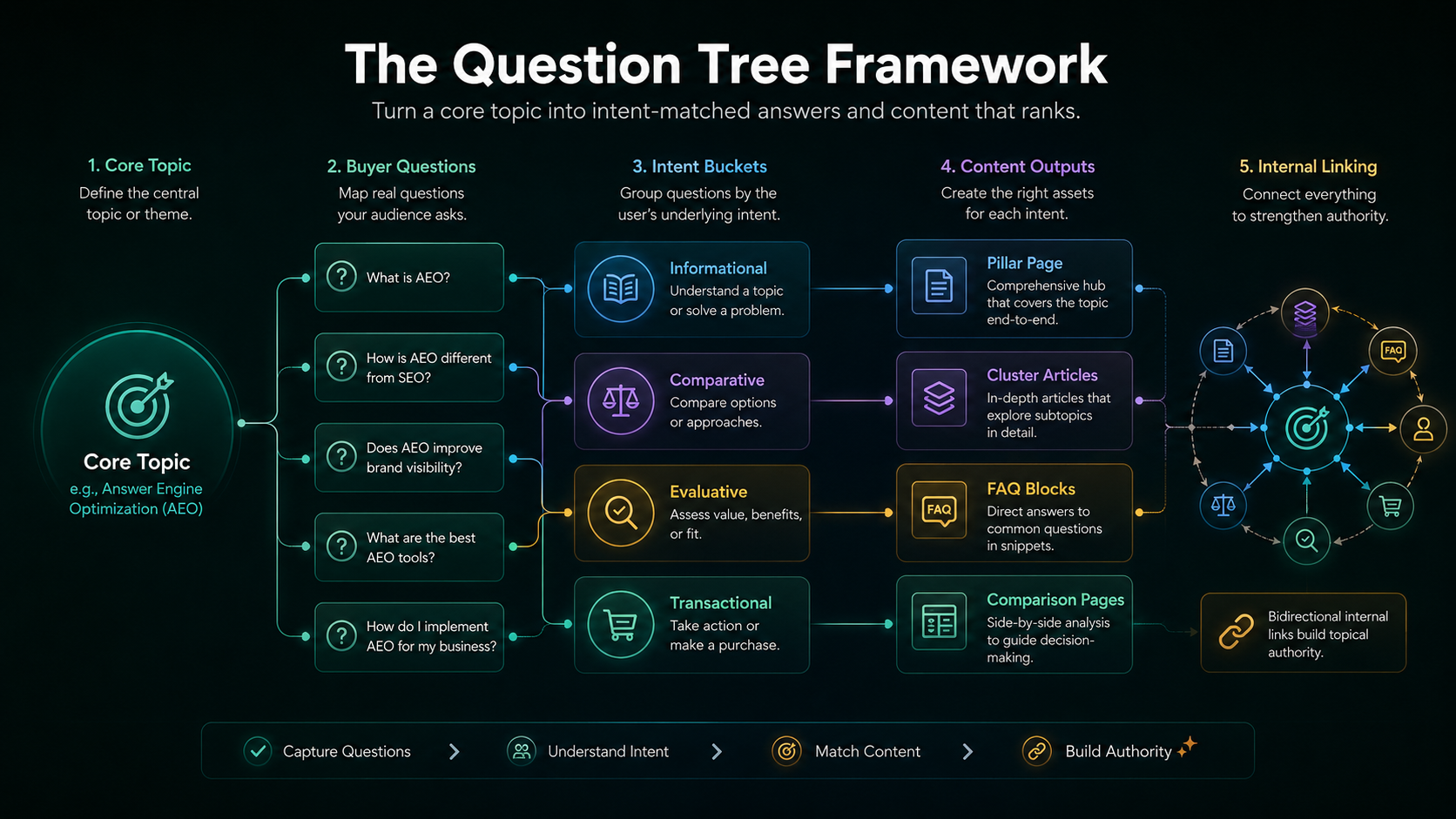
Effective AEO content strategy begins not with keywords but with question trees — the structured maps of every question a buyer asks across their research journey, from initial awareness through evaluation to decision. An AEO content library is built around those question trees, with each question mapped to a specific content piece optimised for direct answer extraction.

[fs-toc-omit]Building Your Question Tree
1. Start with your core topics—the three to five subjects your brand has genuine expertise in.
2. For each core topic, identify all the questions buyers ask: use Google PAA boxes, AlsoAsked.com, AnswerThePublic, and your own Search Console query data.
3. Group questions by intent: informational (what, how, why), comparative (X vs Y, which is better), evaluative (is X worth it, what results does X produce), and transactional (how to get started with X).
4. Map each question group to a content piece—either a new article or an existing page to restructure.
5. For each content piece, write a direct answer for the primary question (the H1/title question), plus direct answers for each related question as separate H2/H3 sections with FAQ Page schema.
6. Link all content pieces into a bidirectional pillar-and-cluster structure—the pillar covers the broad topic, and the clusters cover each question dimension in depth.
[fs-toc-omit]Content Formats That Earn AEO Visibility
Research across multiple platforms identifies five content types that consistently outperform in AEO contexts, according to Enrich Labs’ 2026 GEO guide drawing on comprehensive citation analysis:
• Comprehensive category definitions and explainers—the content that answers "What is X?" with genuine depth. AI systems favor definitional content and return to it consistently.
• Original research and data reports—statistics and findings that other sites cite. Being the source of a cited statistic earns ongoing citations as the claim propagates across the web.
• Comparison and alternative content—side-by-side evaluations for high-intent commercial queries. These match the "X vs. Y” and “best X alternatives” queries that carry the highest buyer intent.
• Use-case specific guides—content that addresses a specific audience segment, use case, or application. "Project management software for construction firms” earns more concentrated citations than “project management software."
• FAQ-rich reference articles—the long-form, comprehensive Q&A resources that AI systems use as reference material for category definitions and explanations. These earn the most durable, compounding AEO visibility.
Technical AEO Implementation
Technical implementation for AEO covers two parallel tracks: on-page structure optimisation and schema markup deployment. Both are required. Content structure alone without schema is citable but less reliable. A schema without strong content structure labels an empty package. Together, they create the conditions for consistent AI citation.

[fs-toc-omit]On-Page Technical Requirements
Static HTML rendering. AI parsing success for static HTML with schema runs at 94% versus JavaScript-rendered content at 23%, according to Erlin’s 2026 research. If your site relies heavily on client-side rendering, AI systems may be unable to extract your content regardless of its quality or schema implementation. Server-side rendering or static HTML generation is the technical prerequisite for reliable AEO performance.
Page speed. Pages loading under 0.4 seconds FCP averages 3 times more AI citations than pages over 1.13 seconds, according to AI Clicks’ 2025 analysis of citation patterns. Page speed is not just a user experience metric—it is directly correlated with AI crawl success and citation frequency.
Crawl access. Check robots.txt for any rules blocking GPT Bot, Perplexity Bot, Claude Bot, or Google-Extended. These blocks are the single most common and most damaging technical AEO error. A perfectly structured, schema-marked page earns zero AI citations if the AI crawler cannot read it.
Internal linking architecture. Bidirectional links between pillar and cluster articles with descriptive anchor text signal topical coherence to AI crawlers and distribute authority across the cluster. Google’s query fan-out patent (US11663201B2) explicitly lists internal link structure as a topical breadth signal.
[fs-toc-omit]The llms.txt Standard
An emerging technical standard for AEO is the llms.txt file—a plain text file placed at the root of your domain that guides AI systems toward your most authoritative pages and away from content not intended for AI retrieval. Similar in concept to robots.txt for traditional crawlers, llms.txt communicates directly to AI systems which pages represent your canonical expertise, which content formats you have optimised for extraction, and which pages should receive the most retrieval attention. Implementation takes under an hour and is one of the few AEO signals with no downside risk.
AEO Best Practices Checklist
The following 25-point checklist consolidates every AEO implementation action in priority order. Use it as a working audit framework for every page intended to earn AI answer inclusion:
AEO Case Studies
The following case studies document real-world AEO implementation results across multiple industries, drawn from published research, platform analyses, and documented brand outcomes:
The pattern across all six case studies is consistent: structured answer content, schema implementation, and topical authority depth produce measurable AEO results within weeks to months. The B2B technology case study—based on documented GEO implementation patterns—illustrates the sales cycle benefit that makes AEO commercially significant beyond traffic metrics. AI-referred buyers arrive pre-qualified, require less education, and make decisions faster. According to Semrush’s 2026 AI visitor behavior research, AI-driven visitors convert at 4.4 times the rate of standard organic visitors and spend 68% more time on-site. AEO is not a traffic play. It is a revenue equality play.
How to Measure AEO Performance
Measuring AEO performance requires different metrics and different tools than traditional SEO monitoring. The primary AEO success signals are citation frequency, featured snippet capture rate, AI brand mention share, and the quality of AI-referred traffic—not rankings or organic session volume.
[fs-toc-omit]Core AEO Metrics
• Featured snippet capture rate: How many of your target queries return your content as the featured snippet? Track via Semrush, Ahrefs, or Google Search Console (high impression / low click patterns indicate snippet presence)
• People Also Ask inclusion rate: How frequently does your content appear in PAA boxes for target query clusters? Monitor with Semrush or manual PAA tracking
• AI citation rate: Run target queries monthly in ChatGPT, Perplexity, Gemini, and Google AI modes. Record whether and how your brand appears. Track trend over time, not individual snapshots
• AI referral traffic quality: In Google Analytics, segment sessions by referral source (chat.openai.com, perplexity.ai, etc.). Track conversion rate, session duration, and goal completion organic baselines.
• Brand mention share: Specialist tools like Profound, Otterly.ai, and Semrush AI track your brand’s share of mentions across AI platforms relative to competitors
• Voice search visibility: Test target queries via actual voice assistants monthly; monitor for changes in the brand returned as the answer
Key Tools for AEO Measurement:
One measurement principle worth stating explicitly: AEO success shows up as influence before it shows up as traffic. LLMrefs' 2026 AEO complete guide confirms that roughly 60% of Google searches now end without a user clicking any result. Being cited in a featured snippet or AI overview delivers brand association and authority even when no click follows. Measuring only click-based metrics will consistently undervalue AEO performance. Build a measurement framework that captures citation presence, brand association, and assisted conversions alongside direct traffic.
Common AEO Mistakes to Avoid
Mistake 1 — Optimising for AEO without an SEO foundation. Google AI Overviews require organic ranking as a prerequisite. Brands that skip SEO and jump directly to AEO implementation will earn featured snippet and voice search optimisation benefits but will miss AI Overview inclusion entirely—the largest and fastest-growing AEO surface.
Mistake 2—Adding FAQ Page schema to non-FAQ pages. Following Google’s August 2023 update, FAQ schema on pages where Q&A is not the primary content format generates no rich result display and wastes crawl budget. FAQ Page schema belongs only on pages where questions and answers constitute the primary content, not as a footer addition to service or product pages.
Mistake 3 — Burying answers. Content that opens with context, history, and background before delivering the answer is structurally misaligned with AI extraction. 55% of AI overview citations come from the first 30% of page content. A section that delivers the answer in sentence five is five times less likely to earn that citation than a section that delivers it in sentence one.
Mistake 4 — Writing for search bots instead of readers. As Click Rank’s semantic intent analysis states, AI systems prefer content written for humans—semantically clear, naturally phrased, and evidenced with specific facts. Keyword-dense, algorithmically structured content fails AEO because it lacks the semantic depth and genuine answer quality that AI systems recognise and select.
Mistake 5 — Treating AEO as a one-time setup. A schema requires re-validation after every content update. Statistics become stale. AI platform preferences evolve. Pages not updated quarterly loseAI citations at 3 times the normal rate. AEO is an ongoing content discipline, not a technical configuration you complete once.
Mistake 6 — Ignoring voice search format requirements. Many brands write AEO content that works for featured snippets but fails for voice. The formats are different: featured snippets can use lists and tables; voice search requires flowing prose of 20-30 words that sounds natural when read aloud. Content that earns a featured snippet but cannot be read naturally by a voice assistant misses the voice search opportunity entirely.
The Future of AEO: What’s Coming in 2026 and Beyond
Google AI Mode will become the dominant search interface. Google’s AI Mode, which launched in 2025, provides a fully conversational search experience within Google. As it rolls out to more users and query types, optimising for AI-generated answers within Google itself becomes as important as optimising for traditional rankings. Frase’s 2026 AEO forward-looking analysis identifies Google AI Mode expansion as the single most impactful near-term development for AEO practitioners.
Multimodal AI search will grow. AI engines are increasingly processing images, video, and audio alongside text. Optimising visual content with descriptive alt text, structured captions, and video transcripts will become standard AEO best practice. Video Object schema and image Alt text quality will directly influence AI Overview inclusion for visual queries.
Voice search and AI assistants will converge. With voice assistant users in the US expected to reach 170.3 million by 2028, AI-powered voice assistants will increasingly pull answers from the same sources as text-based AI search. Conversational, question-and-answer content will perform well across both modalities—reinforcing the AEO investment in structured, direct-answer content.
Personalized AI answers will emerge. As AI platforms learn individual user preferences and search histories, the same query may return different answers for different users. This increases the importance of semantic depth over keyword targeting—content that satisfies the full latent intent network behind a query will perform across personalization variations in ways that single-intent, keyword-optimized content cannot.
The citation gap will narrow—and then widen. Currently, only 20% of organizations have begun AEO implementation. As adoption increases, the citation advantage available to early movers will contract. But the technical and content gap between brands that have built compounding AEO authority and those that have not will widen simultaneously—because AEO authority compounds over time. The window for first-mover advantage is open now. It will not remain open at the current scale indefinitely.
The brands that invest in AEO in 2026 are not just optimizing for today's search landscape. They are building the structured, authoritative, machine-readable content infrastructure that will determine visibility across every AI search interface that emerges over the next decade.
Frequently Asked Questions
[fs-toc-omit]What is Answer Engine Optimization (AEO)?
Answer Engine Optimization (AEO) is the practice of structuring and optimising content so that AI-powered search platforms — including Google AI Overviews, ChatGPT, Perplexity, voice assistants, and featured snippets — select it as a direct cited answer when users ask relevant questions. AEO focuses on being the answer, not just ranking near it.
[fs-toc-omit]How is AEO different from SEO?
Traditional SEO aims to rank pages in a list of search results measured by clicks and rankings. AEO aims to get your brand selected as the direct answer — delivered inside featured snippets, AI Overviews, voice responses, or chatbot citations — measured by citation rate and brand mention share. The two are complementary: solid SEO is the prerequisite for AEO. Without ranking, your content rarely enters the source pool AI platforms draw from.
[fs-toc-omit]How is AEO different from GEO?
AEO focuses specifically on structured answer extraction — getting content selected for featured snippets, People Also Ask boxes, AI Overviews, and voice search. GEO extends further to the full generative AI ecosystem: being cited in longform AI-synthesized responses across ChatGPT, Perplexity, Gemini, and AI Mode. AEO is the practical bridge from SEO to GEO. In 2026, most high-performing content strategies practise both simultaneously because the content signals that earn AEO visibility also improve GEO citation rates.
[fs-toc-omit]What schema types matter most for AEO?
FAQ Page and How To schema carry the highest AEO impact. FAQ Page schema makes pages 3.2 times more likely to appear in Google AI Overviews according to Frase's 2025 research. How To schema is retrieved 6.4 times more than paragraph-based instructional guides. Article schema with Author same As links and Organisation schema with Wikidata and LinkedIn same As are the supporting entity signals that validate credibility. All should be implemented as JSON-LD in a single @graph block.
[fs-toc-omit]How do I win a featured snippet?
To win a featured snippet, your page must first rank in the top 10 organic results for the target query. Then structure the content with a direct 40-60 word answer immediately following a question-phrased heading. For list queries, use numbered or bulleted list sunder a clear heading. For definition queries, provide a one-sentence definition followed by a two-to-three sentence explanation. FAQ Page schema reinforces the signal. BrightEdge's 16-month study found AI Overview citation overlap with organic rankings grew from 32% to 54% between May 2024 and September 2025 — organic ranking remains the prerequisite.
[fs-toc-omit]Does AEO work for voice search?
Yes. Voice search is one of the most direct AEO use cases. 40.7% of voice answers come directly from featured snippets, according to Averi's 2026 research. Voice assistants including Siri, Google Assistant, and Alexa read one answer aloud per query — and that answer is almost always the featured snippet for the query. Optimising for AEO simultaneously optimises for voice. Speakable schema explicitly flags content as suitable for voice reading, and Local Business schema is essential for the76% of voice searches with local intent.
[fs-toc-omit]How long does AEO take to show results?
Featured snippet capture can occur within weeks of correct structural implementation for pages already ranking in the top10. Full AI citation presence across ChatGPT, Perplexity, and Google AI Overviews typically becomes measurable within three to six months. Schema changes take effect after the next crawl cycle — usually within days to weeks for established sites. Off-site authority building, which compounds AEO performance, operates on a three-to-nine month horizon. Early movers gain structural advantages that become increasingly difficult for competitors toc lose.
[fs-toc-omit]Can small businesses compete with large brands in AEO?
Yes — and more effectively than in traditional SEO. AEO rewards answer clarity, structural precision, and topical authority depth over raw domain authority or advertising budget. Only 274,455domains have ever appeared in Google AI Overviews out of 18.4 million in Google's index, meaning the majority of businesses have not started AEO implementation. A small business that structures its content correctly, implements schema, and builds genuine expertise signals in a defined niche can earn featured snippets and AI citations ahead of larger competitors who have not optimised for answer extraction. Specialist authority consistently outperforms generic authority in AI citation selection.
[fs-toc-omit]What is zero-click search and why does AEO matter for it?
Zero-click search occurs when a user receives their answer directly on the search results page — through a featured snippet, AI Overview, knowledge panel, or People Also Ask box — without clicking through to any website .Approximately 60% of all Google searches now end without a click. For queries that trigger AI Overviews, the zero-click rate reaches 93%. AEO is the discipline that ensures your brand appears in those answers, earning brand association and authority even when no click follows. Being absent from zero-click answers means being invisible to the majority of searchers for informational and commercial queries.