.svg)


Most brands approach query fan-out optimisation the wrong way — not because the concept is difficult, but because the instinct to apply old SEO habits to a new retrieval system is nearly universal. The mistakes are predictable. The fixes are specific. And the gap between the two is where AI citation opportunities are won or lost.
According to ALM Corp’s analysis of query fan-out tools and strategy, the most common mistake brands make is treating fan-out like a new keyword list. It is not. Fan-out is a way to understand how a single user need branches into several smaller needs. Optimising for it means understanding that branching structure — not cramming query variants onto a page or building separate pages for every phrasing variation.
This article covers the four most damaging mistakes in query fan-out strategy and exactly how to fix each one.
Writing for Single Intent Only
Single-intent content is the most common structural failure in AI search. A page written to answer one question — however well — addresses only one of the sub-query pathways an AI system generates when it fans out that topic. The AI retrieves the best passage for each sub-query independently. A page that addresses only the head term earns one citation slot. A page that addresses the definitional, comparative, procedural, and evaluative angles earns multiple.

The research is precise on this point. Ekamoira’s February 2026 fan-out analysis found that sites with 80% or more topical coverage retain 85.4% of AI visibility across fan-out events. By contrast, brands relying solely on traditional SEO miss between 87.5% and 89.8% of AI citation opportunities. The difference is not quality of writing. It is breadth of intent coverage.
The fix is not to write longer pages. It is to write more dimensionally. Before drafting any content, map the sub-query angles the topic generates — definitional, comparative, procedural, evaluative, contextual, temporal — and build each section to directly answer one of those angles. Each section becomes a standalone retrieval unit for a different sub-query. The same word count, restructured for coverage rather than flow, earns far more citation opportunities.
A single intent page competes for one citation. A multi-angle page competes for five. The word count is often the same — the architecture is completely different.
Ignoring Semantic Variations
AI retrieval systems do not match exact keywords. They identify entities, evaluate relationships between concepts, and retrieve content based on semantic meaning — not surface phrasing. A page that uses a target phrase thirty times but never varies its language is not optimised for AI search. It is optimised for a crawler that does not exist anymore.
Semantic variation is not about synonyms in the traditional LSI sense. It is about covering the topic through multiple contextual framings that allow the AI to confirm it understands the concept from multiple angles. Search Engine Land’s fan-out optimisation guide describes the requirement clearly: “fan-out retrieval favours coverage of related concepts, entities, relationships, and sub-topics tied to the main topic. Expanding semantic coverage is more effective than repeating a single phrase.” This means writing about the topic using the language of the use cases, the entities, the adjacent concepts, and the outcomes — not just the target keyword in varying positions.
There is also a modifier dimension that most content ignores. Profound's October 2025 research confirmed that answer engines add words like "best," "top," "reviews," and the current year to queries during fan-out. Content that never uses these modifier patterns will not match the expanded sub-queries that ChatGPT, Perplexity, and Google AI Mode generate — regardless of how well it covers the base topic. Including comparison language, review-style assessments, and current-year data references naturally throughout the content is not optional. It is the mechanism through which content matches the actual sub-queries AI systems issue.
Over-Optimizing for Keywords
Keyword optimisation and query fan-out optimisation are not the same discipline. Applying keyword-first thinking to AI search produces content that is legible to traditional crawlers but structurally wrong for AI retrieval. The specific failure mode: repeating the target keyword frequently enough to signal relevance to a keyword-based ranking system, at the cost of the semantic clarity and entity specificity that AI systems require.
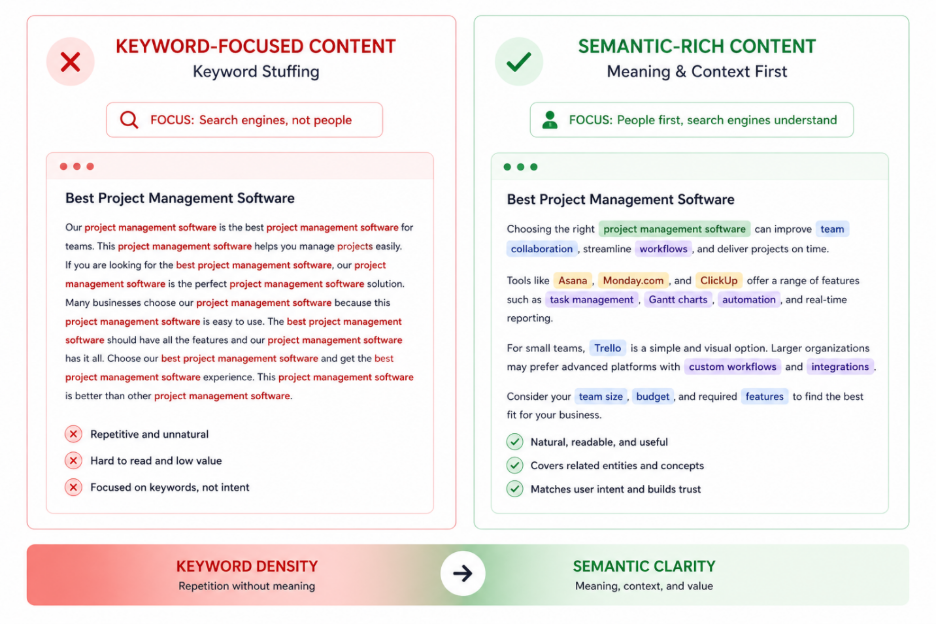
According to iPullRank’s December 2025 analysis of AI search and fan-out, AI search systems “demand atomic, entity-rich content architecture” where individual claims are anchored to canonical entities with verifiable sources. A passage that reads “Query fan-out is a query fan-out technique used in query fan-out optimisation” is keyword-present and semantically worthless. A passage that reads “Query fan-out is the process by which Google AI Mode, ChatGPT, and Perplexity decompose a single user query into multiple parallel sub-queries before retrieving content from across the web” is keyword-sparse and semantically rich. AI systems favour the second version by a significant margin.
The practical correction: write in subject–predicate–object structures. Name the entities involved. Specify the relationships between them. Attribute claims to named sources. Let keyword variations emerge naturally from genuine topic coverage rather than from deliberate insertion. Content that explains a concept precisely and completely will contain the relevant keywords as a byproduct of accuracy — not as a goal in itself.
Keyword density was a ranking signal. Semantic precision is a citation signal. Optimising for the wrong one in the wrong system produces content that ranks but never gets cited.
Poor Internal Linking
Internal linking is the structural mechanism that connects sub-query coverage across a content cluster — and it is consistently underdeveloped in sites that struggle with AI citation. The failure is not always a lack of links. It is a lack of meaningful links: links with generic anchor text, links placed in footers rather than within body content, and links that connect pages arbitrarily rather than along the semantic pathways that AI systems follow when building their understanding of a topic.
Google's query fan-out patent (US11663201B2) explicitly lists internal links as a signal tied to topical breadth and depth. When an AI crawler accesses a page about GEO and finds contextually placed links to dedicated cluster articles about entity authority, citation optimisation, and query fan-out, it can map the full topic cluster. It understands that this site has comprehensive, interconnected coverage of the subject — not just a single page. That mapped coverage increases citation confidence across every article in the cluster, not just the one the crawler initially accessed.
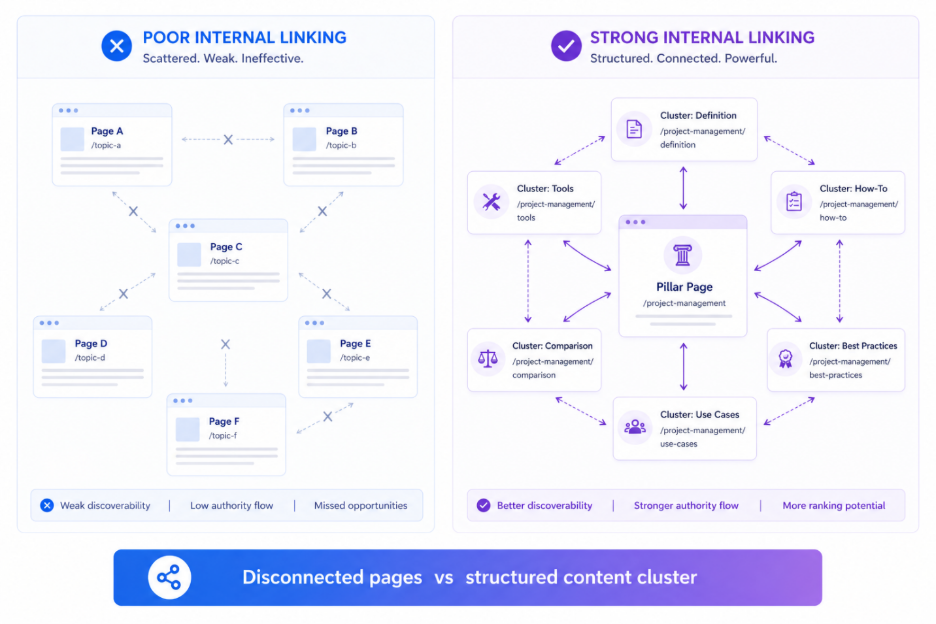
Three specific practices produce the highest-impact internal linking for fan-out coverage. First, descriptive anchor text — links should use the topic of the destination page as the anchor, not generic phrases like “read more” or “click here.” Second, bidirectional linking — every cluster article links to the pillar; the pillar links to every cluster article. As Wellows’ 2026 fan-out strategy guide recommends, this pillar-and-cluster structure with clear bidirectional linking gives AI systems multiple access pathways to the full topic network. Third, contextual placement — links embedded within body paragraphs at the point of topical relevance carry more semantic weight than navigation links or sidebar links that have no relationship to surrounding content.
Fixing These Mistakes
The four mistakes above share a common root: they apply the logic of keyword-first SEO to a retrieval system that operates on semantic understanding. The correction in each case is a shift from asking "does this content contain the target keyword?" to asking "does this content satisfy the full intent network that AI systems generate around this topic?"
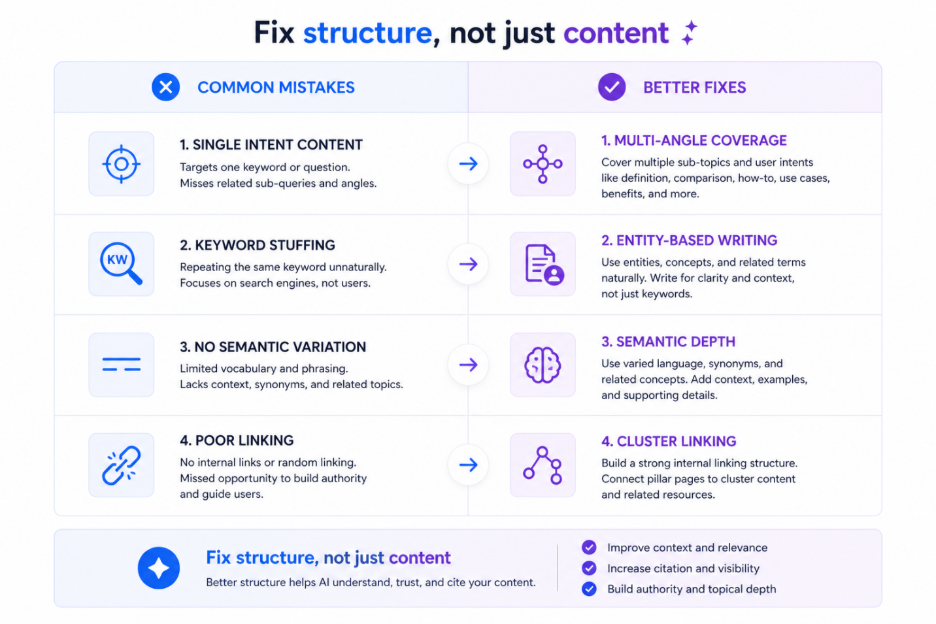
The table below consolidates the primary mistakes and their fixes into a single working reference:
The order of priority matters when addressing these simultaneously. Crawl access — ensuring AI bots are not blocked in robots.txt — is the prerequisite for everything else. A perfectly structured, semantically rich, well-linked content cluster earns zero AI citations if GPTBot cannot read it. After that, internal linking and intent coverage produce the fastest compounding returns, because they increase citation opportunities across the entire cluster rather than on a single page.
The measurement shift matters too. Traditional SEO tracks keyword rankings and organic sessions. Fan-out optimisation requires tracking AI citation rate — running target queries monthly in ChatGPT, Perplexity, and Gemini and recording whether and how your brand appears. Goodie’s query fan-out analysis notes that AI search creates a probabilistic visibility model where citation rates vary 40–60% month-to-month even for the same prompts — which means measuring citation trends over time, not treating any single snapshot as definitive.
Fixing these mistakes is not a one-time audit. It is an ongoing content discipline — because fan-out sub-queries shift as AI platforms update their models, as buyer behaviour evolves, and as the competitive landscape in your category changes. The brands that treat query fan-out optimisation as a living practice, not a technical setup task, are the ones that build compounding AI visibility over time.



.png)