.svg)


Most content strategies are built around one idea: write the best page for a target keyword. In traditional search, that logic held. In AI search, it is only a partial answer.
When a generative engine receives a query, it does not retrieve a single best page. It expands the query into multiple sub-queries, retrieves the best passage for each one, and assembles an answer from the results. The page that addresses only the head term earns one citation slot, at most. A content architecture that addresses multiple sub-query angles earns multiple slots from the same user interaction. According to Search Engine Land’s query fan-out optimisation guide, query fan-out favours content that explains a topic clearly and coherently rather than content narrowly optimised around a single query. Expanding semantic coverage is consistently more effective than repeating a single phrase.
This article covers the five practical techniques that translate that principle into actual content decisions.
Structuring Content for Multi-Angle Retrieval
The most important structural shift for query fan-out optimisation is treating each section of a page as an independent retrieval unit. AI systems do not read a page from top to bottom and score it. They scan for passages that directly answer specific sub-queries — and extract those passages independently of the surrounding content.
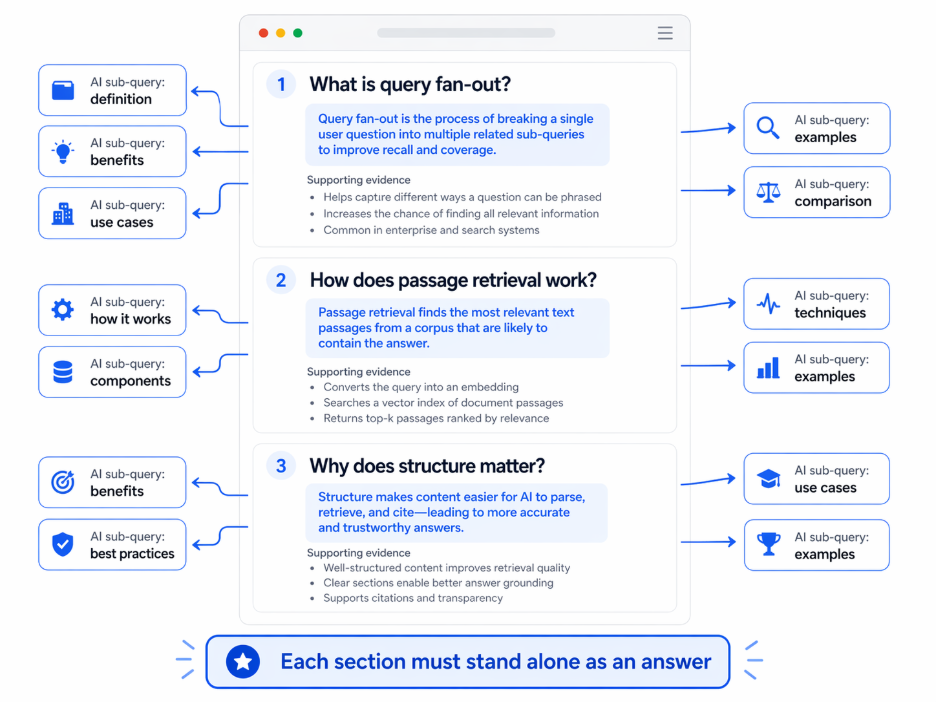
This means every section of a page must be able to stand alone. The opening sentence of each section should answer the implied question of that section’s heading without requiring the reader — or the AI — to have read anything before it. According to Writesonic’s AI Mode query fan-out analysis, “every section must stand on its own: Google extracts responses at the passage level. Each paragraph needs to answer a specific subquery clearly and independently.” A passage that opens with “As we discussed above…” or “Building on the previous section…” is structurally uncitable — the AI cannot extract it without its context.
The practical structure for each section: question-phrased H2 or H3 heading, direct 40-60 word answer as the opening sentence, supporting evidence with a named source, and a closing sentence that connects the concept to the broader topic. This structure serves human readers and AI retrieval systems simultaneously.
A well-structured page is not one where every section flows into the next. It is one where every section can be lifted out and still make complete sense on its own.
Writing for Sub-Query Coverage
Before writing any piece of content, map the sub-query landscape of the target topic. AI systems generate sub-queries across predictable angle types — and each angle type requires a different content response. The table below maps the primary sub-query patterns and what each one demands from your content:
Ekamoira’s January 2026 research found that content with cosine similarity scores above 0.88 to the sub-queries generated for a topic achieves 7.3 times higher citation rates than content with lower scores. Achieving that similarity does not require keyword stuffing — it requires using the exact terminology, context, and framing that the sub-queries expect. Ekamoira’s query fan-out research also confirms that Profound’s October 2025 analysis found that answer engines add words like “best,” “top,” “reviews,” and the current year to queries during fan-out. Content that naturally incorporates these modifier terms matches more sub-query variants than content that avoids them.
The practical approach: before writing, use a fan-out generator or simply ask an AI platform to expand your target topic into the sub-questions it would search for. Then check your existing or planned content against each sub-question. The gaps you find are the citation opportunities you are currently missing.
Using Semantic Depth
Semantic depth is the degree to which a piece of content covers not just the primary topic but the entities, relationships, and contextual dimensions that surround it. AI systems build knowledge models of topics by mapping entity relationships — and content that makes those relationships explicit is more reliably retrieved and cited across a wider range of sub-queries.
The distinction from keyword targeting is important. Semantic depth is not about synonyms or related keywords. It is about demonstrating genuine understanding of how concepts connect. A page about “GEO” that explains what GEO is, how it differs from SEO and AEO, which AI platforms it targets, what signals influence citation, and what results it produces is semantically richer than a page that defines GEO clearly but addresses only that one dimension. According to iPullRank’s analysis of query fan-out and semantic architecture, AI systems that use query decomposition “demand atomic, entity-rich content architecture” — content where individual claims are anchored to canonical entities with verifiable sources, not vague assertions about broad topics.
Concretely, semantic depth is built by: defining every key term the first time it appears, naming the entities your content relates to (platforms, people, organisations, frameworks), citing specific studies or data sources rather than general claims, and addressing how your topic relates to adjacent concepts that buyers are likely to research alongside it. Each of these practices adds a retrievable node to the semantic network your content represents — and each node is a potential citation match for a different sub-query.
Entity Layering Strategy
Entity layering is the practice of building consistent, unambiguous signals about the entities involved in your content — your brand, your authors, your category, and the concepts you cover — across multiple levels of your digital presence.
AI systems use entity recognition to evaluate source credibility during citation selection. A brand that is clearly defined as an entity — consistent name, consistent description, consistent category classification across website, schema markup, LinkedIn, and third-party mentions — is understood more confidently and cited more reliably than a brand with fragmented or inconsistent signals. Inconsistency forces the AI to infer rather than confirm, and inference introduces uncertainty that reduces citation confidence.
The layering process works from the inside out. Start with on-page entity consistency: use the same terminology to refer to the same concepts throughout every piece of content. If you call something “GEO” in one article and “generative engine optimization” in another without defining both as the same thing, AI systems may not recognise them as equivalent and will fail to build a coherent entity model of your topical authority. Then extend entity consistency to schema markup — Organisation schema, Person schema with sameAs links, and Article schema that connects author to publisher. Finally, build the same entity signals externally: consistent brand descriptions on LinkedIn, Crunchbase, and industry directories feed the same knowledge graph that AI retrieval systems draw on. GA Agency’s query fan-out strategy guide confirms that consistent terminology and naming conventions across a site matter because “if you refer to the same product or concept using different names, AI systems may struggle to recognise them as the same entity, fragmenting your authority.”
Internal Linking for Fan-Out Strength
Internal linking is the mechanism that connects the semantic nodes of your content cluster into a coherent knowledge structure that AI systems can navigate. It is not just a navigation tool. It is the architecture that tells AI retrieval systems how your content pieces relate to each other — and which article is the authoritative hub for each sub-query category.
Google’s query fan-out patent explicitly lists internal links as a signal tied to topical breadth and depth. Wellows’ fan-out optimisation research recommends a clear cluster structure: one strong pillar guide of around 2,000–3,000 words, supported by several cluster articles of around 800–1,200 words each, linked together clearly. Each cluster article addresses a specific sub-query pathway in depth. Each link from a cluster article back to the pillar article reinforces the pillar’s authority as the canonical source for the broader topic.
Three internal linking practices that directly support fan-out coverage:
- Anchor text precision. Use descriptive anchor text that reflects the topic of the linked page, not generic phrases like “learn more” or “read here.” Descriptive anchors create semantic relationships that AI systems can use to infer content relevance across the cluster.
- Bidirectional linking. Cluster articles should link to the pillar. The pillar should link to every cluster article. This bidirectional structure gives AI systems multiple pathways to discover and connect related content within your site.
- Contextual placement. Links placed within the body of relevant content — at the point where the linked topic is most naturally relevant — carry more semantic weight than links placed in footers or navigation menus. A link from a paragraph about entity clarity to an article dedicated to entity authority in GEO signals a meaningful conceptual relationship.
The combined effect of these five techniques is a content architecture that addresses more sub-query pathways, is more reliably extracted at the passage level, and presents AI systems with a coherent, entity-consistent knowledge structure that builds citation confidence across the full topic cluster rather than on individual pages. That is the shift from single-keyword optimisation to query fan-out optimisation — and it is the structural difference between occasional AI citations and consistent, compounding AI visibility.
A single great page earns you one seat at the table. A well-connected cluster earns you a seat at every sub-query the AI generates — and that is where compounding citation authority begins.



.png)