The Complete Guide to Visibility in the Age of AI Search
Search has changed permanently. The buyers your brand needs to reach are no longer exclusively scanning ten blue links on Google. They are asking ChatGPT for vendor recommendations. They are reading Perplexity’s synthesised comparisons. They are receiving AI-generated answers in Google AI Mode that resolve their queries without sending them to any website. And in those AI-generated answers, most brands do not exist.
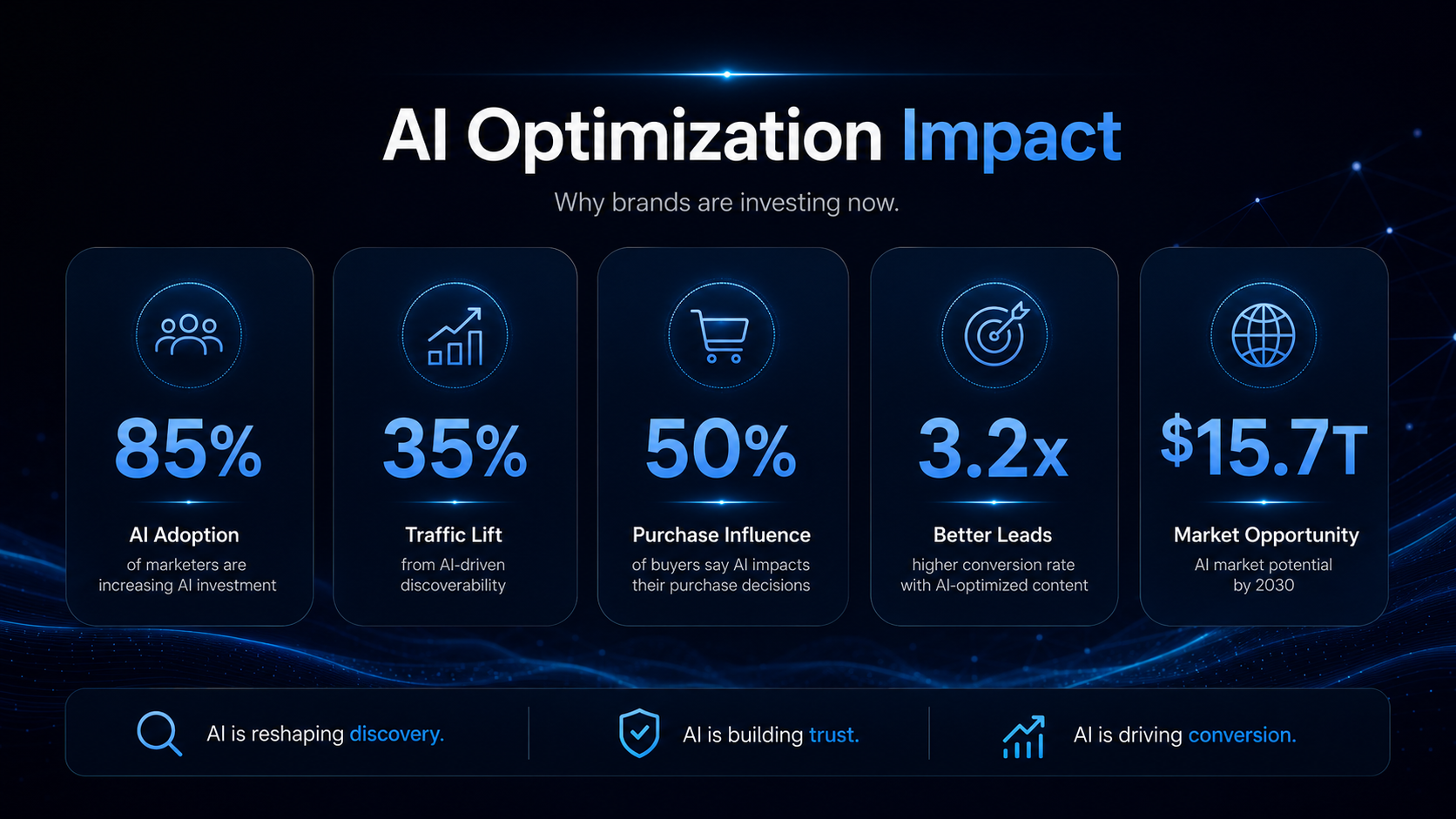
AI optimisation is the discipline that addresses this invisibility. It is the systematic practice of making your brand visible, cited, and recommended across every AI-powered search surface — from Google AI Overviews to ChatGPT to voice assistants. According to Exposure Ninja’s 2026 CMO AI Search Statistics cheat sheet, ChatGPT has 883 million monthly users as of January 2026, processes 2 billion queries daily, and is the fifth most visited website globally. Adobe’s 2025 holiday season data showed traffic from generative AI tools increased 693% year-over-year for retail. Commercial keywords triggering AI Overviews increased 128% year-over-year, rising from 8.15% to 18.57% of all commercial queries according to SEMrush. This is no longer a technology trend to prepare for. It is the current operating environment.

This complete guide covers every dimension of AI optimisation: what it means, the three disciplines it encompasses, how AI platforms select sources, the ranking factors that determine visibility, how to structure content for AI extraction, technical requirements, off-site authority strategies, the content types that earn the most citations, measurement frameworks, proven case studies, common mistakes, and the tools that make AI optimisation trackable and compoundable.
What Is AI Optimisation?
AI optimisation is the integrated practice of ensuring your content, technical infrastructure, and digital brand presence are structured so that AI-powered platforms — including Google AI Overviews, Google AI Mode, ChatGPT, Perplexity, Microsoft Copilot, Gemini, and voice assistants — can find, understand, and recommend your brand when generating answers to user queries.
It is not a replacement for traditional SEO. It is the necessary extension of it. Traditional SEO ensures your content is indexed, authoritative, and discoverable in keyword-based search. AI optimisation ensures that same content is extracted, attributed, and recommended inside AI-generated answers — a form of visibility that produces no direct click but profoundly influences buyer preference, brand trust, and downstream purchasing decisions.

The distinction matters because AI search and traditional search operate on fundamentally different evaluation logic. Traditional search ranks pages for keywords. AI search retrieves passages for sub-queries and synthesises answers. A brand ranking first on Google can be completely absent from ChatGPT. A brand with modest domain authority can earn consistent AI citations through entity clarity, structured content, and multi-source brand presence. The rules have changed — and so has the strategy required to win visibility.
[fs-toc-omit]The Three Disciplines of AI Optimisation
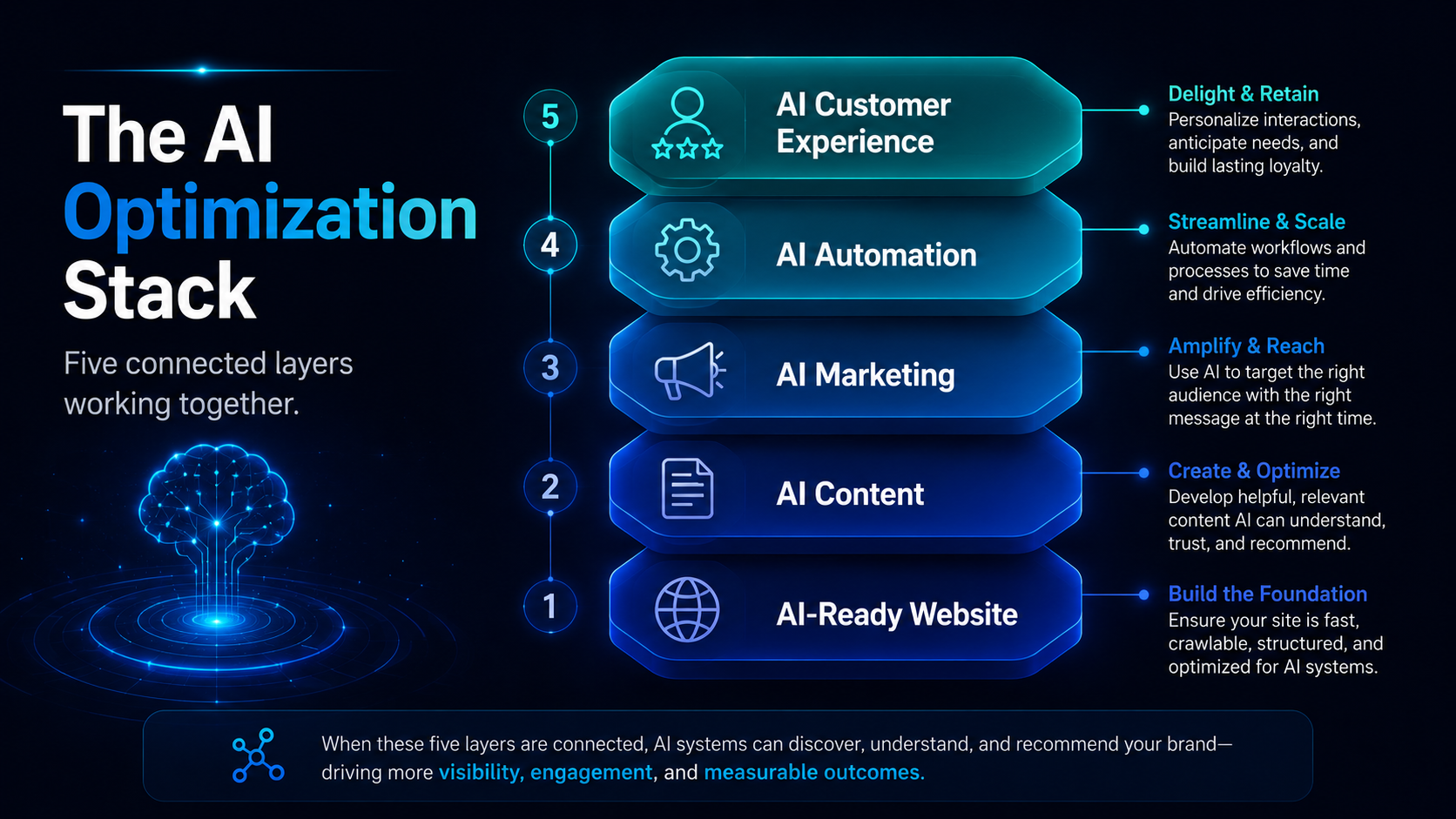
AI optimisation is not one discipline. It is a stack of three complementary disciplines, each targeting a different AI search surface, each building on the one below it:
table
The most important row in this table is the final one: GEO does not replace SEO or AEO. It builds on both. A brand with poor SEO fundamentals will not appear in Google AI Overviews. A brand with strong SEO but no answer-format content will not win featured snippets or voice search. A brand with both SEO and AEO but no off-site entity presence will not earn consistent ChatGPT or Perplexity citations. The complete AI optimisation strategy addresses all three layers simultaneously.
[fs-toc-omit]The Market Context for AI Optimisation in 2026
The commercial urgency of AI optimisation in 2026 is quantifiable. 63% of websites analysed by Ahrefs had already received referral traffic from AI-generated answers. Yet only 20% of organisations have begun implementing AI optimisation strategies, while 70% believe it will significantly impact their strategy within one to three years. As Search Engine Journal’s GEO Strategy analysis notes, the early movers will own this space. The window for first-mover AI optimisation advantage is narrower than it appears — citation patterns are already establishing, and the brands visible in AI answers today are building compounding advantages that late movers will find structurally difficult to close.
AI optimisation is not the future of digital marketing. It is the present. The brands that understand this now are quietly building the citation authority that will define category leadership in 2027 and beyond.
The Five Pillars of AI Optimisation
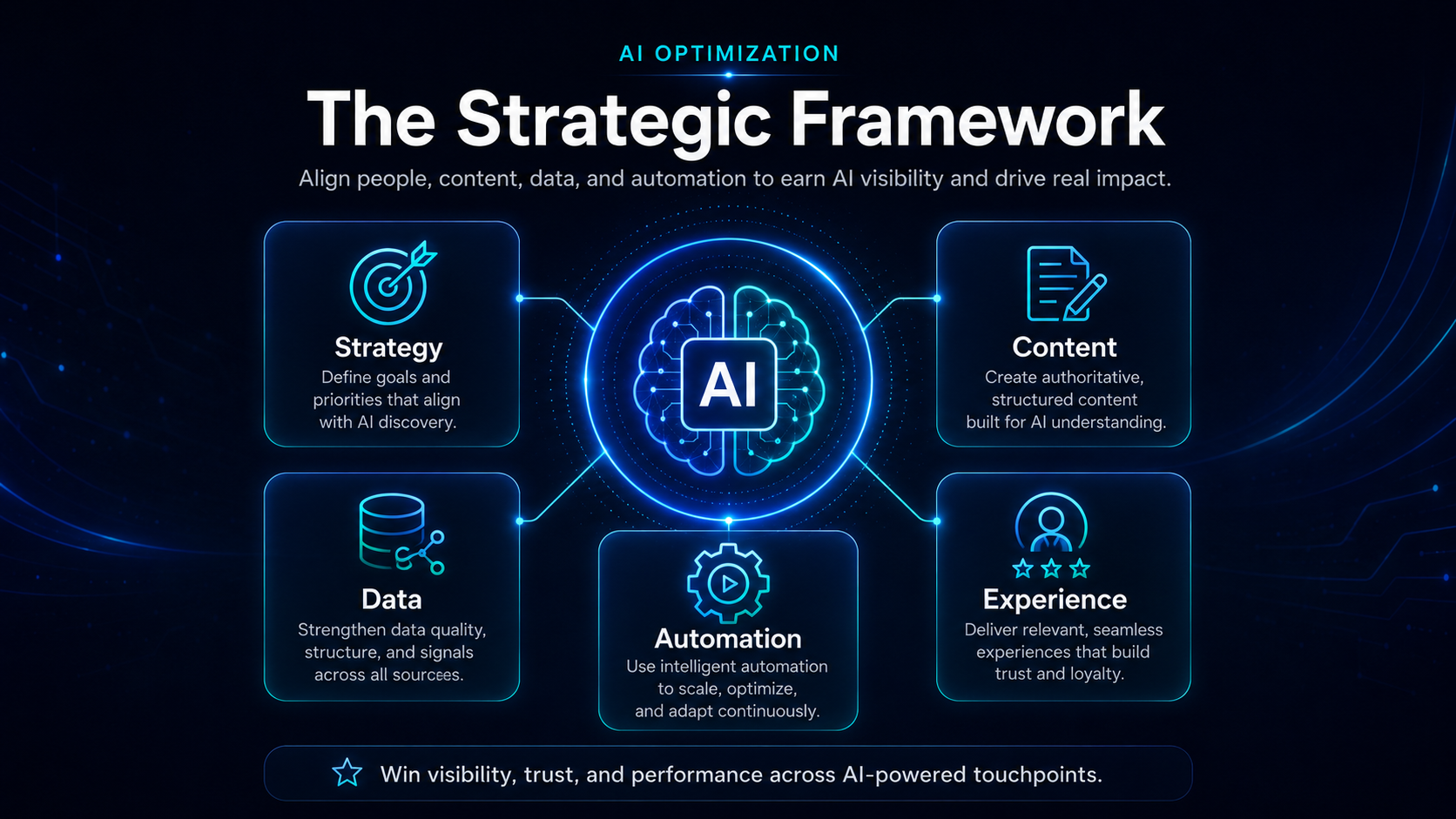
Effective AI optimisation is not a collection of isolated tactics. It is a structured framework built on five foundational pillars, each interdependent and compounding when implemented together. Addressing only one or two pillars produces partial results. All five together produce sustained AI search visibility across every major platform.
table
The most neglected pillar is Pillar 4: Off-Site Presence. Most AI optimisation guides focus on on-page content and technical schema — the signals a brand controls directly. But brand mentions across independent sources carry a 0.664 correlation with AI citation probability versus backlinks at 0.218. Earned media distribution increases AI citations by a median 239% according to Stacker’s March 2026 research. Journalistic and earned media sources account for nearly 25% of all citations generated by large language models, according to Position Digital’s April 2026 AI SEO Statistics analysis. A brand with five perfectly structured pages and no off-site presence will consistently underperform a competitor with moderate on-page quality and broad multi-source mention coverage.
How AI Platforms Select and Cite Sources
AI platforms do not select sources the way Google ranks pages. Each platform has its own retrieval architecture, and optimising for one without understanding the others leaves significant AI visibility uncaptured. Understanding the mechanics of each platform is the prerequisite for building an effective multi-platform AI optimisation strategy.
[fs-toc-omit]Google AI Overviews
Google AI Overviews draw from Google's existing search index. A page must already rank organically — or rank for closely related queries — before Google considers it as an AI Overview source. BrightEdge's 16-month study found that AI Overview citation overlap with organic rankings grew from 32% to 54% between May 2024 and September 2025. This means organic SEO is the non-negotiable prerequisite for Google AI Overview inclusion. Once index-eligible, Google selects passages that directly answer the query in 40-80 words, supported by authoritative page-level signals and schema markup.
[fs-toc-omit]Google AI Mode
AI Mode is powered by Google Gemini and has reached 75 million daily active users. Unlike AI Overviews, it uses query fan-out — generating 9-11 sub-queries per prompt — and draws from a broader source pool than the organic top-10. Only 14% of AI Mode cited URLs rank in top 10 (SE Ranking, August 2025). This makes AI Mode the platform with the widest available citation opportunity for brands willing to build structured, entity-clear content. Based on Omnia’s citation data, AI Mode is the only engine actively expanding citation behaviour — up 27% in the five months to April 2026 while other platforms contracted.
[fs-toc-omit]ChatGPT
ChatGPT uses Bing for live web retrieval but applies its own credibility evaluation layer. It drives 87.4% of all AI referral traffic according to Conductor’s 2026 Benchmarks. As of February 2026, ChatGPT enables search on 34.5% of queries — meaning 65.5% of responses still rely on training data. Ahrefs’ April 2026 analysis found that ChatGPT only cites 50% of the pages it retrieves, and 88% of cited URLs come directly from search. The brand mention dimension is critical for ChatGPT: domains with millions of mentions on Quora and Reddit have roughly 4x higher citation probability, and domains with G2, Capterra, or Trustpilot profiles are 3x more likely to be cited.
[fs-toc-omit]Perplexity
Perplexity foregrounds citations — showing sources prominently before generating the response. It draws heavily from Reddit, news publications, review platforms, and community content. It emphasises recency, with a strong bias toward recently published or updated content. YouTube overtook Reddit as the most cited social platform in early 2026 according to Adweek, representing a meaningful shift in Perplexity source preferences. Brands with active community presence and fresh content earn Perplexity citations at rates disproportionate to their domain authority.
[fs-toc-omit]Voice Assistants
Voice search is the most concentrated AI optimisation surface. One answer is returned per query. 40.7% of voice answers come from featured snippets. AEO optimisation for voice requires Speakable schema, 20-30 word answers that sound natural when read aloud, and Local Business schema given that 76% of voice searches carry local intent. Siri, Alexa, and Google Assistant all draw from the same featured snippet pool — winning the snippet wins the voice citation simultaneously.
AI Optimisation Ranking Factors
The following table consolidates the primary ranking factors that determine AI search citation and visibility across all major platforms, drawn from peer-reviewed academic research and large-scale citation analysis as of April 2026:
table
The April 2026 analysis by Cyrus Shepard, cited in Position Digital’s statistics compilation, identifies URL accessibility, search rank, fan-out rank, preview control, query-answer match, and intent-format match as the strongest correlating factors. The first of these — URL accessibility — encompasses whether AI crawlers can access the page. This is the most overlooked AI optimisation factor, and it is binary: either your content is accessible to AI systems, or it earns zero citations regardless of every other signal.
How to Structure Content for AI Optimisation
Content structure for AI optimisation follows one overriding principle: AI systems retrieve passages, not pages. They scan for specific text blocks that directly answer individual sub-queries — self-contained, factually specific, and extractable without surrounding context. Content written for narrative flow fails this test. Content written for passage extraction passes it.
[fs-toc-omit]The BLUF Principle: Non-Negotiable
BLUF — Bottom Line Up Front — is the structural law of AI-optimised content. The first sentence of every section must be a complete, standalone answer to the implied question of that section’s heading. 44.2% of all LLM citations come from the first 30% of content (Growth Memo, February 2026). A section opening with context or background before delivering the answer is structurally uncitable. Semrush’s April 2026 AI content optimisation guide frames the highest-leverage action clearly: “Replace vague statements with concrete data like statistics with proper attribution. This single change often produces the fastest AI citation improvements.”
Optimal Passage Lengths by Platform
• Google AI Overviews: 40-80 words — directly answerable, factual, attributable without context
• Featured snippets: 40-60 words — complete standalone answer, no qualifying clauses at start
• ChatGPT / Perplexity passage chunks: 100-167 words — optimal semantic chunk size for LLM passage retrieval
• Voice assistant answers: 20-30 words — natural flowing prose, complete sentence, no lists
[fs-toc-omit]Content Types That Earn AI Citations
Not all content performs equally in AI search. The following table maps content types to AI citation value:
table
The comparison and alternative content finding — case studies and pricing pages as the best content types for AI-era traffic (Siege Media, September 2025) — represents a significant strategic reorientation. Top-of-funnel informational content dropped in traffic as AI Systems answer those queries directly. Bottom-of-funnel content containing named outcomes, specific pricing comparisons, and implementation details is what AI systems cannot generate from training data alone. Exposure Ninja’s AI search trend analysis confirms this: commercial keywords triggering AI Overviews increased 128% year-over-year, meaning buyers are receiving AI-synthesized answers for high-intent commercial queries. Brands with structured commercial content earn AI citations at the exact moment buyers are forming vendor preferences.
Zero-Click Search and AI Optimisation
Zero-click search is the structural reality that makes AI optimisation commercially urgent. When users receive their answer inside the AI response without visiting any website, the brand inside that answer earns brand association and preference-setting authority. The brand absent from that answer is invisible in the moment that most influences the buyer's consideration set.
TABLE
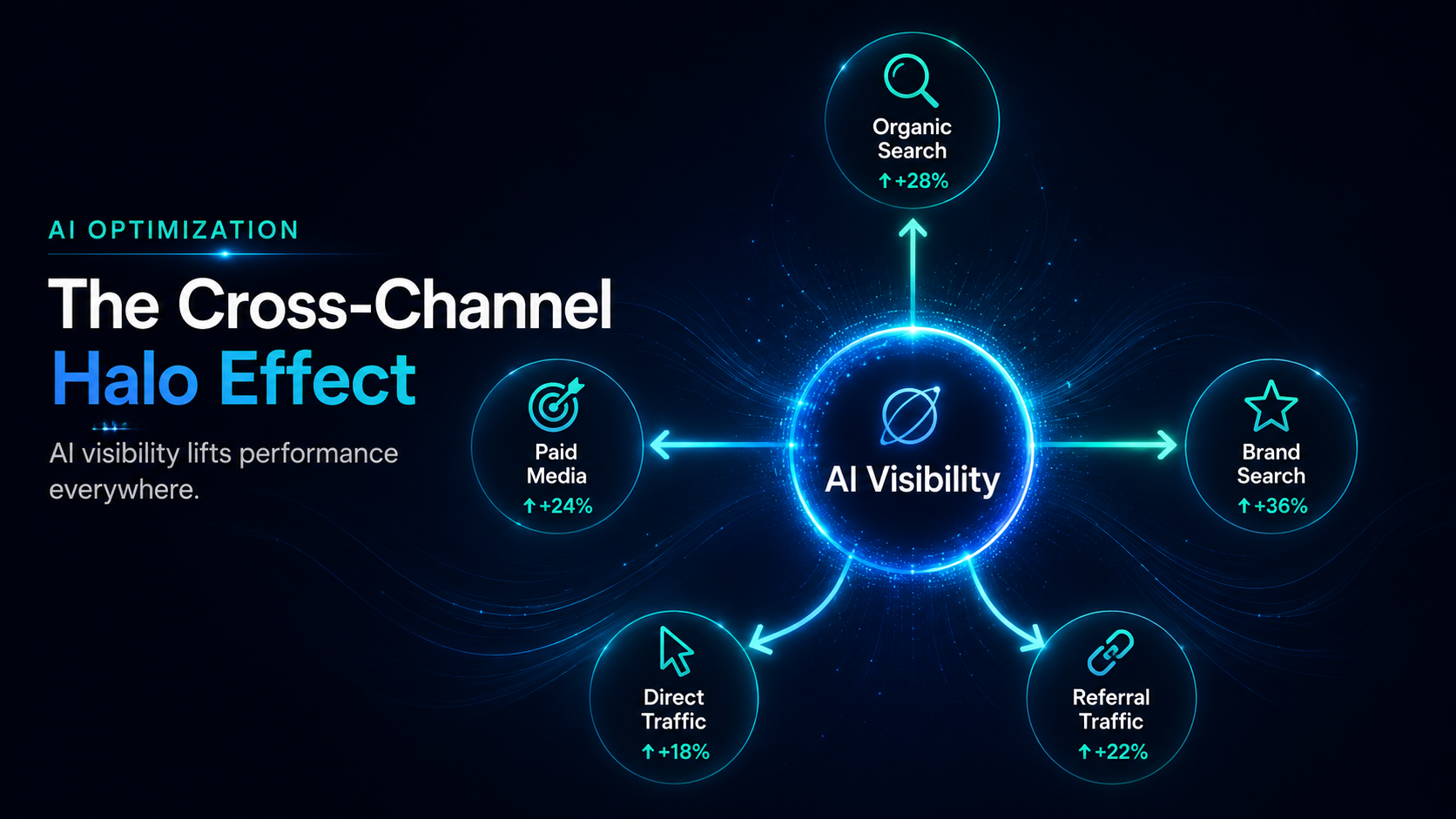
The conversion case for zero-click optimisation is frequently misunderstood. Brands measuring AI optimisation exclusively through website traffic will consistently undervalue its contribution. As Exposure Ninja’s CMO cheatsheet documents, even when users do not click, seeing a brand cited in multiple AI answers primes them to return directly when they are closer to a purchase decision. This “brand salience” effect makes AI Share of Voice a leading indicator of future direct traffic, branded search volume, and conversion rates — not just a vanity metric. The brands that appear consistently in AI answers for category-level queries are building the brand familiarity that drives commercial outcomes weeks and months later.
Technical AI Optimisation
Technical AI optimisation covers the infrastructure that enables AI systems to access, parse, and confidently cite your content. Most brands have never audited their technical AI optimisation baseline. The failures are invisible to human visitors but highly visible to AI crawlers — and they silently prevent every content and authority investment from earning citations.
[fs-toc-omit]AI Crawler Access: The Non-Negotiable First Step
Check your robots.txt file for any rules blocking GPT Bot, Perplexity Bot, Claude Bot, or Google-Extended. Three in four websites are partially or fully invisible to AI engines, according to Sona's 2026 AI Visibility research. The most common cause: catch-all bot disallows rules that block AI crawlers alongside other unwanted bots. Fix this before any other AI optimisation investment. It costs nothing, takes minutes, and its impact is immediate. A perfectly structured, schema-marked, content-rich page earns exactly zero AI citations if GPT Bot cannot read it.
[fs-toc-omit]Bing Webmaster Tools: The Overlooked Requirement
ChatGPT drives 87.4% of all AI referral traffic and uses Bing for live retrieval. A brand not indexed in Bing is invisible to ChatGPT's real-time search pathway regardless of Google rankings. Set up Bing Webmaster Tools, submit your XML sitemap, verify domain ownership, and monitor Bing crawl health. For ChatGPT specifically, Bing optimisation is not a secondary task — it is a direct prerequisite for live retrieval citation.
[fs-toc-omit]Static HTML Rendering
AI parse success for static HTML runs at 94% versus JavaScript-rendered content at 23% (Erlin, 2026). If your site relies on client-side rendering, AI systems may be unable to extract your content despite good content quality and correct schema. Server-side rendering, static site generation, or hybrid rendering are the solutions. This is not a performance optimisation — it is a binary AI visibility requirement.
[fs-toc-omit]Schema Markup Implementation
Schema markup is the technical contract that communicates your content's meaning to AI systems explicitly, replacing inference with certainty. All schema should be implemented as JSON-LD in a single @graph block. The minimum required schema set for any B2B or content-driven website: Organisation (with same As links), Article (with date Modified and author), Person/Author (with same As to LinkedIn or Wikidata), and FAQ Page on all Q&A pages. Validate every implementation with Google's Rich Results Test before publishing. Re-validate after every content update — stale schema creates trust mismatches that reduce citation confidence.
[fs-toc-omit]Page Speed and the llms.txt Standard
Pages loading under 0.4 seconds FCP average 6.7 AI citations, while pages over 1.13 seconds average just 2.1 (AI Clicks, 2025) — a 3x difference attributable to retrieval timeout requirements in AI systems. Separately, the llms.txt standard is an emerging plain-text file placed at the root of your domain to guide AI crawlers toward your most authoritative pages. As To The Web’s April 2026 GEO guide identifies, AI agents extracting and summarising your content for others can be guided toward canonical pages through both llms.txt and an mcp. json file — an emerging agentic AI control standard. Implementation of both files takes under an hour and provides the clearest possible AI-readable signal about your content hierarchy.
Building AI Optimisation Authority: The Off-Site Dimension
AI optimisation authority is built across the web, not on your own website. AI systems evaluate brand credibility based on how a brand is discussed, cited, and validated across independent sources — not just how its own pages are structured. This off-site dimension is the AI optimisation investment most brands are making last, despite being the signal that most strongly predicts citation performance.
[fs-toc-omit]The Multi-Source Corroboration Model
AI search platforms synthesise answers from multiple sources and evaluate brands that appear consistently across independent references as more credible than brands known only from their own website. The specific data: brand mentions correlate with AI citation at 0.664 versus backlinks at 0.218. YouTube mentions specifically carry a 0.737 correlation — the highest measured single factor. Journalistic and earned media sources account for nearly 25% of all LLM citations. Earned media distribution increases AI citations by a median 239% (Stacker, March 2026). Sight AI’s brand visibility strategy analysis identifies the operating principle: “The compounding effect of consistent, optimised content tracked and refined through AI visibility analytics is what separates brands that get mentioned from brands that get overlooked.”
[fs-toc-omit]Platform-Specific Off-Site Strategy
YouTube: The most cited social platform by AI systems as of early 2026. Create video content on core topics; include full text transcripts; add VideoObject schema. Transcripts make video content available to text-based AI retrieval.
Reddit: Perplexity draws heavily from Reddit. Domains with millions of Reddit mentions have 4x higher ChatGPT citation probability. Identify the communities where your buyers discuss category problems and contribute substantive, genuine guidance.
LinkedIn: Microsoft Copilot draws heavily from LinkedIn for B2B queries. Active company pages with consistent brand descriptions and regular thought leadership posts are a direct Copilot AI optimisation signal.
Review platforms: G2, Capterra, Trustpilot, and Yelp listings increase ChatGPT citation probability 3x. The listing takes hours. The citation impact is immediate and persistent.
Industry publications: Target publications that AI systems already cite for your category. A mention on a domain AI Mode frequently retrieves for your topic area is worth more than a generic high-DA backlink.
Original research: Sites with proprietary data saw a 22% visibility increase; being cited in an AI Overview boosted brand clicks by 35% (Ranktracker, 2026). Original research creates a citation asset that propagates across the web, feeding both RAG retrieval and training data.
AI Optimisation Best Practices Checklist
The following 32-point checklist consolidates every AI optimisation action in priority order. Use it as a comprehensive audit for building multi-platform AI search visibility:
table
Measuring AI Optimisation Performance
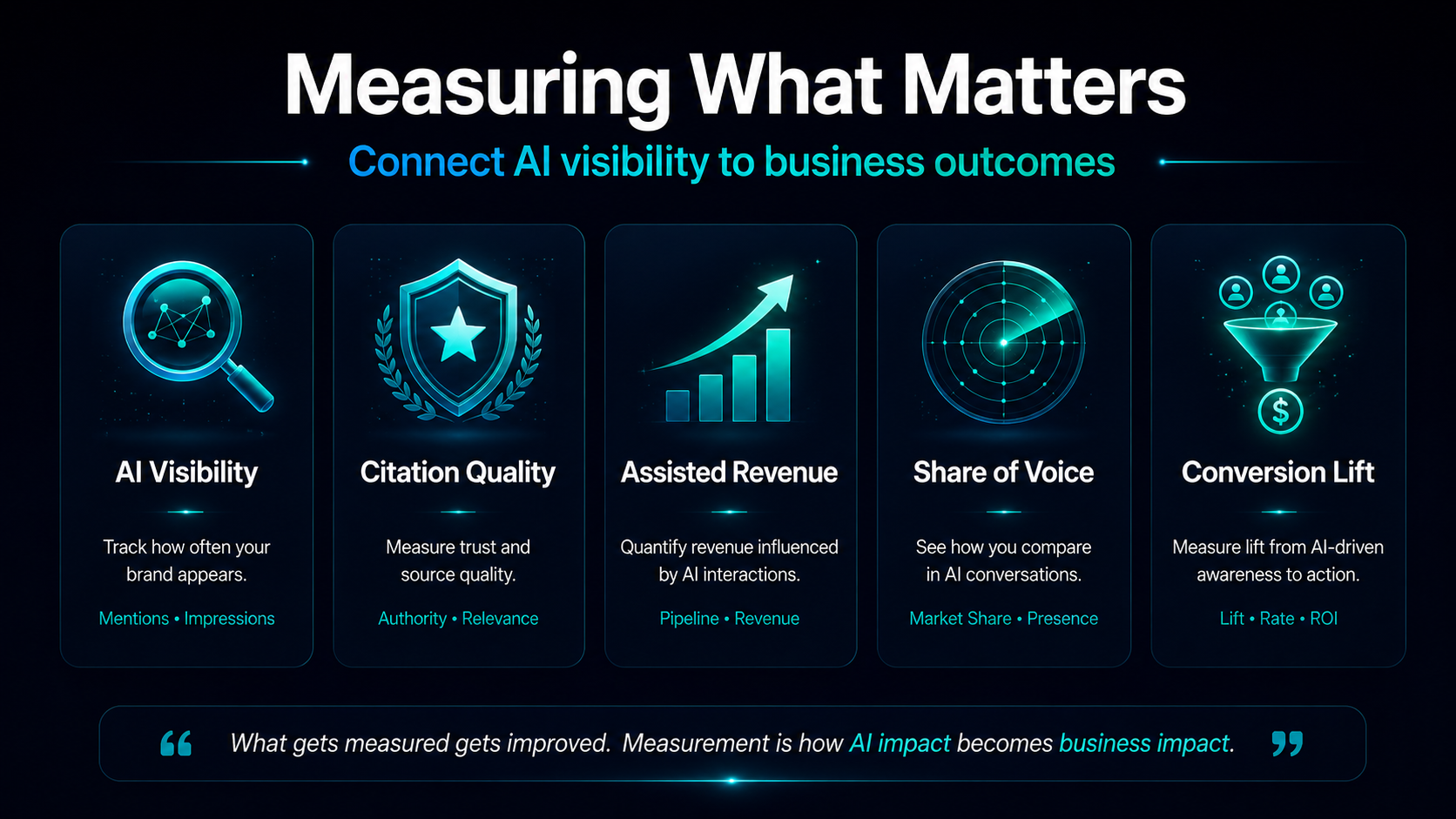
Measuring AI optimisation requires metrics beyond the traditional SEO dashboard. A brand consistently cited by ChatGPT for its core commercial queries may show minimal change in Google Analytics organic traffic — because AI citations build brand salience before generating clicks. The measurement framework must capture both citation presence and downstream commercial impact.

table
[fs-toc-omit]Setting Up GA4 for AI Search Tracking
1. Open GA4 Admin > Data Streams > your web stream > Configure tag settings
2. Navigate to Channel Groups; create a new custom channel group called Generative AI
3. Add source rules matching: chat.openai.com | perplexity.ai | gemini.google.com | claude.ai | bing.com/chat | you.com
4. Apply the channel group to Acquisition reports
5. Create a segment comparing Generative AI channel sessions against Organic Search on conversion rate, session duration, and pages per session
6. Set a monthly calendar alert to manually test 30-40 target prompts across ChatGPT, Perplexity, Gemini, and AI Mode, recording brand appearance and description accuracy
AI Optimisation Case Studies
The following case studies documentreal-world AI optimisation results across industries:
table
The Adobe holiday season finding — 693% year-over-year increase in AI-referred retail traffic — is the clearest commercial proof point that AI optimisation produces measurable revenue impact, not just brand awareness. The Washington Post’s 4-5x conversion rate premium for AI-referred visitors demonstrates that AI citation quality as a traffic source is structurally different from organic search: users who arrive through AI citations have been pre-qualified by the AI’s synthesis process, arriving further along in their research and more ready to act.

This conversion quality premium is the commercial case that justifies AI optimisation investment even for brands where AI referral traffic volume remains small — the value per session is dramatically higher than traditional organic.
Common AI Optimisation Mistakes

Mistake 1 — Blocking AI crawlers without knowing it. Three in four websites have AI engine visibility issues. Catch-all bot disallows rules in robots.txt silently block GPT Bot, Perplexity Bot, and Claude Bot. The content may be excellent, the schema may be perfect, but no AI citation is possible if the crawler cannot read the page. Audit robots.txt as the first AI optimisation action.
Mistake 2 — Treating AI optimisation as a content-only discipline. 85% of AI brand mentions come from third-party sources. A brand investing entirely in on-site content restructuring while ignoring off-site presence is addressing 15% of the AI citation signal. Review platform listings, community engagement, and publication mentions are not supplementary — they are primary AI optimisation signals.
Mistake 3 — Not setting up Bing Webmaster Tools. ChatGPT drives 87.4% of AI referral traffic and uses Bing for live retrieval. Brands not indexed in Bing are invisible to ChatGPT’s real-time search pathway. This is the most overlooked technical AI optimisation gap — it costs nothing to fix and its impact on ChatGPT citation probability is direct.
Mistake 4 — Measuring AI optimisation through traffic alone. The value of AI optimisation is captured in brand salience and conversion quality before it appears in traffic volume. Brands that measure AI optimisation success purely through click data miss the majority of its commercial impact. AI Share of Voice, citation rate, and competitive mention share are the leading indicators of AI optimisation ROI.
Mistake 5 — Publishing mass AI-generated content as AI optimisation. After Google’s March 2026 core update, mass-produced unedited AI content saw a 71% traffic drop. LLMs want new information they have not seen before — original insights, first-hand expertise, proprietary research. AI-generated content without expert review and genuine information gain is the opposite of what earns AI citations.
Mistake 6 — Optimising for only one AI platform. The same brand can see citation volumes differ by 615x between Grok and Claude (Superlines, March 2026). Each platform has distinct citation preferences, source pools, and retrieval logic. Optimising only for Google AI Overviews leaves ChatGPT, Perplexity, and AI Mode opportunity uncaptured. Multi-platform tracking and strategy is the only approach that captures the full AI optimisation opportunity.
The Future of AI Optimisation

Agentic AI will change the fundamental stakes. AI agents are already browsing, evaluating, and completing purchases on behalf of users. OpenAI’s Agentic Commerce Protocol and Shopify’s AI agent checkout are live. When a user tells an AI agent “Find the best marketing agency in my city and book a consultation”, the agent evaluates and acts without the user opening a browser. The brands visible in those agentic workflows are the ones that have built strong AI optimisation presence before agents become the default interface.
Commercial AI intent will continue expanding. Commercial keywords triggering AI Overviews increased 128% year-over-year in 2025. Profound’s 2026 research found that 9.5% of ChatGPT prompts are commercial in intent. As AI platforms mature and users develop more sophisticated prompt habits, the share of high-intent commercial queries resolved through AI synthesis will grow. AI optimisation is not just for informational queries — it is increasingly the discipline that determines commercial visibility.
AI optimisation measurement will standardise. Currently, most brands have no AI visibility dashboard. As platforms like Profound, Superlines, and HubSpot’s AEO Grader mature, standardised AI optimisation measurement will become as routine as Google Analytics. The brands building measurement infrastructure now will have baseline data and optimisation history that gives them faster response capability as the AI search landscape continues shifting.
Multimodal AI search will expand the optimisation surface. YouTube became the most-cited social platform in AI responses in early 2026. AI systems are increasingly processing images, video, and audio. The brands extending their AI optimisation to video transcripts, image alt text, and structured audio content are building citation advantages in the emerging multimodal AI search landscape.
The brands that invest in AI optimisation now are not just adapting to a search landscape that has already changed. They are building the structured, authoritative, multi-source digital presence that determines visibility across every AI interface that emerges over the next decade. The compounding advantage of early AI optimisation investment is real, measurable, and increasingly difficult for late movers to close.
Frequently Asked Questions
[fs-toc-omit]What is AI optimisation?
AI optimisation — also called AI search optimisation — is the practice of structuring your content, technical infrastructure, and digital brand presence so that AI-powered platforms understand, trust, and recommend your brand when generating answers to user queries. It encompasses three layered disciplines: traditional SEO (the foundation), AEO or Answer Engine Optimization (for featured snippets, voice search, and AI Overviews), and GEO or Generative Engine Optimization (for citations in synthesised AI responses from ChatGPT, Perplexity, Gemini, and AI Mode). AI optimisation is not a replacement for SEO — it is the next required layer built on top of it.
[fs-toc-omit]Why is AI optimisation important in 2026?
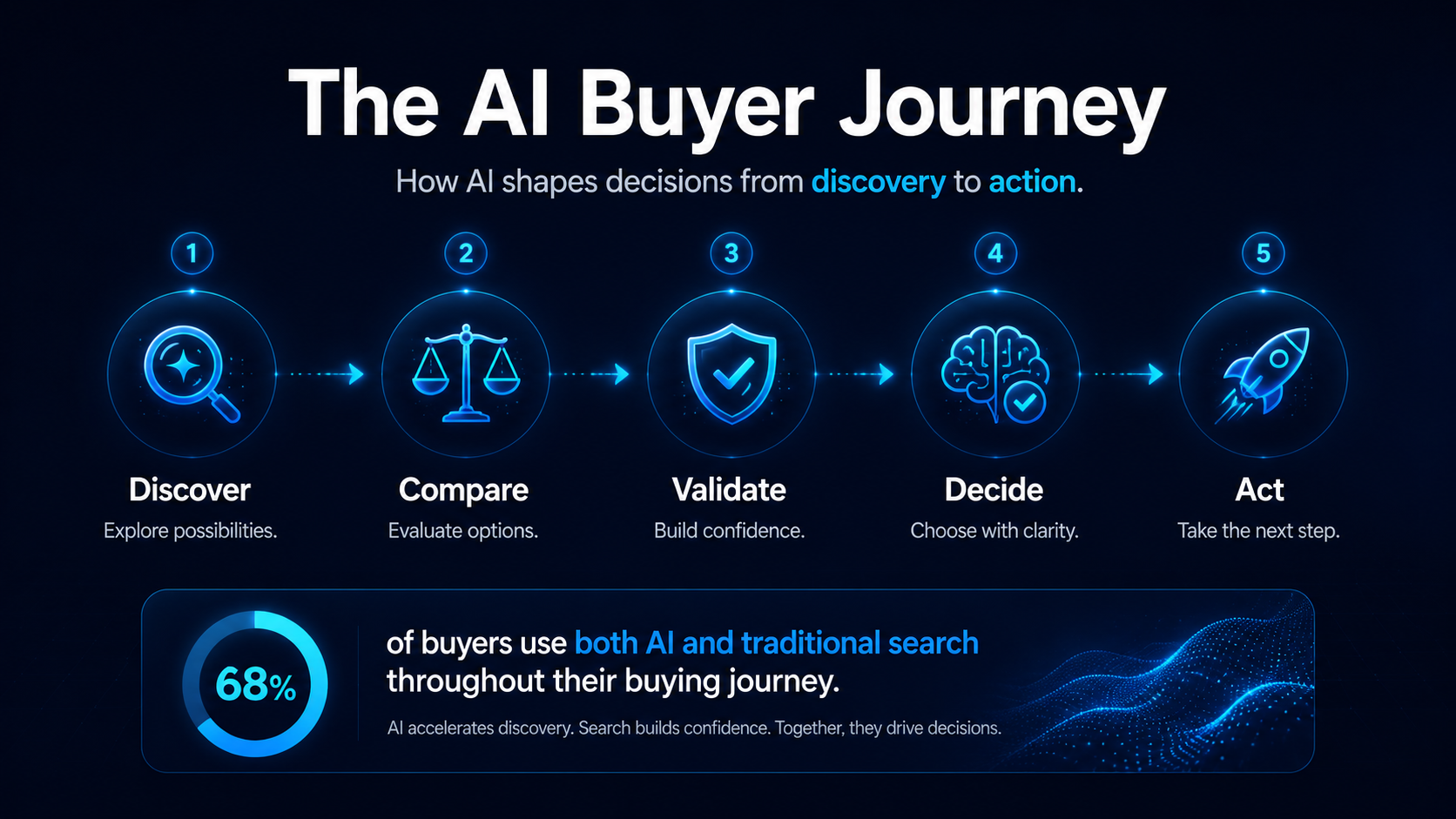
AI optimisation is important because 60% of searches now end without a click, AI Overviews appear in approximately 25% of Google queries, ChatGPT processes 2 billion daily queries and has 883 million monthly users, and AI-referred visitors convert at 4.4 times the rate of standard organic visitors. Brands not visible in AI-generated answers are invisible at the moment buyers form preferences — before any website visit, before any click. 90% of B2B buyers now use generative AI tools during their purchasing journey, and half start their research in AI platforms rather than Google. The commercial consequence of AI search invisibility is measurable and growing.
[fs-toc-omit]How is AI optimisation different from traditional SEO?
Traditional SEO optimises for keyword rankings in a list of blue links, measured by positions, clicks, and organic traffic. AI optimisation targets citation and brand mention presence inside AI-generated answers, measured by citation rate, Share of Voice, and AI referral conversion quality. The key structural difference: SEO evaluates pages for keywords; AI optimisation evaluates passages for sub-query relevance. A brand can rank first on Google and be entirely absent from ChatGPT. A brand can have moderate domain authority and earn consistent AI citations through entity clarity, structured content, and off-site brand mentions.
[fs-toc-omit]What are the most important AI optimisation ranking factors?
Based on April 2026 research from Cyrus Shepard, Position Digital, Ahrefs, SE Ranking, and Growth Memo, the top AI optimisation factors are: (1) URL accessibility and AI crawler access — blocked bots produce zero citations regardless of content quality; (2) search ranking for AIO prerequisites — 76.1% of AI Overview citations also rank in top 10; (3) direct answer in first 40-60 words — 44.2% of citations come from the first 30% of content; (4) brand mention diversity — 0.664 correlation with AI citation, YouTube specifically at 0.737; (5) entity clarity via Organisation and Author schema with sameAs links. These five factors collectively determine AI optimisation baseline eligibility.
[fs-toc-omit]What is AI Share of Voice and why does it matter?
AI Share of Voice (AI SoV) is the metric measuring how frequently your brand appears when AI systems discuss your category, relative to competitors. It is the AI optimisation equivalent of traditional search share of voice but measured in citations and brand mentions inside AI responses rather than rankings. It matters because AI share of voice captures brand influence at the exact point buyers form vendor shortlists — inside synthesised research summaries that they read before any website visit. According to Exposure Ninja's 2026 CMO cheat sheet, even when users do not click, seeing a brand cited in multiple AI answers primes them to return directly when they are closer to a purchase decision, making AI SoV a leading indicator of future direct traffic and conversion.
[fs-toc-omit]Does traditional SEO still matter for AI optimisation?
Yes — SEO remains essential for two reasons. First, Google AI Overviews, which appear in approximately 25% of all Google queries, draw predominantly from organically ranking pages: 76.1% of AI Overview citations also rank in the top 10 organic results. Without organic ranking, brands are ineligible for Google's largest AI answer surface. Second, ChatGPT uses Bing for live retrieval, and Bing rankings are fed by SEO fundamentals. However, SEO alone is no longer sufficient. For ChatGPT, Perplexity, and AI Mode specifically, 28.3% of cited pages have zero organic visibility — meaning brand mentions, entity clarity, and structured content extractability independently produce AI citations regardless of search rankings.
[fs-toc-omit]How do I optimise for zero-click search?
Optimising for zero-click search means ensuring your brand earns visibility inside the AI answer itself, rather than relying on a click-through to your website. The strategy differs by platform: for Google AI Overviews, AEO principles apply — FAQ Page schema, BLUF structure, organic ranking prerequisite. For Google AI Mode, GEO principles apply — entity clarity, off-site brand mentions, structured passage extraction. For ChatGPT, Bing ranking combined with entity signals determines live retrieval citation. The conversion case for zero-click optimisation: even when users do not click, AI citations build brand association and authority that drives direct search later. The 4.4x conversion rate of AI-referred visitors represents users who have been pre-qualified by the AI's citation process.
[fs-toc-omit]How long does AI optimisation take to produce results?
Technical AI optimisation changes — fixing robots.txt, implementing schema, enabling static HTML rendering — take effect after the next AI crawler visit: typically days to weeks. Structural content changes produce measurable AI citation improvements within four to eight weeks for pages already indexed. Featured snippet capture can occur within weeks of correct structural implementation for pages already ranking in the top 10. Bing optimisation for ChatGPT live retrieval follows traditional SEO timelines: weeks to months. Off-site authority building — review platforms, publications, community presence — operates on three-to-nine months of compounding returns. Full multi-platform AI citation presence typically becomes consistently measurable within three to six months of integrated implementation.
[fs-toc-omit]What tools do I need for AI optimisation?
A complete AI optimisation tool stack covers five functions. For citation tracking: Profound (enterprise), Otterly.ai, or Superlines. For baseline brand AI scoring: HubSpot's free AEO Grader measures sentiment, presence quality, recognition, SoV, and market position across ChatGPT, Perplexity, and Gemini. For organic and AI Overview tracking: Semrush or Ahrefs combined with Google Search Console. For Bing indexing (ChatGPT prerequisite): Bing Webmaster Tools. For schema validation: Google Rich Results Test. For AI referral traffic measurement: GA4 with a custom Generative AI channel group filtering known AI referral domains. The free combination of Google Search Console, Bing Webmaster Tools, GA4, HubSpot AEO Grader, and Google Rich Results Test covers the essential baseline for any brand starting AI optimisation.