.svg)


When you type a query into ChatGPT, the AI does not search for that exact phrase. It rewrites it. It breaks it apart. It generates a set of related sub-queries — each targeting a different angle of what you probably needed — and retrieves content for all of them before writing a single word of its response.
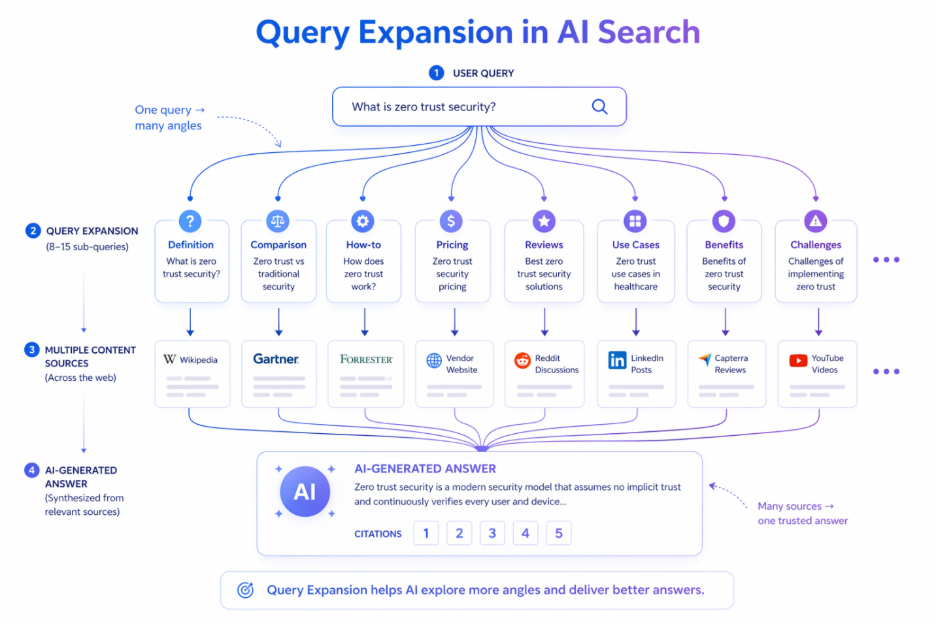
This is query expansion: the process by which generative AI systems transform one input into many retrieval pathways. Understanding it is not a technical curiosity — it is the most direct explanation for why some brands appear consistently in AI-generated answers and others do not, even when those other brands rank well in traditional search.
What Is Query Expansion in AI Search?
Query expansion in AI search is the process by which a generative engine transforms a single user query into multiple related sub-queries before retrieving any content. Each sub-query targets a different facet of the original question — a different intent layer, a different angle, a different probable follow-on need. The AI retrieves content for every sub-query simultaneously, then synthesises the results into one coherent answer. According to Search Engine Land’s analysis of query fan-out, Google’s own patent US11663201B2 describes this formally as “query variant generation” — a system that takes a single input and produces multiple related variants using a trained generative model, each issued separately before results are combined.
The scale of this expansion varies by platform and query complexity. Simple factual questions may generate three to five sub-queries. Complex research or comparison questions can generate twelve to fifteen — and Google's AI Mode can fan out to over fifty sub-queries for deeply layered topics, all executed in parallel in under two seconds.
The practical implication for any brand trying to earn AI citations: the AI is not looking for the best page for the original query. It is looking for the best passage for each individual sub-query. A brand that appears across multiple sub-query pathways earns multiple citation opportunities within the same user interaction. A brand that has optimised for only the head term earns one, at best.
The AI is not searching for your page. It is searching for the specific answer to each sub-question it has generated. If you have not written those answers, it will find them elsewhere.
How AI Breaks a Query into Sub-Queries
The expansion process follows a consistent pattern across all major AI platforms, even though each platform names it differently and applies its own weighting logic.

When a user submits a query, the AI model first analyses intent — inferring not just what was typed but what the user probably needs to fully resolve their question. It then generates sub-queries across several dimensions: definitional (what does this term or concept mean?), comparative (how does this compare to alternatives?), practical (how do I actually do this?), evaluative (does this work, and what is the evidence?), and contextual (how does this apply to my specific situation?). Not every query generates sub-queries in every dimension — the AI models which dimensions are most relevant based on the phrasing, the topic, and the platform context.
Platform behaviour differs in notable ways. Google AI Mode explicitly states in its documentation that it uses query fan-out to "capture different possible user intents, retrieving more diverse, broader results from different sources." ChatGPT describes its process as query rewriting — when a user asks, "What are some good restaurants near me?", ChatGPT may rewrite this as "top restaurants San Francisco" based on location data, before issuing further related searches. Perplexity makes its sub-query generation visible to users during the retrieval process, showing multiple focused searches firing before the final answer is assembled.
What matters for GEO is that all of these platforms share the same fundamental behaviour: one query in, multiple sub-queries out, with passages retrieved from whichever source best answers each one. According to Wellows’ 2026 optimisation research, content that only targets a single keyword “is often skipped entirely” by AI systems — one of the main reasons websites are ignored by AI search even when they rank well in traditional SERPs.
Difference Between Query Expansion and Keyword Matching
The distinction between how traditional SEO keyword matching works and how AI query expansion works is not a matter of degree — it is a structural difference in what is being optimised for.
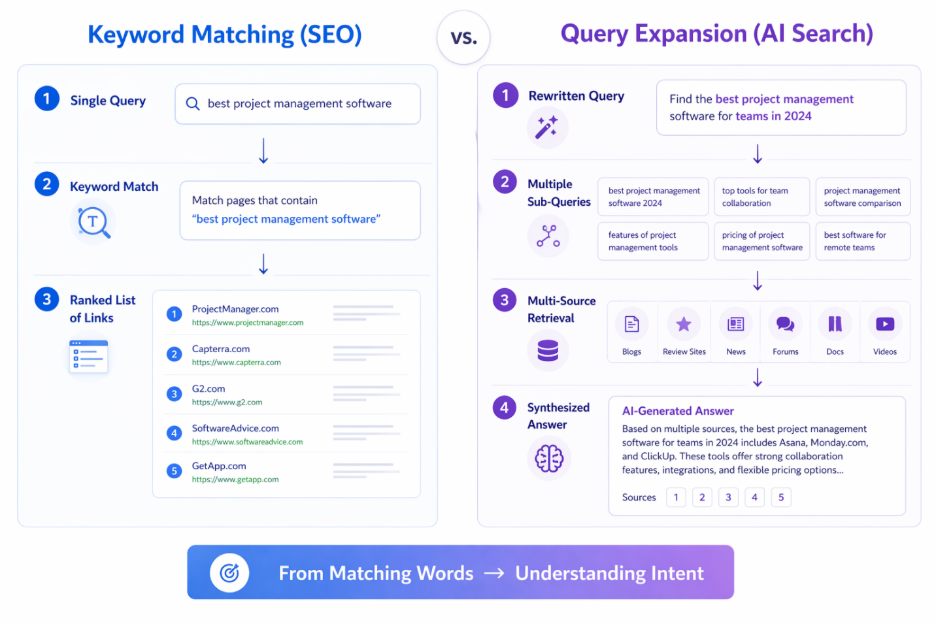
The freshness row in this table deserves attention. Ahrefs found in 2025 that AI tools cite pages that are 25.7% fresher than those surfaced in traditional search. This means the AI expansion process is not just retrieving the most authoritative source for each sub-query — it is actively prioritising sources that are more recently updated. A page that ranked well in traditional search two years ago but has not been touched since will underperform in AI citation against a newer, well-structured competitor — even if the older page has more backlinks.
Keyword matching asks: does this page contain the right words? Query expansion asks: does this page answer the right questions? Optimising for the first without addressing the second is an increasingly expensive mistake.
Why Query Expansion Matters for GEO
Query expansion is the mechanism that makes topical breadth more valuable than single-keyword depth in AI search. Because the AI generates sub-queries across multiple intent dimensions, a brand that has published content addressing all of those dimensions earns more citation opportunities per user session than a brand that has published one comprehensive page on a head term.
The citation data confirms this directly. LLMrefs’ GEO guide describes the core strategic implication clearly: when a user asks an AI a complex question, the AI breaks it into smaller sub-queries and retrieves content for each one separately. The correct response is not to create separate pages for every sub-query variation — that produces thin, fragmented content. The correct response is to build a cluster architecture where a pillar article covers the topic broadly and cluster articles address each sub-query pathway in depth. Each cluster article becomes a citation candidate for a different set of sub-queries generated from the same root topic.
There is also a convergence dimension. ALM Corp’s 2026 AI search trends report notes that by 2028, McKinsey projects over 75% of Google searches will include an AI summary. AI Overviews already appear on approximately 48% of tracked queries as of February 2026, up from 31% a year earlier. Every percentage point increase in AI Overview prevalence is a percentage point increase in the proportion of searches where query expansion — not keyword matching — determines which brands appear. The brands building for query expansion now are building for the search landscape that is arriving, not the one that has already passed.
Optimisation Checklist
The following checklist applies query expansion principles to content and technical strategy. Use it as a working audit for any page or cluster intended to earn AI citations:
One implementation note worth adding: Search Engine Land’s query fan-out tools guide identifies a practical way to map sub-queries before writing: using a query fan-out generator or simulator. These tools take a root topic and return the structured set of query variants that AI systems are likely to generate when users search for it. Mapping those variants before creating content — rather than after — is the most efficient way to build a cluster architecture that addresses the full expansion pathway from the start.
Query expansion is not a new concept in information retrieval — it has been part of search system design for decades. What changed in 2025 is that it became the primary retrieval mechanism for the platforms where a growing share of buyer research now begins. Optimising for it is not a future consideration. It is the current state of how AI search works.



.png)