.svg)
.svg)

Semantic SEO for LLMs
How to build meaning, context, and topical depth for AI systems — using entity ecosystems, cluster architecture, Knowledge Graph alignment, and semantic signals that place your brand in the right LLM neighbourhood.
A brand’s LLM visibility is shaped by more than the pages it publishes. It is shaped by the semantic neighbourhood the model places it in: the categories, platforms, competitors, metrics, and audiences repeatedly associated with the brand across owned and third-party sources.
Semantic SEO for LLMs is not keyword density. It is the deliberate construction of entity relationships, topical clusters, and trusted knowledge signals that help AI systems understand what the brand means and when it should be cited.
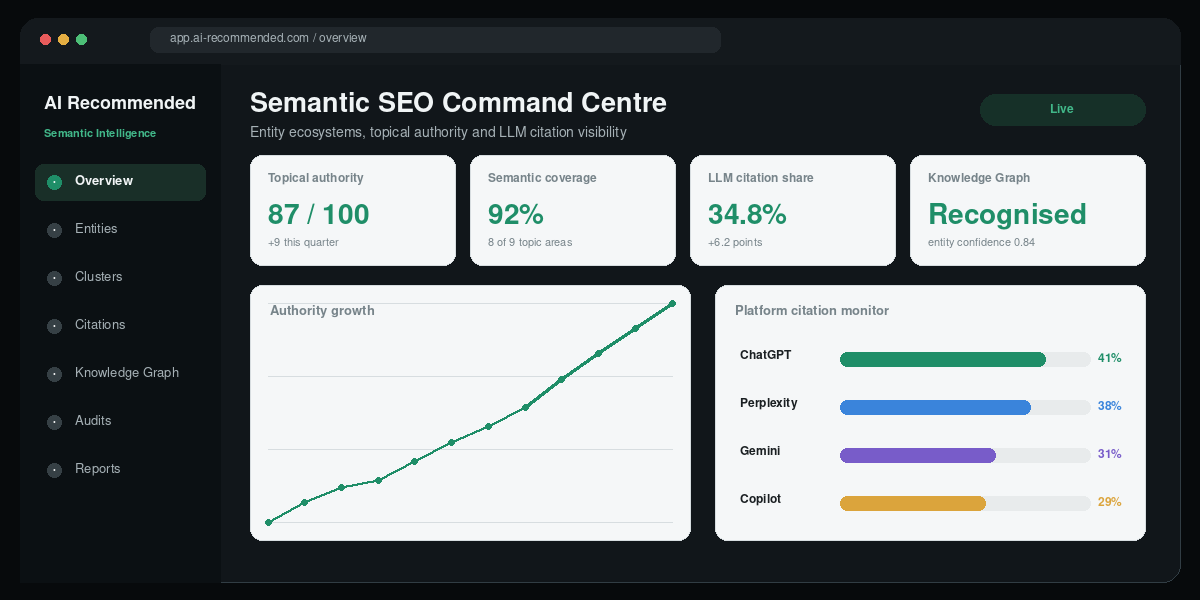
What Do the Semantic SEO and LLM Visibility Numbers Show?
Semantic SEO becomes commercially important as generative systems resolve more research inside the answer surface. A brand that is missing from the semantic knowledge graph can be absent while the buyer is forming an opinion, even when that brand still has pages ranking for isolated keywords.
How Is Semantic SEO Different From Keyword SEO?
Direct answer: Semantic SEO optimizes content for meaning, entity relationships, and topical authority. Embeddings represent semantic relationships in vector space, which helps explain why contextual similarity matters more than raw repetition rather than isolated keyword frequency. Keyword SEO typically treats the individual page as the optimisation unit. Semantic SEO treats the pillar-and-cluster ecosystem as the unit AI systems evaluate when deciding whether a brand owns a concept space.
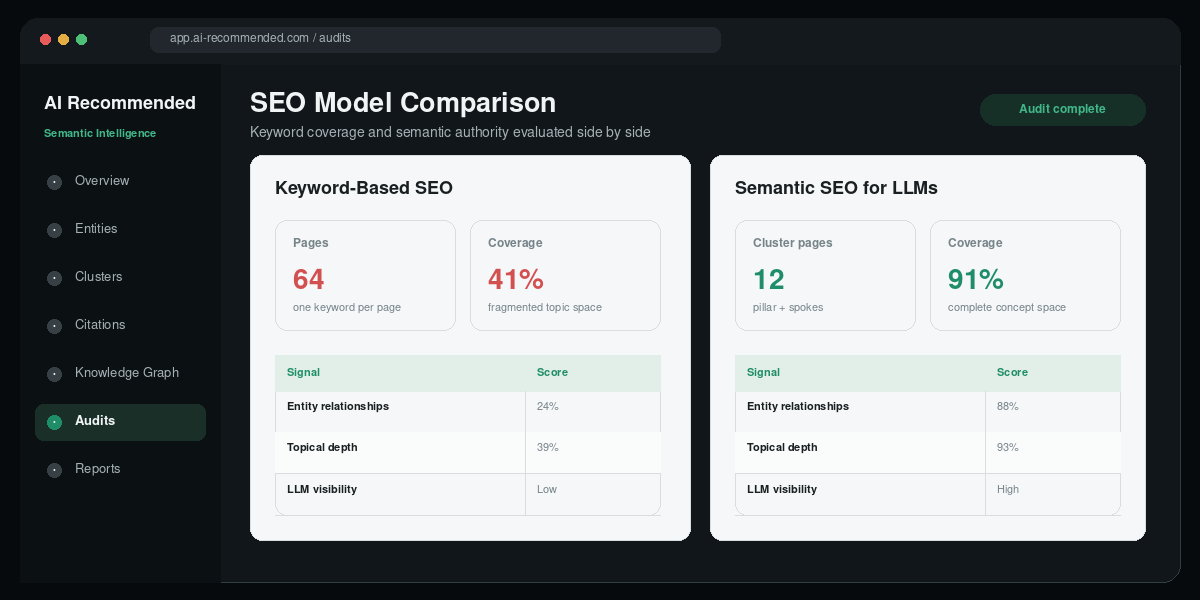
| Dimension | Keyword SEO | Semantic SEO for LLMs |
|---|---|---|
| Optimization unit | Individual page targeting one primary query | Pillar plus interconnected spokes covering the full topic space |
| Success signal | Ranking position for a keyword | Topical authority across a complete concept network |
| LLM citation impact | Limited because keyword frequency is not an LLM selection mechanism | Direct because entity placement influences which semantic neighbourhood activates |
| Effect of more content | Additional rankings with diminishing returns and possible cannibalisation | Deeper authority when every page fills a distinct conceptual gap |
| Value over time | Can decline as isolated pages age or algorithms change | Compounds as cluster depth, links, and entity associations grow |
This cluster belongs to the LLM Optimization pillar. For a dedicated comparison, read Entity-Based SEO vs Keyword-Based SEO.
What Is the Entity Chain Behind AI Citation?
Direct answer: The entity chain describes how semantic signals move from brand establishment into Knowledge Graph and retrieval systems, then into LLM knowledge and finally into AI citation. Building entity clarity at the first stage is the prerequisite for reliable selection at the final stage.
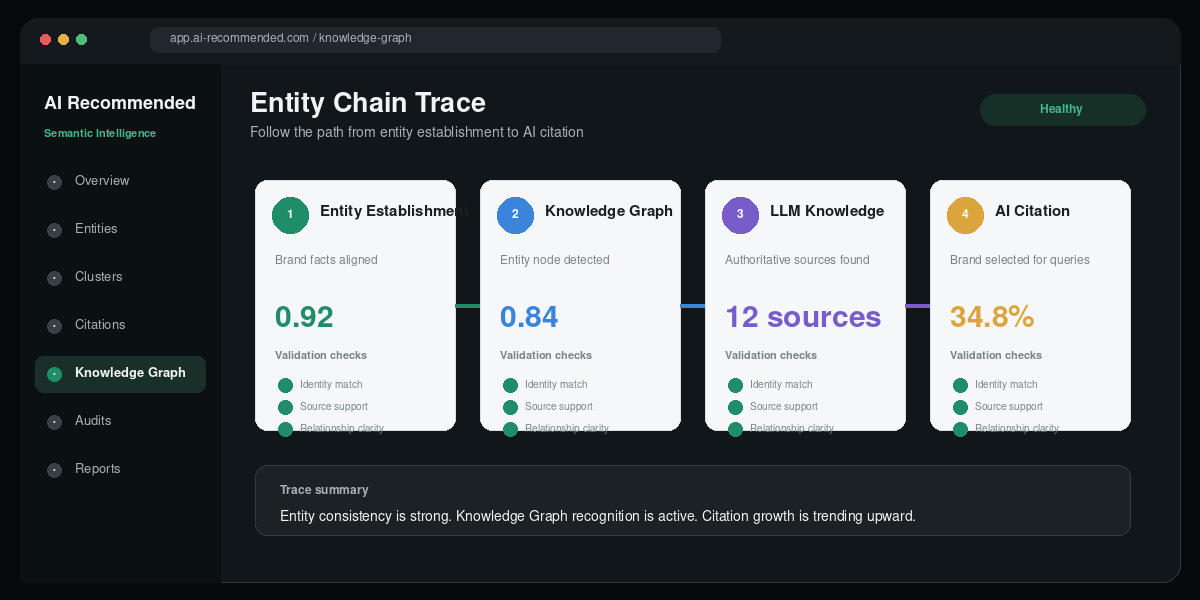
| Chain Step | What It Requires | How to Build It |
|---|---|---|
| 1. Entity establishment | The brand is described consistently through a distinct named entity and verifiable relationships. | Align brand name, category, founding facts, description, and sameAs references across the website and recognised platforms. |
| 2. Knowledge Graph inclusion | Search systems recognise the brand as an entity node connected to categories, people, products, and places. | Use Organization structured data, authoritative mentions, consistent external profiles, and strong entity salience on priority pages. |
| 3. LLM knowledge | High-authority sources describe the brand accurately enough to enter training corpora or retrieval indexes. | Earn editorial coverage in publications AI systems repeatedly cite and maintain consistent descriptions across independent sources. |
| 4. AI citation | The model confidently names and describes the brand for relevant buyer questions. | Measure monthly recommendation rate and correct weak categories, source gaps, and inaccurate associations. |
What Is an Entity Ecosystem and How Do You Map One?
An entity ecosystem follows the network of concepts, platforms, competitors, metrics, and audiences associated with a brand. Strong ecosystems are concentrated and specific. Weak ecosystems rely on generic statements such as “we help businesses with AI,” which produce diffuse, low-confidence associations.
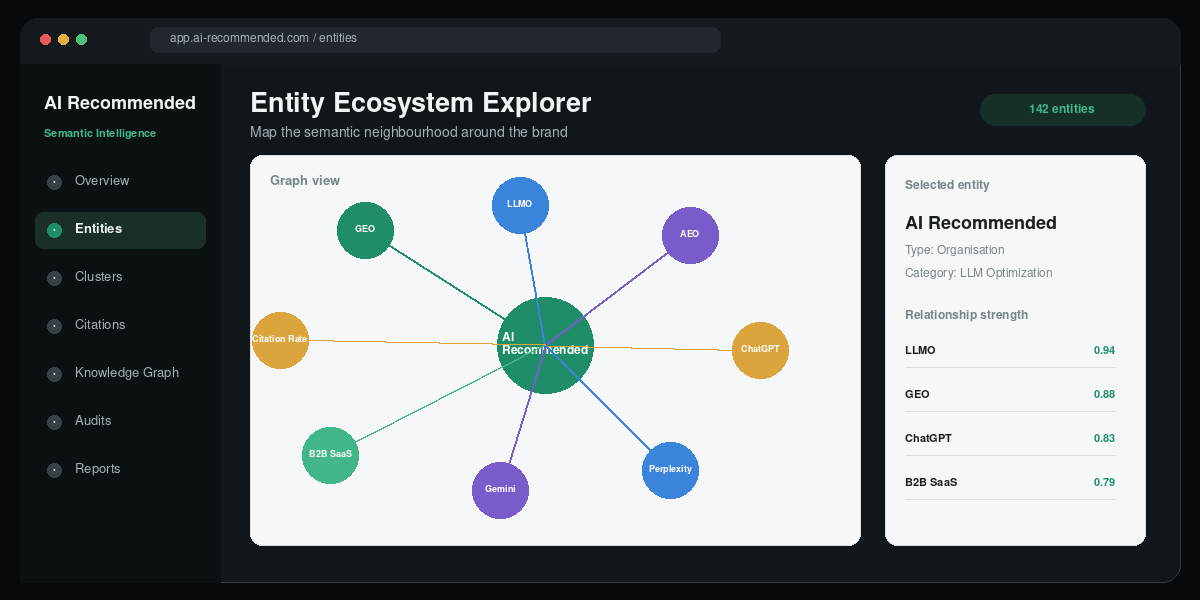
| Entity Type | Examples for an LLMO Brand | How to Build the Association |
|---|---|---|
| Category entities | GEO, LLMO, AEO, AI SEO, generative engine optimization | Name the category explicitly in content, schema, profiles, case studies, and third-party coverage. |
| Platform entities | ChatGPT, Perplexity, Gemini, Google AI Overviews, Copilot | Publish platform-specific guidance and cite platform-specific evidence and use cases. |
| Competitor entities | Named alternatives and adjacent providers in the category | Create factual comparison pages that name both the brand and relevant competitors. |
| Metric entities | Citation rate, recommendation rate, brand mention share, AI Overview inclusion | Use the category’s precise measurement language consistently across content and reporting. |
| Audience entities | B2B SaaS marketing directors, growth-stage brands, enterprise content teams | Name the audience and its constraints explicitly in headings, examples, offers, and case studies. |
Entity and relationship implementation is covered in How to Use Entities and Relationships in LLM SEO.
Why Does Cluster Architecture Matter to LLMs?
Direct answer: A topic cluster is a machine-readable map of how comprehensively a site covers a concept space. A strong LLM cluster uses one pillar and distinct supporting subtopics, with bidirectional entity-named links and no orphaned content.
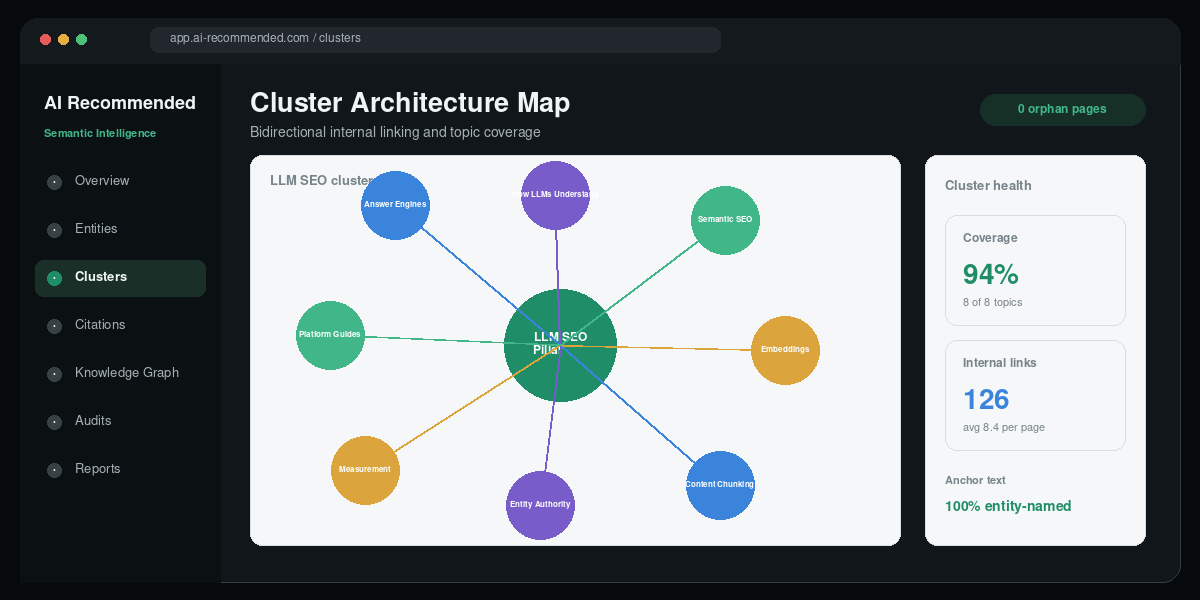
The practical cluster-building workflow is explained in How to Build Topical Authority for LLM SEO.
What Are the Three Rules of LLM-Effective Cluster Architecture?
Link every cluster page back to the pillar
Use descriptive, crawlable internal-link anchor text rather than generic phrases. A link labelled “LLM SEO” states a semantic relationship; “learn more” does not.
Remove orphaned pages
Every cluster page should link to the pillar and at least two adjacent pages. Orphaned content fragments topical authority instead of concentrating it. Google’s sitemap guidance also notes that important pages should remain reachable through site navigation or links.
Use breadth to prove authority and depth to earn citation
Cluster breadth covers definitions, comparisons, mechanisms, platforms, use cases, and measurement. Page depth adds original evidence, named entities, and expert interpretation.
For the internal-linking layer, read Semantic Internal Linking for LLM-Friendly Websites.
For the model-processing and retrieval layers, continue with How Large Language Models Understand Content and Embeddings and Vector Search Optimization.
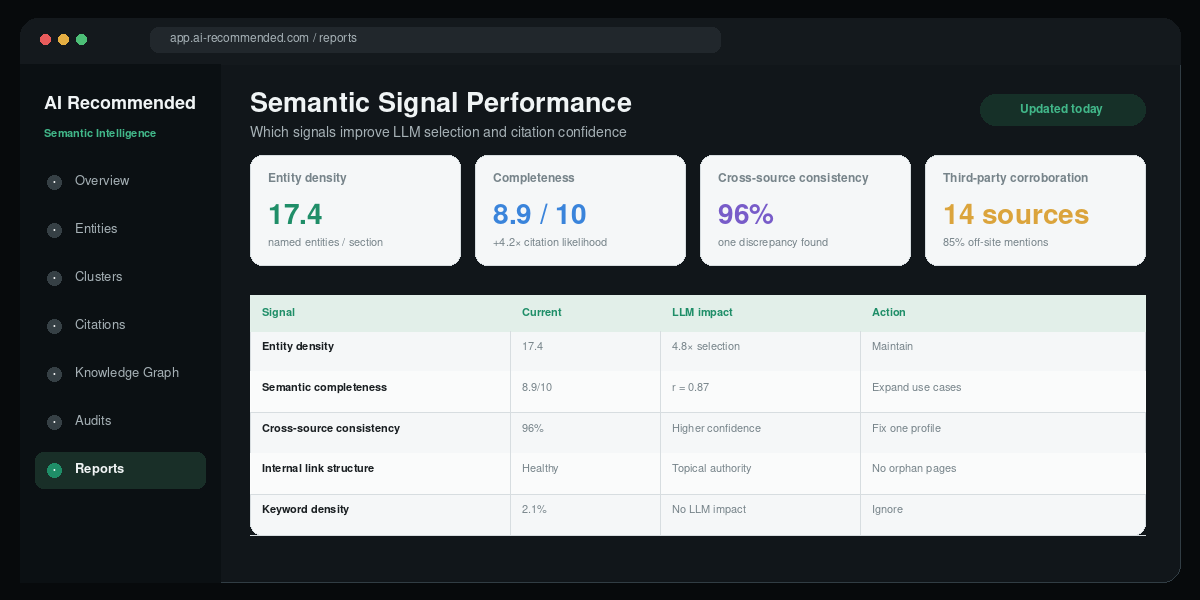
Which Semantic Signals Do LLMs Reward?
| Signal | LLM Impact | How to Build It |
|---|---|---|
| Entity density per section | Sections with 15 or more named entities showed 4.8× higher AI selection probability in the cited analysis. | Name specific brands, platforms, tools, researchers, organisations, metrics, and audiences rather than generic labels. |
| Semantic completeness | High completeness scores correlate strongly with AI Overview citation and deeper retrieval relevance. | Cover definition, mechanism, platform differences, use cases, measurement, limitations, and FAQ questions. |
| Cross-source consistency | Consistent entity facts reduce model disambiguation errors and strengthen citation confidence. | Use the same brand name, category, founding facts, and description across owned and trusted external sources. |
| Third-party corroboration | A large share of brand mentions inside AI answers comes from independent sources rather than the brand’s own domain. | Earn topically relevant editorial mentions, reviews, analyst references, community discussion, and expert commentary. |
| Internal cluster structure | The linked content ecosystem supports semantic authority and answer-engine visibility. | Use pillar-to-spoke and spoke-to-pillar links, descriptive anchors, adjacent-page links, and zero orphan pages. |
| Keyword density | No direct LLM-selection impact because models do not use keyword counting as the core semantic mechanism. | Prioritise entity co-occurrence, contextual completeness, and concept relationships instead. |
A deeper treatment is available in Semantic Coverage vs Keyword Coverage.
Semantic SEO for LLMs Audit Checklist
| Area | What to Audit | Pass Condition |
|---|---|---|
| Entity chain | The brand has a recognised entity record or consistent entity footprint with correct category and sameAs relationships. | Brand searches return a stable entity result and recognised sources describe the brand consistently. |
| Entity consistency | Brand name, category, founding facts, and description match across website, LinkedIn, directories, and editorial coverage. | No meaningful discrepancy across the primary five sources. |
| Entity ecosystem | Category, platform, competitor, metric, and audience entities are mapped. | Every target entity has an owned-content and third-party association plan. |
| Cluster architecture | Pillar links to all cluster pages, every cluster page links back, and adjacent pages are interconnected. | No orphaned pages and every link uses descriptive anchor text. |
| Cluster breadth | The cluster covers 8–12 distinct subtopics across awareness, evaluation, and decision-stage questions. | Fewer than two significant concept gaps remain. |
| Entity density | Each important H2 includes multiple specific named entities and category relationships. | Priority pages show clear primary entities and strong semantic salience. |
| Third-party corroboration | Independent publications, reviews, communities, and experts describe the brand in the target category. | At least three credible independent sources create consistent category associations. |
How Do You Build Semantic Depth Step by Step?
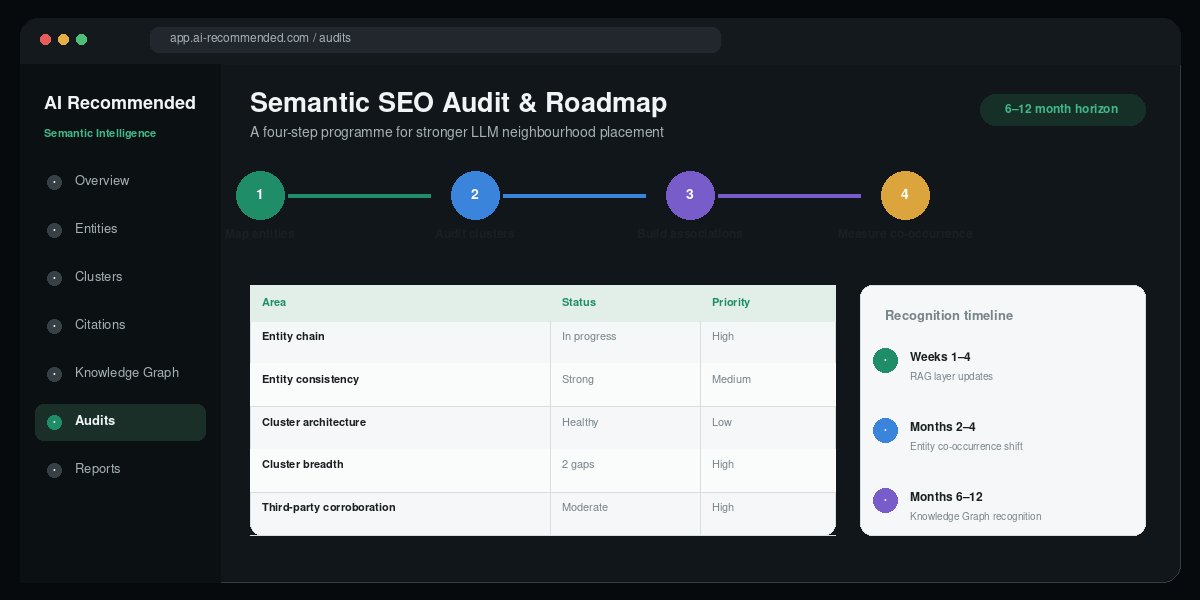
Map the entity ecosystem
Document category, platform, competitor, metric, and audience entities. Rate each relationship as strong, moderate, or absent. The absent list becomes the first content and earned-media brief.
Audit cluster architecture
Map which pages exist, which link from the pillar, which link back, which are orphaned, and which subtopics are missing. Every structural gap limits the authority the model can infer.
Build associations through content and earned media
Create owned pages that name the target entities explicitly alongside the brand, then pursue independent coverage in publications where those entities already have authority.
Measure entity co-occurrence in LLM answers
Run a fixed monthly prompt set using an AI-search measurement framework across ChatGPT, Perplexity, and Gemini. Record category descriptions, competitor pairings, audience recommendations, citations, and month-over-month shifts.
How Should Semantic SEO Progress Be Measured?
Frequently Asked Questions
What is semantic SEO in LLM terms?
Why does the entity chain matter?
How many cluster pages are needed for topical authority?
How long does semantic SEO take to affect AI citations?
Does keyword density help LLM SEO?
What is the fastest way to find semantic gaps?
Key Takeaways
- Semantic SEO builds meaning, context, and entity relationships rather than relying on isolated keyword frequency.
- The entity chain runs from establishment to Knowledge Graph inclusion, LLM knowledge, and AI citation.
- A useful entity ecosystem maps category, platform, competitor, metric, and audience entities.
- Strong topical authority normally requires one pillar and 8–12 distinct spokes with bidirectional links.
- Cluster breadth proves authority; original depth and evidence earn the citation.
- Entity density, semantic completeness, source consistency, corroboration, and internal linking matter more than keyword density.
- Measure recommendation rate, entity co-occurrence, cluster coverage, source mix, and description accuracy separately by platform.

About the Author
Marcus Hibbert is the founder of AI Recommended, a leading Generative Engine Optimisation (GEO) agency helping UK B2B technology companies become the trusted recommendation across ChatGPT, Google AI Mode, AI Overviews, Gemini, Claude, Perplexity and Microsoft Copilot whenever decision-makers search for products, services and solutions.
Connect with Marcus on LinkedIn.
Request an LLMO Audit
Discover how AI platforms describe, cite and recommend your brand across the prompts your ideal buyers use—and uncover opportunities to become AI's trusted recommendation.
By submitting this form, you’re requesting a Large Language Model Optimization (LLMO) audit for your brand.

.png)