.svg)
.svg)

How Large Language Models Understand Content
A practical guide for LLM SEO — tokenization, embeddings, self-attention, parametric memory, context windows, and what content teams must know to write for machines that process information differently from humans.
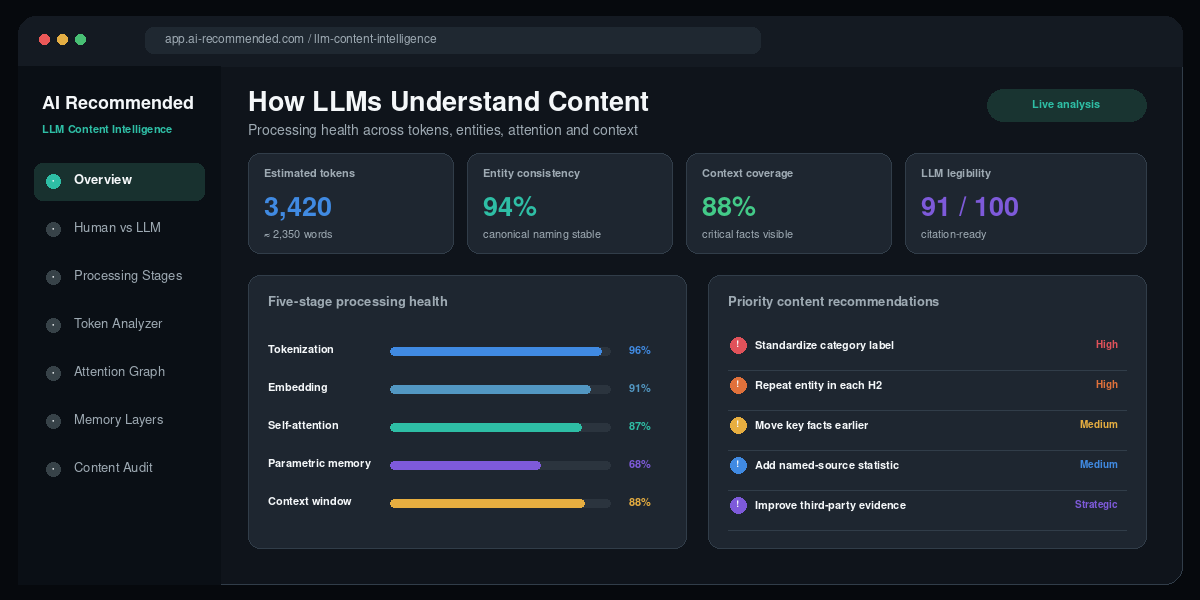
Most content teams write for humans who read linearly, while LLM SEO requires content that remains clear when processed and retrieved in parts. Large language models process content through a different neural retrieval mechanism: text becomes tokens, tokens become vectors, relationships are calculated through attention, and useful information is either encoded during training or retrieved at inference.
Every major LLMO content decision connects to a processing stage: canonical naming supports tokenization, consistent category language supports semantic understanding, explicit entity co-occurrence supports attention, authoritative third-party coverage supports parametric memory, and early-page facts improve context-window visibility.
This cluster supports the AI Search Engine Optimization pillar. For related implementation, read Content Chunking for LLM SEO.
How Do LLMs Read Content Differently From Humans?
Direct answer: LLMs do not interpret content through exact words alone. They divide text into tokens and process relationships through embeddings and attention operations.
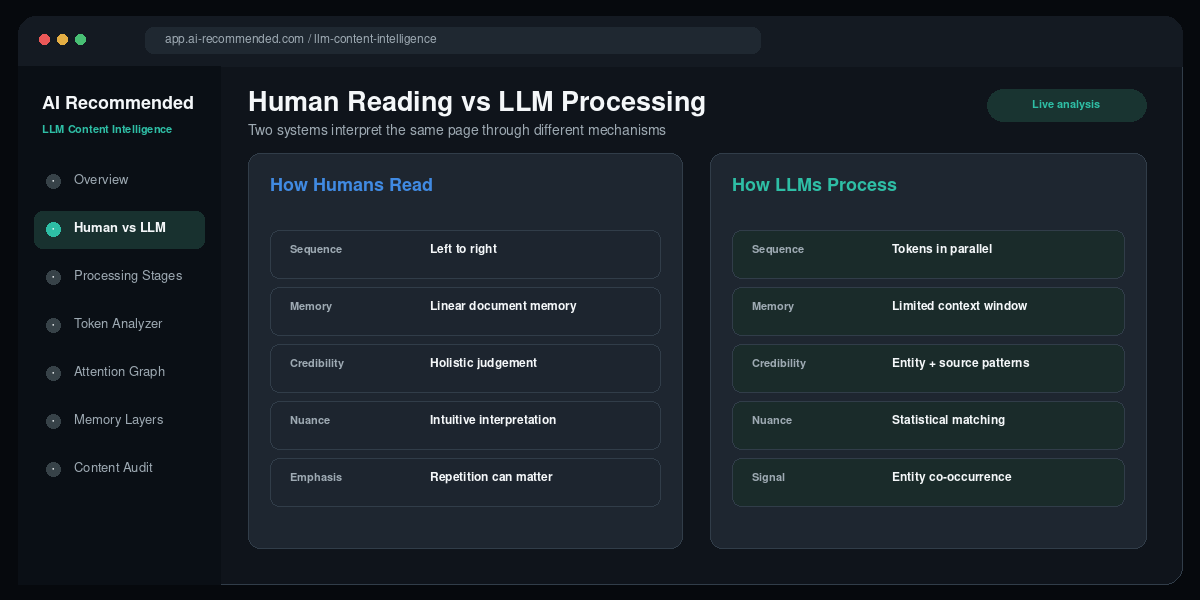
| How Humans Read | How LLMs Process Content |
|---|---|
| Read from left to right and infer meaning sequentially. | Process token relationships in parallel through self-attention. |
| Can follow a long document using memory and accumulated context. | Can only use information available inside the active context window. |
| Evaluate credibility holistically using judgement and prior experience. | Infer credibility from source patterns, entity associations, corroboration, and learned relationships. |
| Understand nuance, metaphor, and implication intuitively. | Estimate nuance through statistical patterns learned from large training corpora. |
| May interpret repetition as emphasis. | Do not treat raw keyword density as a direct signal; meaning and contextual co-occurrence matter more. |
What Are the Key LLM Content-Processing Principles?
These figures help content teams translate traditional page length and structure into the units and constraints that language models actually process.
What Are the Five LLM Content-Processing Stages?
Large language models move content through connected retrieval and processing stages. Each stage creates a different requirement for brand naming, category alignment, section structure, source authority, and fact placement.
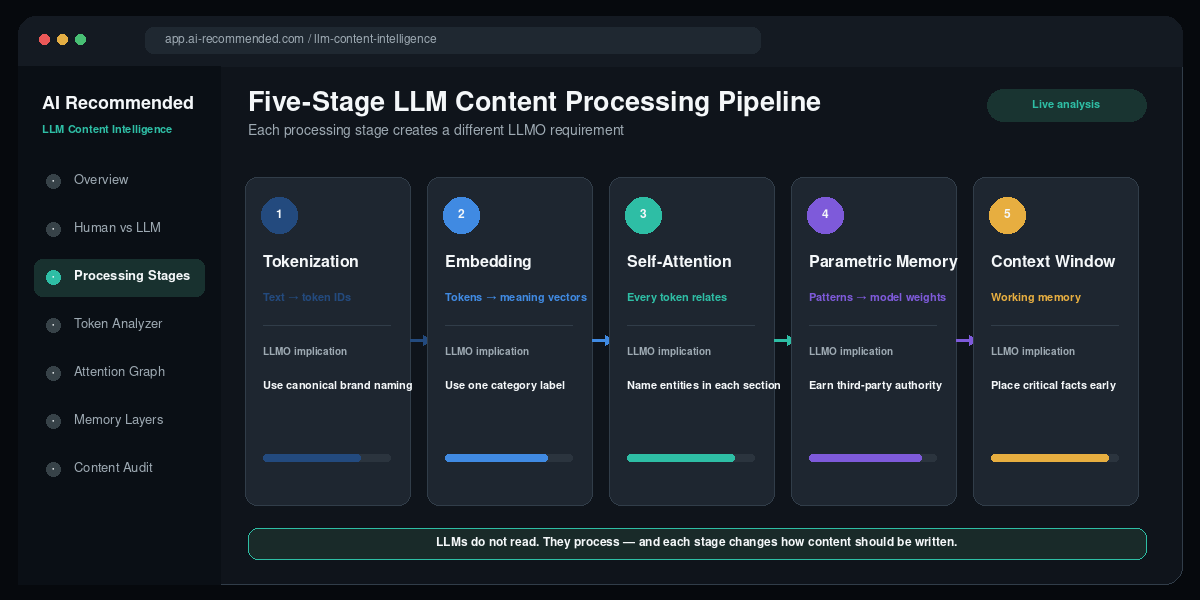
| Processing Stage | What Happens | LLMO Implication |
|---|---|---|
| 1. Tokenization | Text is divided into subword units and converted into token IDs. | Use the exact canonical brand name consistently across pages, profiles, and third-party coverage. |
| 2. Embedding | Token IDs are converted into numerical vector representations of meaning. | Use one consistent category label and semantic position. |
| 3. Self-attention | Every token can form a weighted relationship with every other relevant token in the input. | Name the brand alongside its category, platform, audience, and proof inside every important section. |
| 4. Parametric memory | Patterns discovered during training become encoded inside the model’s internal weights. | Prioritise authoritative distribution and consistent independent descriptions. |
| 5. Context window | At inference, the model can only use the tokens placed inside its current working context. | Place critical brand facts and category relationships inside the opening sections of the page. |
What Are Tokens and Why Do Context Windows Matter?
Direct answer: A token is a numerical subword unit used by an LLM to process text. OpenAI’s official tokenizer shows how text is split into tokens. A context window is the maximum number of tokens the model can consider simultaneously while generating a response.
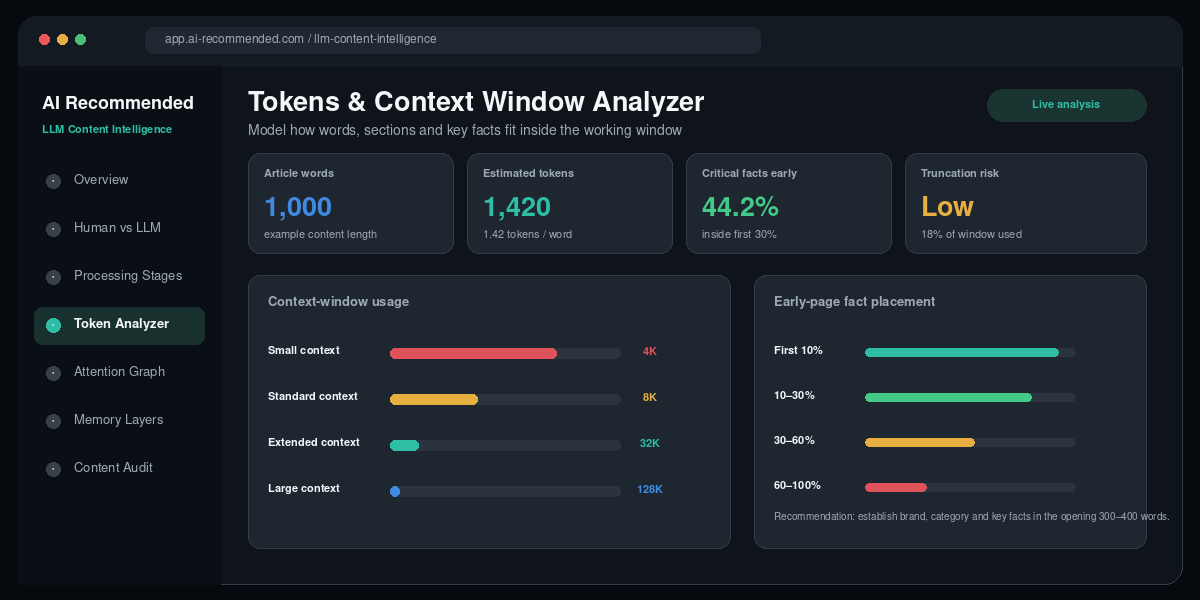
A larger context window does not remove the need for strong information architecture. Retrieval systems may still select only a small number of passages, and later-page facts may never enter the active context.
How Does Self-Attention Identify Meaning and Entity Relationships?
Direct answer: Self-attention assigns different weights to relationships between tokens. This allows the model to connect a brand name with its category, audience, platform, evidence, and outcome even when those terms appear in different parts of the same input.
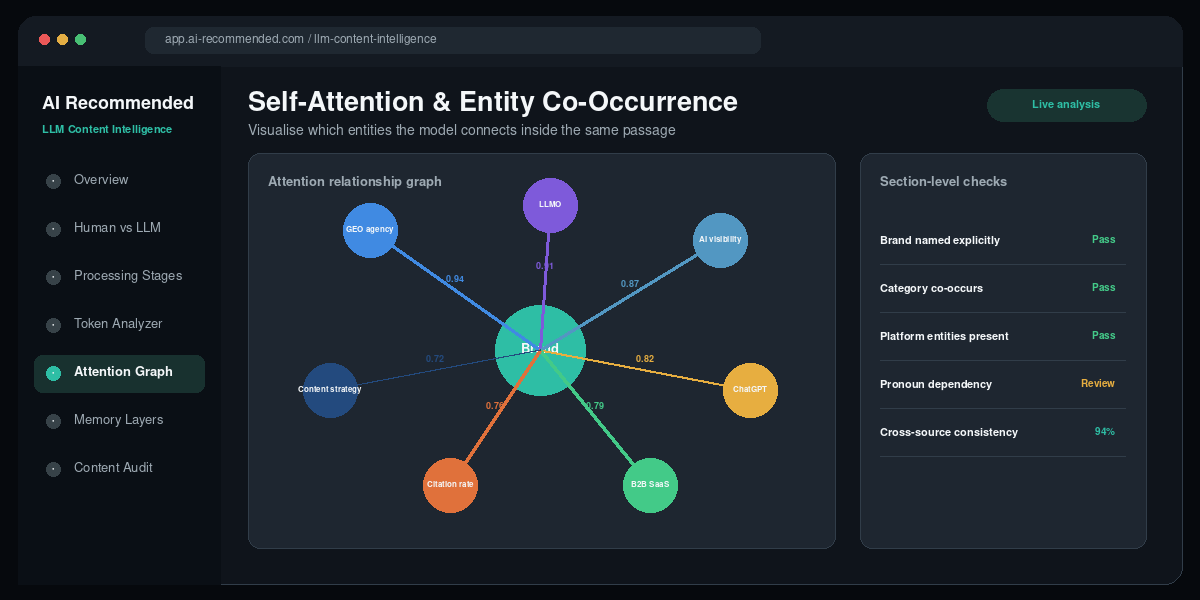
Name the entity instead of relying on pronouns
“AI Recommended provides LLM Optimization services” creates an explicit entity-category relationship. “We provide these services” depends on missing context when the section is retrieved independently.
Repeat relationships, not isolated keywords
The useful signal is not the frequency of one phrase. It is the repeated contextual relationship between the brand, the category, the audience, platforms, evidence, and outcomes.
Make every important section independently clear
A retrieved passage should explicitly identify its main entities and relationships without depending on the article introduction or an earlier heading.
Keyword density counts repetition. Self-attention evaluates relationships. For LLM SEO, the relationship between named entities is more meaningful than the number of times one keyword appears.
LLM content-processing principleWhat Is Parametric Memory and How Is It Different From RAG?
Parametric memory is knowledge encoded into model weights during training. RAG retrieval supplies live or indexed external content at query time, while agentic RAG can expand retrieval into multi-step workflows. A strong LLMO programme works across both layers.
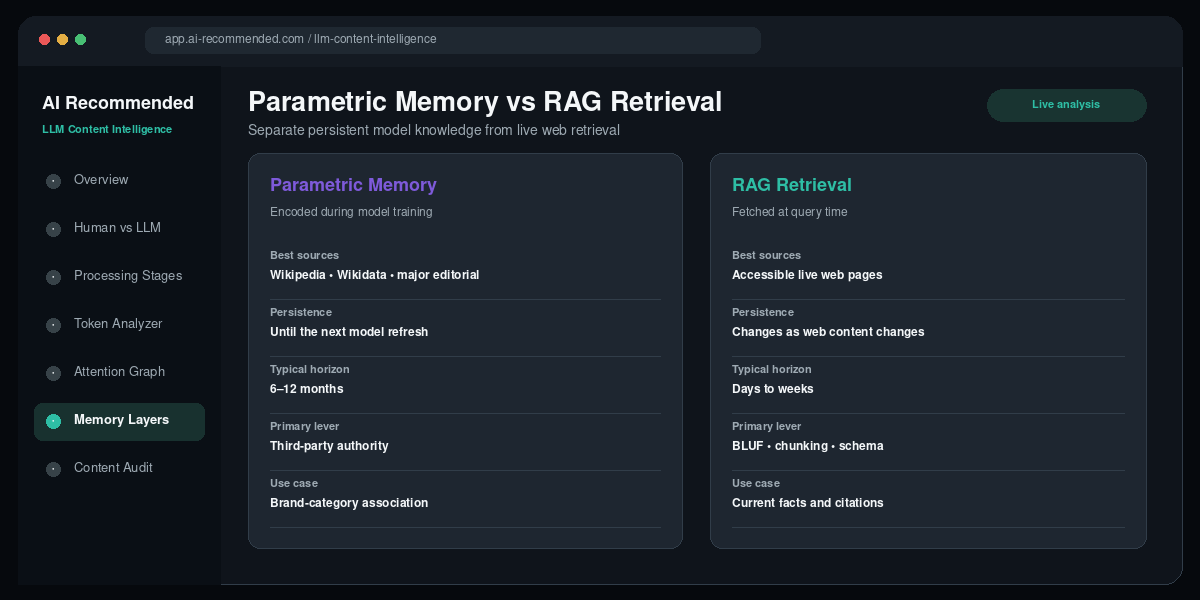
| Dimension | Parametric Memory | RAG Retrieval |
|---|---|---|
| When knowledge enters | During pre-training, continued training, or a later model update. | At query time through live or recently indexed external sources. |
| How long it persists | Persists until the model is retrained or replaced. | Changes as the source page, index, or retrieval results change. |
| Strongest content sources | Widely distributed, authoritative, corroborated, and frequently indexed sources. | Accessible, relevant, well-structured, current web pages and indexed documents. |
| Primary optimisation lever | Entity consistency and credible third-party publication. | Crawler access, BLUF answers, chunking, semantic alignment, and factual density. |
| Typical use | Foundational brand knowledge and category associations. | Current facts, updated services, evidence, prices, events, and citations. |
What Content Properties Can LLMs Actually Evaluate?
LLMs are strong at recognising explicit entities, category relationships, factual patterns, source associations, and structural clarity. They do not use every traditional SEO signal in the same way a search-ranking system does.
| Content Property | Can an LLM Evaluate It? | Practical LLMO Implication |
|---|---|---|
| Entity clarity | Yes — strongly | Name the brand, person, platform, product, and category explicitly instead of relying on “we” or “the company”. |
| Category association | Yes — strongly | Use one canonical category term alongside the brand across owned and independent sources. |
| Factual specificity | Yes — with verification signals | Place the specific figure, named source, year, and measurement context inside one sentence. |
| Keyword density | Not as a direct selection signal | Replace repetition with semantic relationships and topical completeness. |
| Source reputation | Indirectly through learned and retrieval patterns | Earn mentions in sources that models and retrieval systems repeatedly treat as authoritative. |
| Writing elegance | Indirectly through clarity and predictability | Prefer clear expository structure over complex syntax that hides the main claim or entity relationship. |
What Are the Three LLM Training and Usage Stages?
Pre-training, fine-tuning, and inference shape different parts of the model’s behaviour. LLMO tactics should be connected to the stage they can realistically influence.
| Stage | What It Does | LLMO Lever |
|---|---|---|
| Pre-training | Learns general language, concepts, entities, facts, and next-token relationships from massive text corpora. | Build authoritative independent coverage and consistent entity information. |
| Fine-tuning | Adapts the model for instruction-following, conversation, safety, domain behaviour, or task-specific formats. | Use predictable answer formats such as Q&A blocks, BLUF openings, definitions, structured lists, and clear procedures. |
| Inference and RAG | Processes the current query using parametric knowledge and, where available, retrieved external context. | Improve crawler access, semantic alignment, chunk structure, entities, evidence, and freshness. |
Which Five Content Decisions Follow From How LLMs Process Text?
These decisions translate technical processing mechanics into practical content rules that writers, editors, SEO teams, PR teams, and website managers can apply.
Name entities explicitly inside every major section
Include the brand name, canonical category, platform, audience, and relevant concepts wherever the relationship matters. Do not expect the model to recover a missing entity from a distant introduction.
Use one consistent topic and category label across all sources
A brand described as a GEO agency on one platform, an AI SEO company on another, and an LLMO consultancy elsewhere creates competing semantic positions. Select one primary label and apply it consistently.
Place the most important facts inside the first 30%
Open with the brand identity, category, audience, location or scope, core differentiator, and strongest evidence. Do not hide defining facts near the end of the page.
Prioritise credible third-party authority and human review
Ten similar posts on the same company blog do not create the same independent corroboration as a clear brand description inside one credible publication that models repeatedly encounter.
Write in a predictable expository structure
Use a direct answer first, followed by mechanism, evidence, examples, limitations, and actions. Avoid unnatural LLM-first rewriting, dense introductions, ambiguous pronouns, and complex sentence structures that hide the main relationship.
LLM Content-Processing Checklist
Use this checklist across the homepage, About page, service pages, author pages, priority articles, major profiles, and editorial placements.
| Processing Stage | What to Check | Pass Condition |
|---|---|---|
| Tokenization | Canonical brand name is written identically across the website and external profiles. | No unnecessary spelling, spacing, punctuation, or abbreviation variations. |
| Embedding | The same primary category terminology describes the brand across all important sources. | One canonical category label appears consistently across at least five major touchpoints. |
| Self-attention | Brand and category entities appear together inside every important H2 section. | No section relies only on pronouns or references such as “as mentioned earlier”. |
| Parametric memory | Independent sources accurately describe the brand, category, founding information, and relationships. | Multiple credible external sources use the same entity facts and category description. |
| Context window | Critical identity, category, audience, and value information appears near the beginning. | The first 300–400 words establish what the business is and why it matters. |
| Factual specificity | Every key statistic includes a number, named source, year, and explanation of what was measured. | No vague phrases such as “research shows” or “studies indicate” remain in priority sections. |
What Is the Four-Step LLM Content Action Plan?
The implementation order begins with identity consistency, then aligns the brand’s category, rewrites priority content for LLM legibility, and finally expands third-party authority.
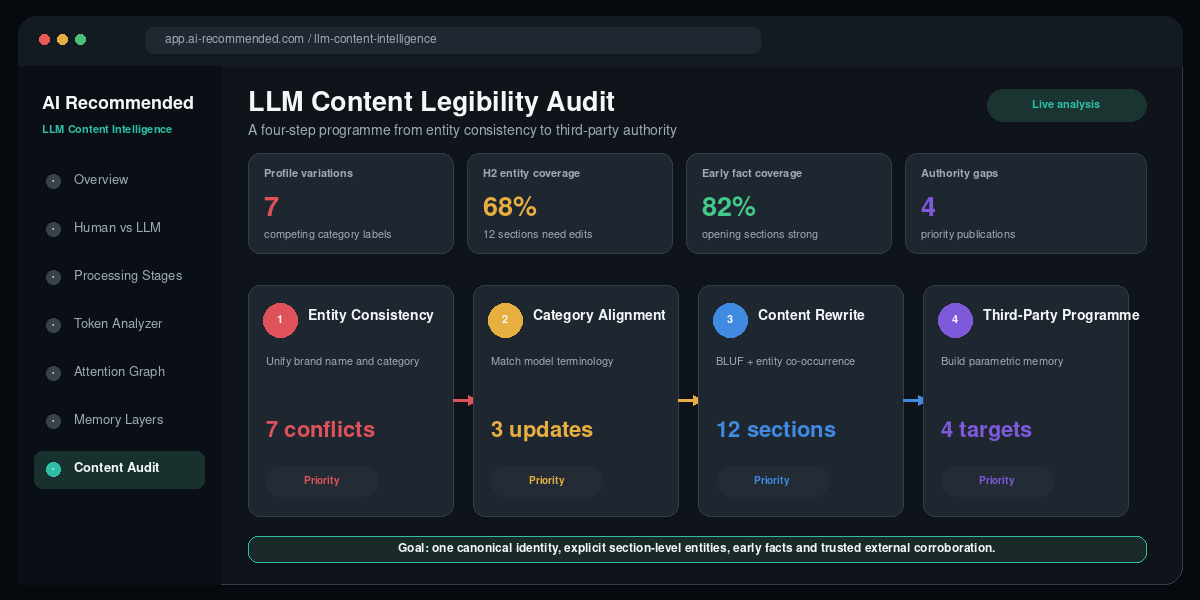
Run an entity-consistency audit
Search the brand across the website, LinkedIn, directories, review platforms, knowledge sources, company databases, and editorial coverage. Record every variation in brand name, category, description, founding information, and location.
Review category alignment
Ask ChatGPT, Perplexity, and Gemini to categorise or describe the business. Compare the terminology they use with the terminology on owned and third-party profiles, then resolve conflicting descriptions.
Rewrite priority pages for LLM legibility
Confirm the page is technically accessible and the brand and category appear in the first section, each H2 uses explicit entities, every answer opens with a 40–60 word BLUF paragraph, and every statistic contains a named source.
Build a third-party publication programme
Identify the publications repeatedly cited for target category queries. Pursue editorial placements that use the canonical brand name and category description established during the first two steps.
Frequently Asked Questions
Do LLMs read content the same way a search crawler does?
Why does keyword density not matter in the same way for LLMs?
What is parametric memory?
How does a context window affect content strategy?
Should a brand use one category term everywhere?
Can content on the company website build parametric memory?
Key Takeaways
- LLMs process tokens and mathematical relationships rather than reading pages linearly like humans.
- Tokenization rewards consistent canonical brand naming.
- Embeddings reward concentrated and consistent category terminology.
- Self-attention makes explicit entity co-occurrence more useful than raw keyword frequency.
- Parametric memory is influenced by consistent and credible information encountered during training.
- RAG retrieval supplies current, accessible, and semantically relevant passages at query time.
- Critical brand facts should appear inside the opening sections because later information may not enter the active context.
- Clear expository writing, BLUF openings, explicit entities, and named evidence improve machine legibility.

About the Author
Marcus Hibbert is the founder of AI Recommended, a leading Generative Engine Optimisation (GEO) agency helping UK B2B technology companies become the trusted recommendation across ChatGPT, Google AI Mode, AI Overviews, Gemini, Claude, Perplexity and Microsoft Copilot whenever decision-makers search for products, services and solutions.
Connect with Marcus on LinkedIn.
Request an LLMO Audit
Discover how AI platforms describe, cite and recommend your brand across the prompts your ideal buyers use—and uncover opportunities to become AI's trusted recommendation.
By submitting, you’re requesting an LLMO audit.

.png)