.svg)
.svg)

How to Optimize Content for Direct Answers
In Google, ChatGPT, and AI Search — platform-specific format requirements, a practical rewriting framework, and the freshness system that determines whether a page stays cited.
Direct answer optimization is not simply about ranking a page. It is about structuring specific passages so answer engines can extract, understand, verify, and attribute them inside Google AI Overviews, ChatGPT Search, Perplexity, and voice responses.
AEO works at the fact level. Every H2 section is a separate citation candidate, and every platform applies a different definition of what a good answer looks like.
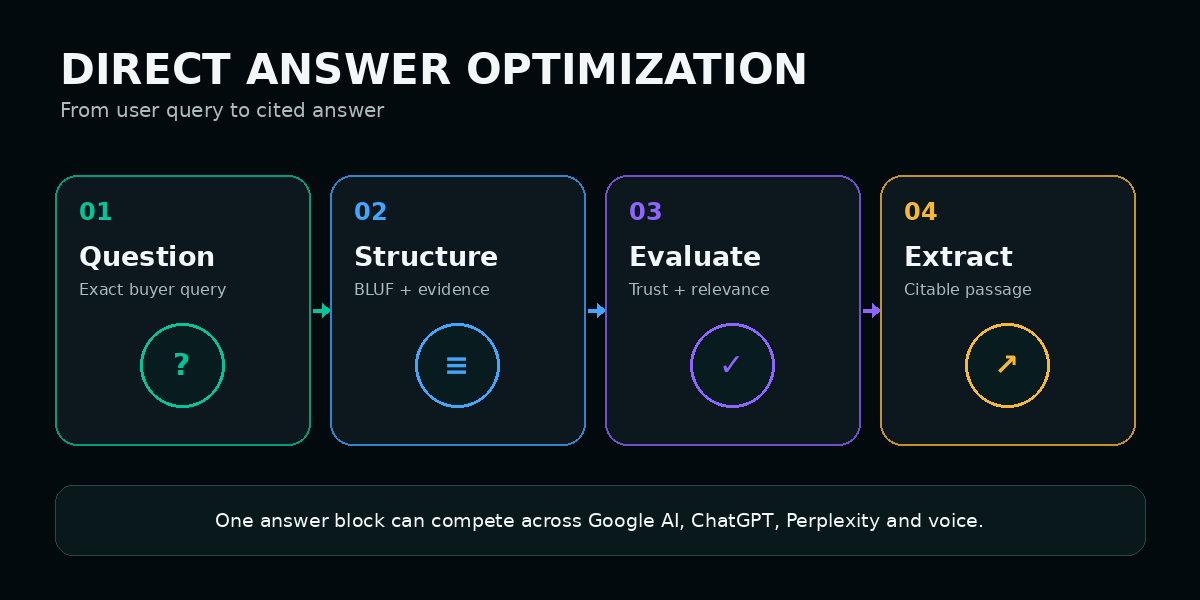
What Does Direct Answer Optimization Actually Mean?
Direct answer: Direct answer optimization, as Semrush’s AEO framework explains, is the practice of structuring content so AI-powered platforms can extract and attribute specific passages as answers to user questions. It works at the fact level rather than the page level: each H2 section must make sense independently, without relying on surrounding context.
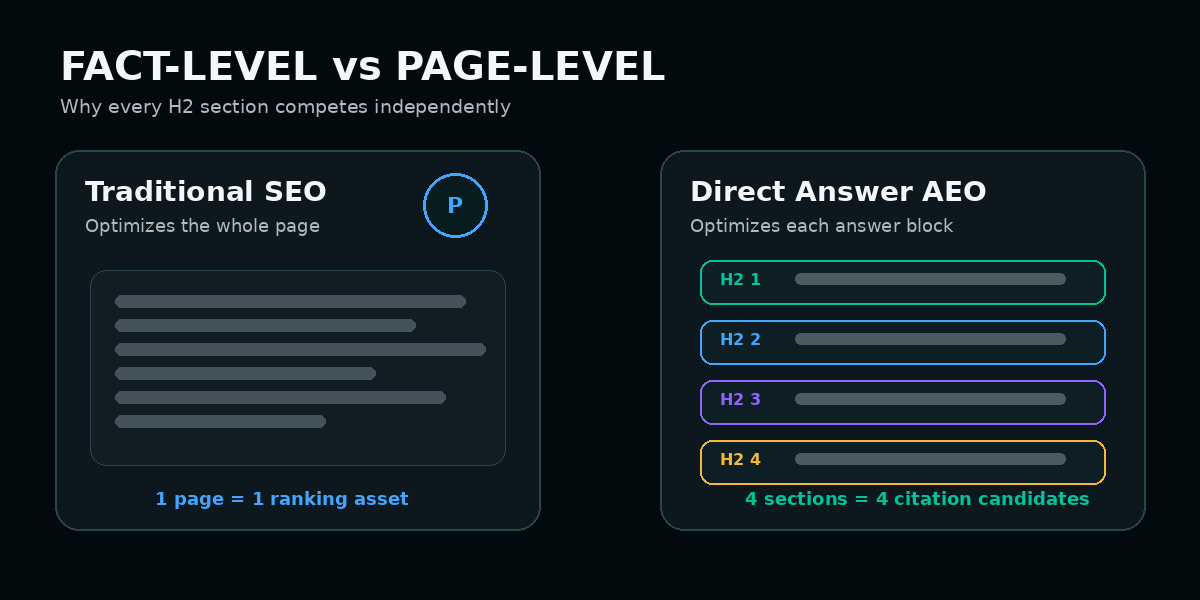
| Traditional SEO | Direct Answer Optimization |
|---|---|
| Unit: the complete page | Unit: each H2 section or answer block |
| Goal: rank in the results list | Goal: become the attributed answer inside an AI response |
| Success: position and CTR | Success: citation frequency and description accuracy |
| Property: keywords and authority | Property: self-containment, extractability, and attribution-readiness |
| Failure: wrong keyword targeting | Failure: delayed answers, vague data, and pronoun dependency |
Why Is Direct Answer Optimization Commercially Important?
Ahrefs’ 2026 AI Overview study found 38% citation overlap with Google’s organic top ten. Semrush’s technical study found that crawl and delivery foundations still shape whether content can be retrieved and cited.
AI visibility increasingly starts before a website click. The business objective is no longer only to earn the click. It is also to shape the answer that forms the buyer’s understanding, shortlist, and next question.
How Does Each Platform Define a Direct Answer Differently?
Google AI Overviews, ChatGPT Search, Perplexity, and voice assistants use different passage lengths, tones, source preferences, and rejection rules. A universal structure is useful, but priority sections still need platform-specific tuning.
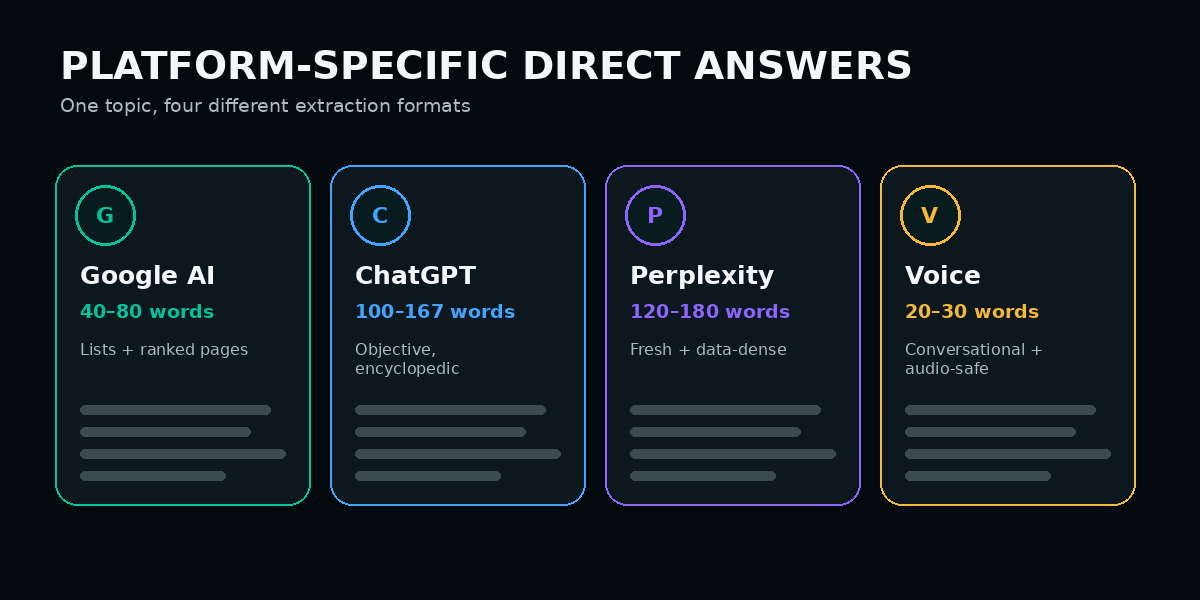
| Surface | Preferred Format | Ideal Length | What Disqualifies Content |
|---|---|---|---|
| Google AI Overviews | Concise, structured, often list-based summaries from organically eligible pages | 40–80 words per cited passage | Weak organic eligibility, missing E-E-A-T, unclear structure |
| Google AI Mode | Deeper multi-source synthesis supported by topical clusters and entity clarity | 100–200 words per section | Thin coverage and isolated pages without cluster context |
| ChatGPT Search | Objective, declarative, encyclopedic writing with explicit entities | 100–167 words | Promotional language, vague claims, weak attribution |
| Perplexity | Fresh, specific, data-dense answers with named sources | 120–180 words | Stale summaries, vague data, generic framing |
| Voice assistants | Conversational complete sentences that sound natural aloud | 20–30 words | Tables, bullets, visual dependencies, awkward phrasing |
What Are the Five Answer Formats That Earn Citations Across Platforms?
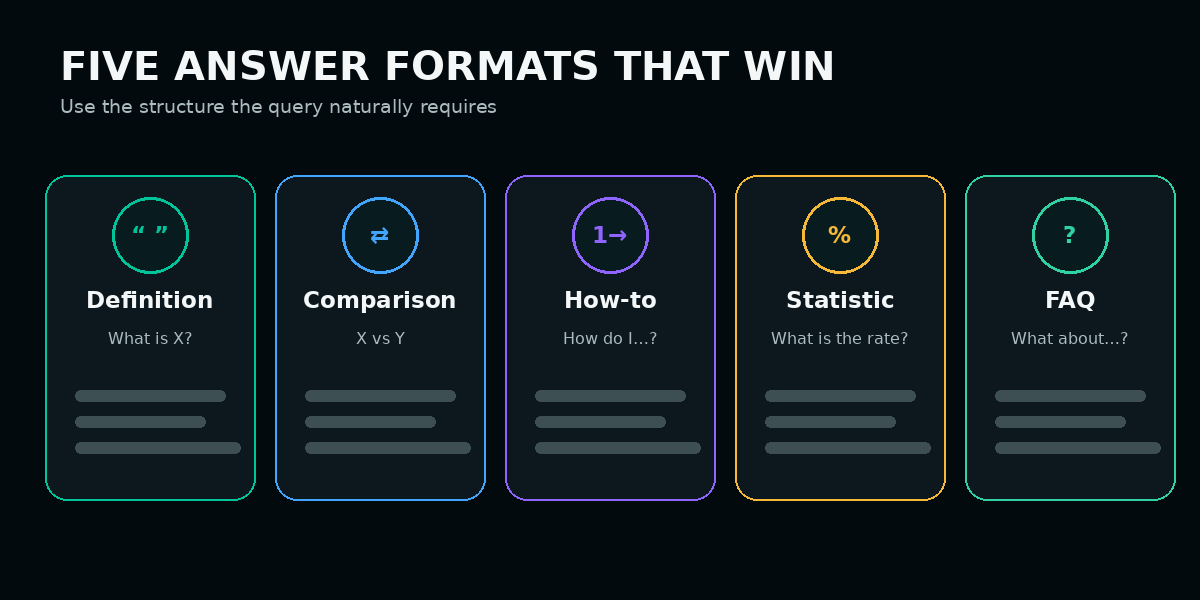
| Answer Format | What It Answers | Recommended Structure | Best Surfaces |
|---|---|---|---|
| Definitional answer | What is X? | Named entity in sentence one, one-sentence definition, then two or three supporting sentences; 40–60 words. | All platforms |
| Comparative answer | X vs Y — which is better for Z? | Comparison table plus a concise recommendation naming both options explicitly. | Google AI Mode, ChatGPT, Perplexity |
| Procedural answer | How do I do X? | Numbered steps, one or two sentences each, with step one beginning the process immediately. | Google AI Overviews, voice, all process queries |
| Statistical answer | What is the rate, size, or benchmark? | Figure + named source + year + context in one complete sentence. | All platforms |
| FAQ answer set | What are the common follow-up questions? | Visible question-led headings with 40–60 word self-contained answers and FAQPage schema. | Google, PAA, voice, ChatGPT |
This cluster sits under the Answer Engine Optimization pillar. See How to Write Direct Answer Paragraphs for AEO, How to Use Question-Based Headings for AEO, and Best Content Formats for Direct Answers.
How Do You Rewrite Existing Content for Direct Answer Eligibility?
The fastest improvements come from moving the answer forward, replacing vague claims with attributable facts, and removing language that depends on earlier sections.
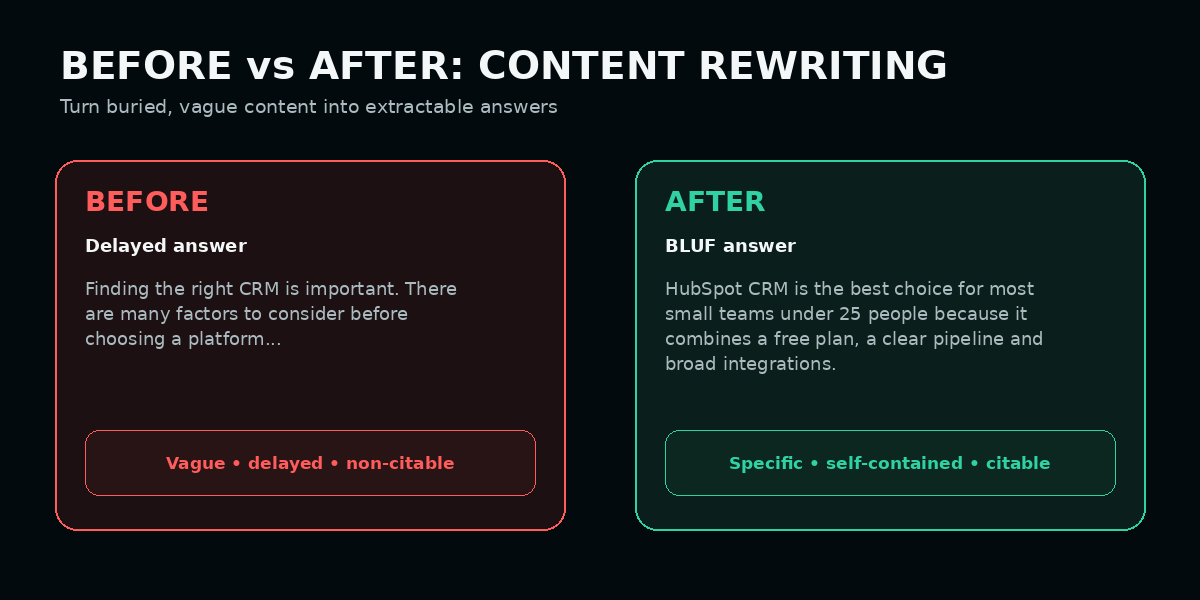
Transformation 1: Delayed answer to BLUF
Before: The paragraph introduces the topic, lists factors, and promises an answer later. After: The first sentence names the recommended option, the audience it suits, and the reasons it wins. Supporting alternatives follow after the answer.
Transformation 2: Vague statistic to self-contained evidence
Before: “Studies show AI search is changing traffic.” After: “69% of Google searches ended without a website click in 2025, according to the industry tracking data cited in CXL’s 2026 AEO analysis.” The updated version is attributable and usable in isolation.
Transformation 3: Pronoun dependency to explicit reference
Before: “This method works better because it aligns with these systems.” After: “Direct answer optimization improves citation eligibility because AI systems evaluate self-contained chunks rather than relying on the full page argument.”
For the wider selection layer, read How Answer Engines Work and Google AI Overview Optimization.
How Should Content Be Optimized for Google AI Overviews?
Direct answer: Google AI Overviews favour pages eligible through Google Search systems, then select concise passages with clear headings, list structures, named authors, strong E-E-A-T signals, and answers that usually fit within 40–80 words.
How Should Content Be Written for ChatGPT Search?
Direct answer: ChatGPT Search rewards objective, declarative, entity-rich writing that resembles an encyclopedic reference. Priority sections should name organisations, products, dates, and definitions explicitly, avoid promotional claims, and usually provide 100–167 words of complete treatment.
Write the passage so it could be copied into an answer without editing. Every named entity, claim, and relationship should remain accurate when the section is read alone.
Allow OAI-SearchBot and ChatGPT-User where appropriate, keep the content server-accessible, and use explicit references instead of phrases such as “leading platform” or “this approach.”
How Should Content Be Optimized for Perplexity?
Direct answer: Perplexity rewards freshness, specificity, named data, and alignment with the sub-queries generated during retrieval. Priority pages should follow an 8–12 week review cycle, contain explicit dates and current evidence, and answer one precise sub-query per section.
- Add a visible Last Updated date and accurate dateModified schema.
- Include named-source statistics in each key section.
- Use explicit temporal language such as “As of Q2 2026.”
- Study Perplexity retrieval and crawler access before finalising headings.
- Build authentic community visibility rather than manufacturing promotional mentions.
How Should Direct Answers Be Written for Voice Assistants?
Direct answer: Voice answers should use one short conversational sentence, normally 20–30 words, that sounds natural when spoken aloud and does not require a table, bullet list, image, or previous paragraph to make sense.
Read the answer aloud before publishing. If the wording sounds awkward, overloaded, or dependent on visual context, it is not voice-ready.
Target complete question phrasing and add Speakable schema only to content genuinely suitable for audio delivery.
What Freshness System Helps a Page Stay Cited?
A page earns a citation through relevance, structure, and current evidence, but it maintains that citation through consistent, substantive updates.
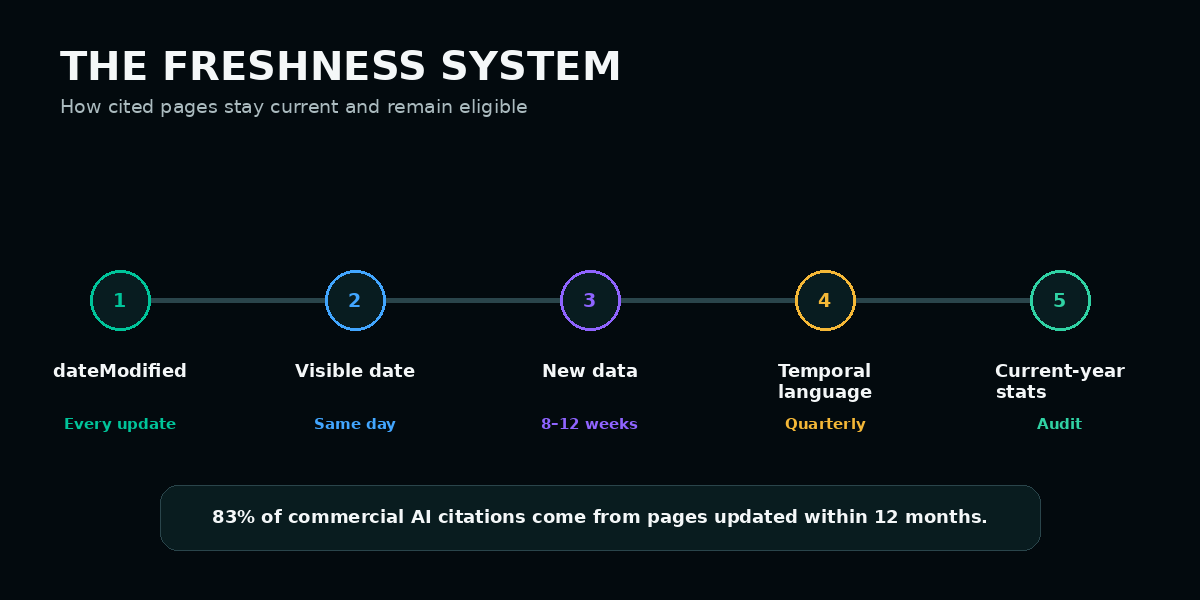
| Freshness Signal | What It Signals | Recommended Cadence |
|---|---|---|
| dateModified in Article schema | Machine-readable confirmation of a substantive update | On every meaningful change |
| Visible Last Updated date | Human-readable and crawlable recency | Same day as the content update |
| One refreshed data point | The page changed materially rather than cosmetically | Every 8–12 weeks on priority pages |
| Explicit temporal language | The passage is anchored to a known period | Whenever time-sensitive facts change |
| Current-year statistics | The page is actively maintained | Quarterly audit |
Which Content Types Win Direct Answers Across Platforms?
For the FAQ implementation layer, read How to Create FAQ Blocks for Answer Engines.
What Direct Answer Optimization Mistakes Block Citations?
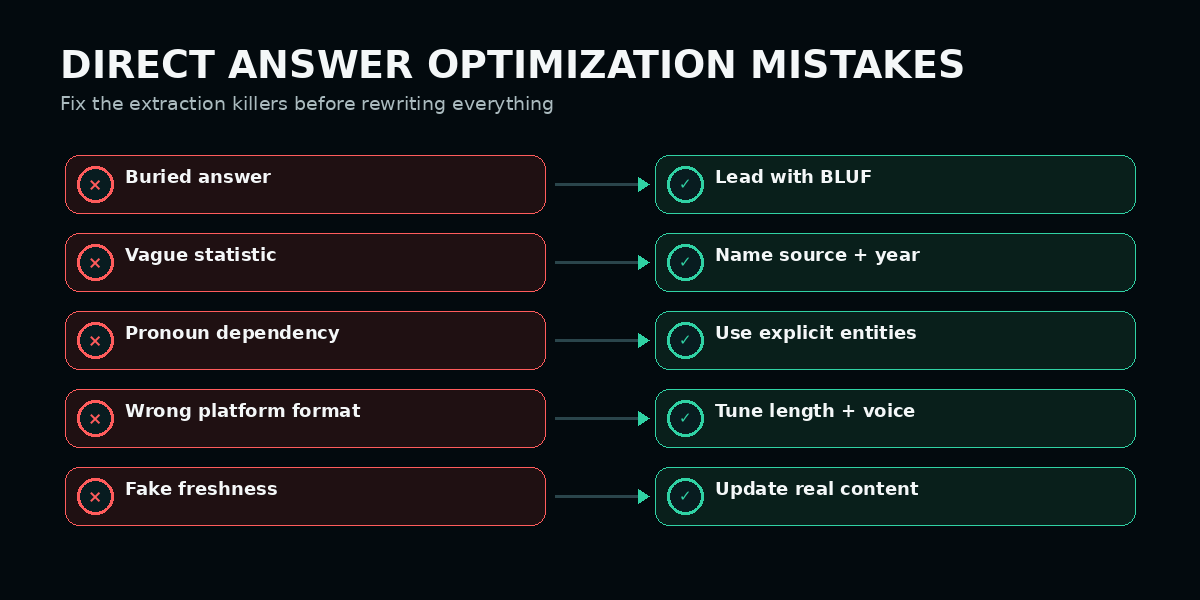
Writing for a general topic
Replace broad subject coverage with one precise question and one clearly bounded answer per section.
Using one format everywhere
Tune passage length, tone, structure, and evidence to the platform the section is designed to win.
Updating only the timestamp
A genuine refresh requires changed evidence, revised facts, or meaningful improvement—not only a new dateModified value.
Ignoring technical access
Confirm relevant crawlers receive a 200 response and can access the core content without blocked scripts or CDN rules.
Counting citations without checking accuracy
Review how the brand is described, which category it is placed in, and whether the answer reflects the correct product scope.
See Direct Answer Optimization Mistakes for the full diagnostic guide.
Direct Answer Optimization Checklist
| # | Category | What to Check | Applies To |
|---|---|---|---|
| 1 | Universal | Every H2 is phrased as the exact question it answers. | All platforms |
| 2 | Universal | Each section opens with a 40–60 word BLUF answer. | All platforms |
| 3 | Universal | No pronoun dependency or references to previous sections. | All platforms |
| 4 | Universal | Every statistic includes figure, source, year, and context. | All platforms |
| 5 | Universal | FAQPage schema is used only on genuine visible Q&A content. | All platforms |
| 6 | Page has organic eligibility and list formatting where appropriate. | AI Overviews / AI Mode | |
| 7 | Named author, author page, Person schema, and LinkedIn sameAs. | Google AI experiences | |
| 8 | ChatGPT | OAI-SearchBot and ChatGPT-User access are allowed. | ChatGPT Search |
| 9 | ChatGPT | Priority sections use objective third-person language. | ChatGPT Search |
| 10 | Perplexity | Visible date, current evidence, and 8–12 week freshness cycle. | Perplexity |
| 11 | Voice | One 20–30 word conversational answer exists for voice intent. | Voice assistants |
| 12 | Voice | Speakable schema is applied only to audio-ready passages. | Voice assistants |
What Is the Step-by-Step Content Rewriting Process?
Identify the sub-queries
Run the primary topic through Perplexity and ChatGPT browsing, then record the intermediate searches and likely follow-up questions.
Turn every H2 into a question
Replace topic labels with the exact question a buyer would ask. If a heading cannot become a specific question, the section is probably too broad.
Rewrite the opening in BLUF format
Move the direct answer to sentence one and test whether the section still makes sense when removed from the page.
Replace vague statistics
Every evidence sentence should name the figure, source, year, and what was measured.
Platform-tune length and voice
Use 40–80 words for Google, 100–167 for ChatGPT, 120–180 with current data for Perplexity, and 20–30 spoken words for voice.
Add schema and freshness infrastructure
Validate structured data for Article, FAQPage, HowTo, Person, and Speakable markup where relevant, then schedule substantive refreshes.
How Should Direct Answer Optimization Success Be Measured?
| Metric | How to Measure | Important Note |
|---|---|---|
| Snippet and AI Overview capture | Track target queries with Search Console, live SERP checks, and AI visibility tools. | Relevant to Google surfaces only. |
| AI citation rate by platform | Run 15–25 buyer-intent prompts monthly with repeated tests per platform. | Do not combine platforms into one average. |
| AI referral traffic | Segment GA4 by ChatGPT, Perplexity, Gemini, and Copilot referral sources. | Track each source separately. |
| Description accuracy | Manually review how the brand, category, and offering are described. | A wrong citation can be worse than no citation. |
| Branded search lift | Track branded impressions and searches in Google Search Console. | Useful for influence that does not create a direct click. |
Frequently Asked Questions
What does fact-level optimization mean in AEO?
How long should a direct answer section be?
Why does ChatGPT prefer encyclopedic writing?
How often should content be updated to stay cited?
Do I need different pages for every AI platform?
What is the fastest fix for a page not earning citations?
Key Takeaways
- Direct answer optimization works at the fact level, not only the page level.
- Every H2 section should be a self-contained citation candidate.
- Google, ChatGPT, Perplexity, and voice require different lengths and formats.
- BLUF answers, explicit entities, named evidence, and clean structure improve extraction.
- Freshness must be substantive: update dates, data, and temporal context together.
- The fastest gains come from fixing buried answers, vague evidence, and pronoun dependency.
- Measure citation presence and description accuracy separately for each platform.

About the Author
Marcus Hibbert is the founder of AI Recommended, a leading Generative Engine Optimisation (GEO) agency helping UK B2B technology companies become the trusted recommendation across ChatGPT, Google AI Mode, AI Overviews, Gemini, Claude, Perplexity and Microsoft Copilot whenever decision-makers search for products, services and solutions.
Connect with Marcus on LinkedIn.
Request an AEO Audit
Discover how AI platforms describe, cite and recommend your brand across the prompts your ideal buyers use—and uncover opportunities to become AI's trusted recommendation.
By submitting, you’re requesting an AEO audit for your brand.

.png)