.svg)
.svg)

AI Marketing Optimization
How to improve campaigns, targeting, content, and performance with AI — including McKinsey’s ROI priority sequence, four marketing domains, the cross-channel halo effect, and the training gap limiting most teams.
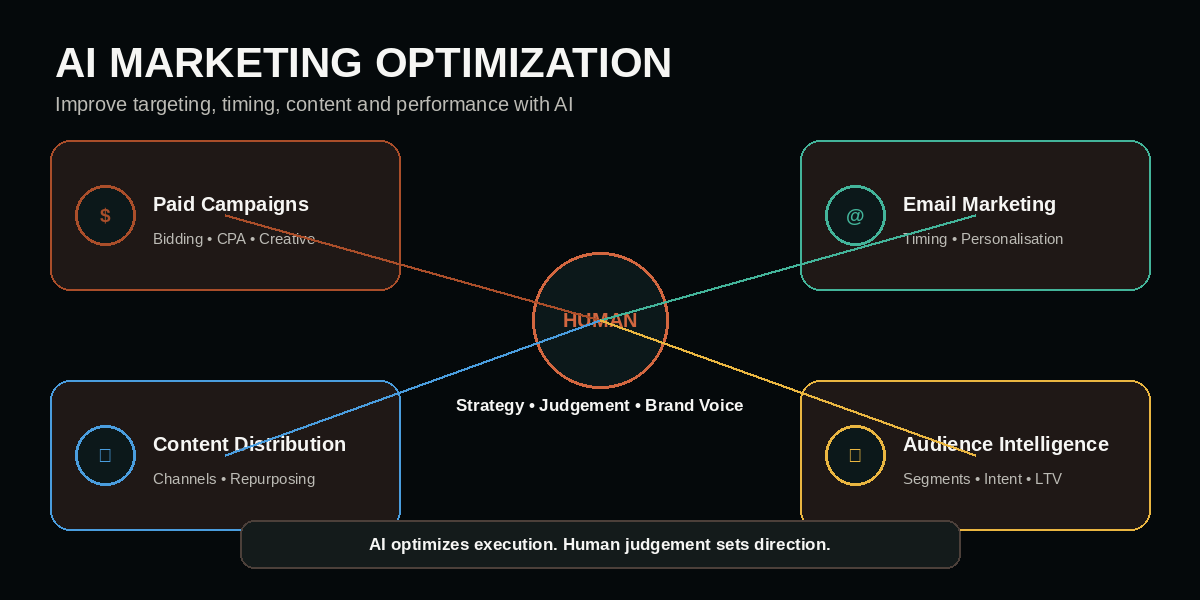
AI marketing optimization is the strategic use of artificial intelligence to improve targeting, relevance, timing, content distribution, and campaign performance across paid media, email, social, and audience intelligence.
The strongest AI marketing programmes do not deploy the most tools. They match the right application to the right domain, establish measurement before implementation, and keep strategy, creative judgement, and brand voice human-led.
What Do the AI Marketing Numbers Show?
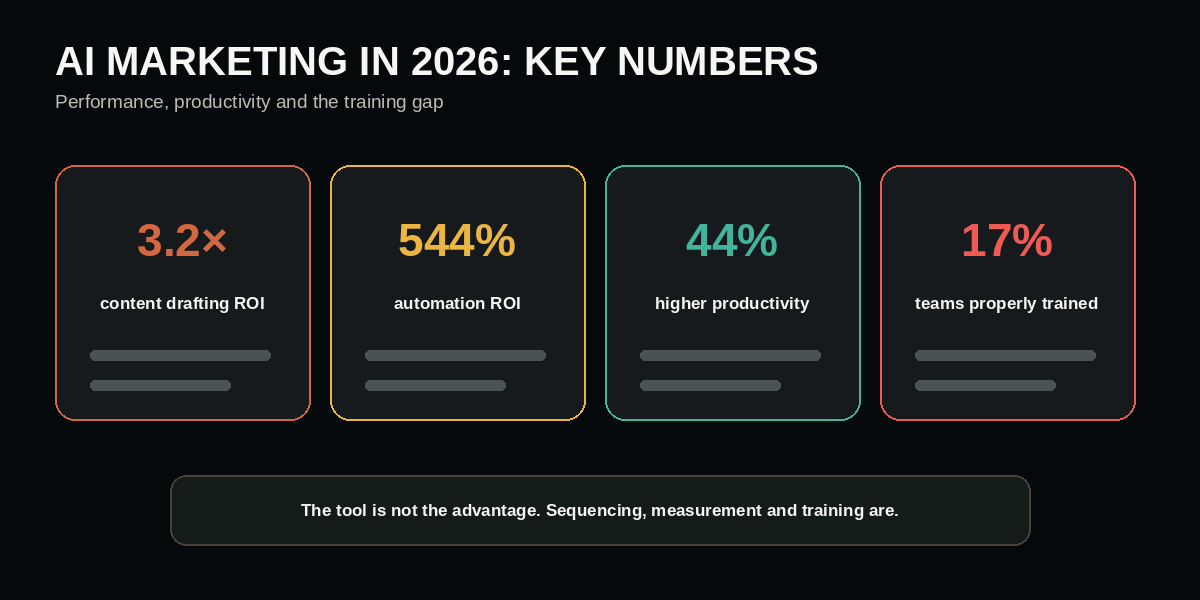
AI is already embedded in everyday marketing workflows, but the performance gap between adoption and measurable value remains large. High-return teams sequence investments, instrument attribution, and train people to redesign workflows rather than use AI as a faster version of existing tools.
What Is AI Marketing Optimization?
Direct answer: AI marketing optimization is the strategic use of AI to improve the targeting, relevance, timing, and performance of marketing activity across paid campaigns, email, content distribution, and audience intelligence. Success is measured through conversion rate, customer acquisition cost, campaign ROI, pipeline contribution, and revenue impact.
AI marketing is Layer 3 of the broader AI Optimization framework. It depends on a usable website foundation and strong content quality. Better targeting cannot compensate for a weak destination page, poor trust signals, or content that fails to answer the buyer’s next question.
For the foundational framework, read What Is AI Marketing Optimization?. External perspectives include Semrush’s AI marketing guide, Ahrefs’ AI marketing research, and Neil Patel’s guide to using AI in marketing.
Where Should AI Marketing Investment Begin?
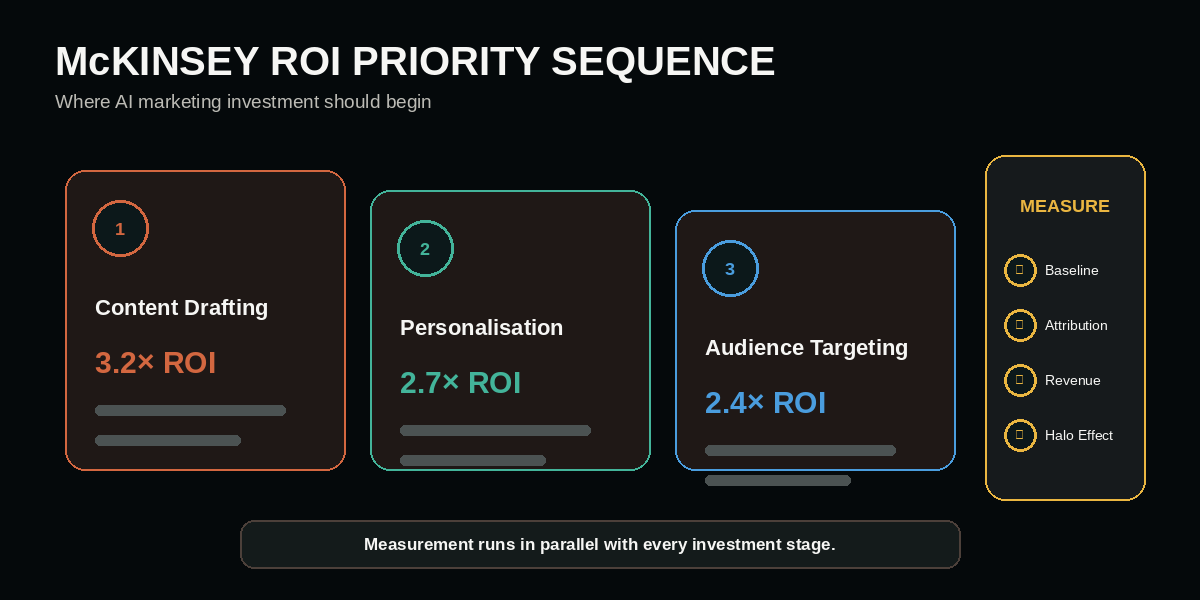
Direct answer: The practical investment sequence begins with content drafting, moves into personalisation after the data foundation is reliable, and then expands into audience research and targeting. Attribution and measurement must be installed in parallel from the beginning.
| AI Application | ROI Benchmark | What It Does | Priority |
|---|---|---|---|
| AI content drafting | 3.2× | Researches, outlines, drafts, adapts, and optimizes content across formats and channels. | Start here: immediate productivity impact and comparatively low implementation risk. |
| AI personalisation engines | 2.7× | Adapts messaging, recommendations, and experiences using behaviour and intent signals. | Second: deploy after data quality, identity resolution, and consent controls are stable. |
| Audience research and targeting | 2.4× | Finds and segments audiences, predicts intent, and improves targeting precision. | Third: compounds after content and personalisation are producing reliable signals. |
| Attribution and measurement | Enables every stage | Connects AI-assisted activity to pipeline and revenue. | Parallel: establish the baseline and reporting model before scaling spend. |
Equal investment across every AI marketing application is not a strategy. Sequence the applications by return, dependency, and measurement readiness.
AI marketing investment principleWhat Are the Four AI Marketing Domains?
Domain 1: Paid Campaigns
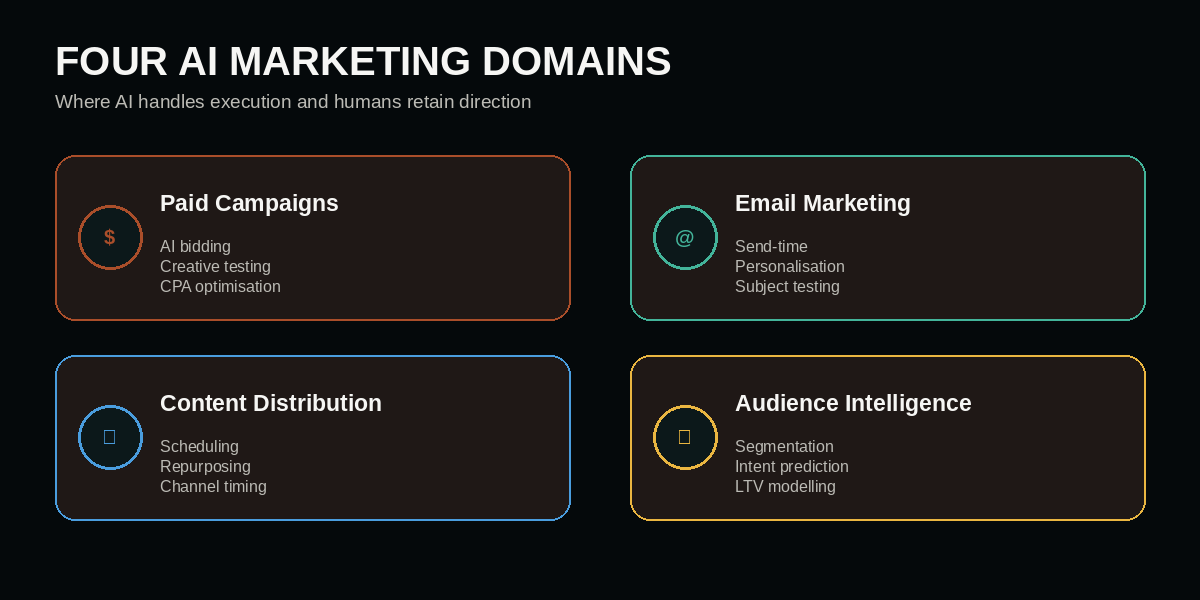
AI has become an operational layer for bidding, targeting, budget pacing, creative testing, and performance prediction. Google Ads documents Smart Bidding as automated bidding that uses machine learning to optimise for conversions or conversion value. The opportunity is not simply to generate more ad variations; it is to test more intelligently and move budget toward the combinations producing qualified outcomes.
Domain 2: Email Marketing
Email is one of the most mature AI marketing domains because subject lines, send times, dynamic content, and behavioural segments can be tested against clear performance baselines.
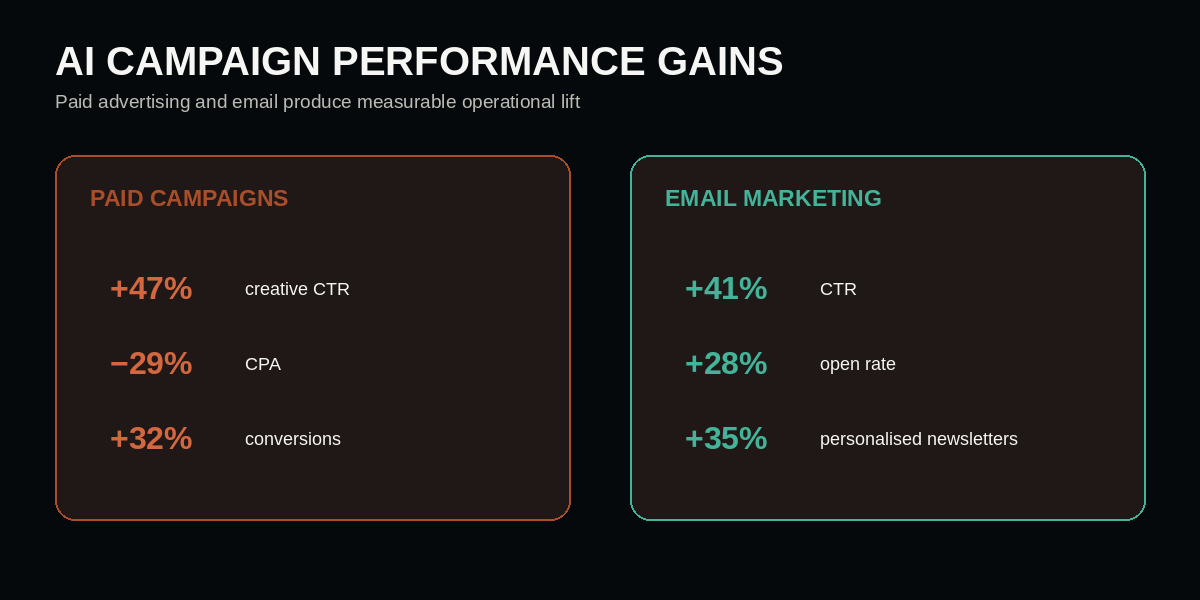
| Domain | AI Responsibilities | Human Responsibilities | Primary Metrics |
|---|---|---|---|
| Paid campaigns | Bidding, pacing, targeting, variation, testing, and prediction. | Strategy, creative direction, exclusions, budget philosophy, and brand safety. | CTR, CPA, ROAS, conversion quality, and incremental revenue. |
| Email marketing | Subject-line testing, send-time optimisation, content variants, personalisation, and attribution support. | Core message, list hygiene, suppression logic, frequency, and commercial positioning. | Open rate, CTR, replies, conversions, unsubscribe rate, and revenue per recipient. |
Domain 3: Content Distribution
AI distribution optimization matches approved content with the channel, format, timing, and audience most likely to engage. It can repurpose an article into social, email, short video, and sales-enablement formats while the editorial team retains authority over the topic and the final message.
- Use AI to identify platform-specific posting windows from historical engagement.
- Repurpose approved long-form content into channel-specific drafts.
- Test formats and angles without changing the underlying factual position.
- Keep topic selection, editorial sequencing, and final approval human-led.
For a dedicated workflow, read AI for Social Media Content Planning.
Domain 4: Audience Intelligence
AI audience intelligence moves segmentation beyond demographics into observed behaviour, intent, likelihood to convert, churn risk, and predicted lifetime value. The outputs can be more precise than manually created segments, but they still require human interpretation and ethical governance. The NIST AI Risk Management Framework provides a practical reference for managing AI risks and accountability.
The research process is covered in How to Use AI for Audience Research, while paid implementation is covered in AI for Paid Ads Optimization.
What Is the Cross-Channel Halo Effect?
Direct answer: The cross-channel halo effect is the compounding pattern in which stronger performance in one AI-assisted marketing channel improves the conditions for other channels. Better content distribution can increase branded search, which can improve paid efficiency, release budget, create more visibility, and strengthen future audience models.
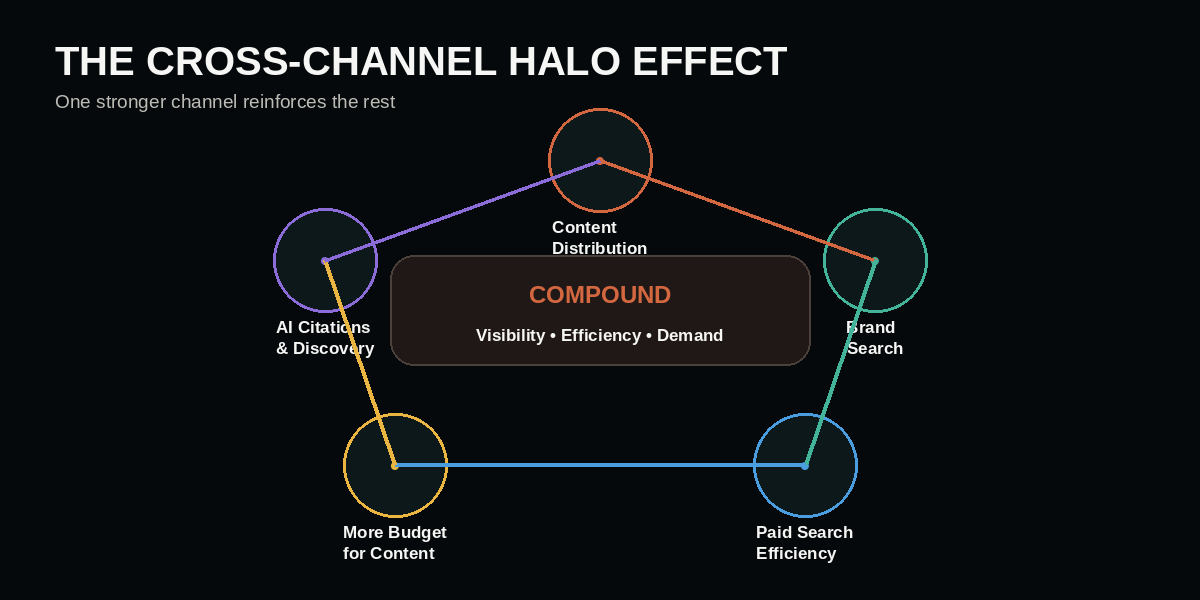
| AI-Strengthened Signal | What It Reinforces Elsewhere |
|---|---|
| Content distribution | Improves recognition, branded search, organic CTR, referral quality, and the audience data available for later targeting. |
| Paid campaign performance | Releases budget for content amplification and reveals messages and offers that can inform organic and email content. |
| Email personalisation | Produces higher-intent site sessions, improves behavioural models, and reduces the need to reacquire existing audiences. |
| Audience intelligence | Improves paid targeting, content relevance, email granularity, and next-best-action decisions. |
Channel-by-channel reporting is necessary, but it is incomplete. Leadership also needs a compound view showing how stronger signals in one channel change performance elsewhere.
Why Are Most Teams Not Capturing the Full Return?
The most underappreciated barrier is capability. Teams frequently adopt AI tools without structured training in prompting, attribution, audience interpretation, governance, and workflow redesign. They then use AI as a faster production layer rather than a different operating capability.
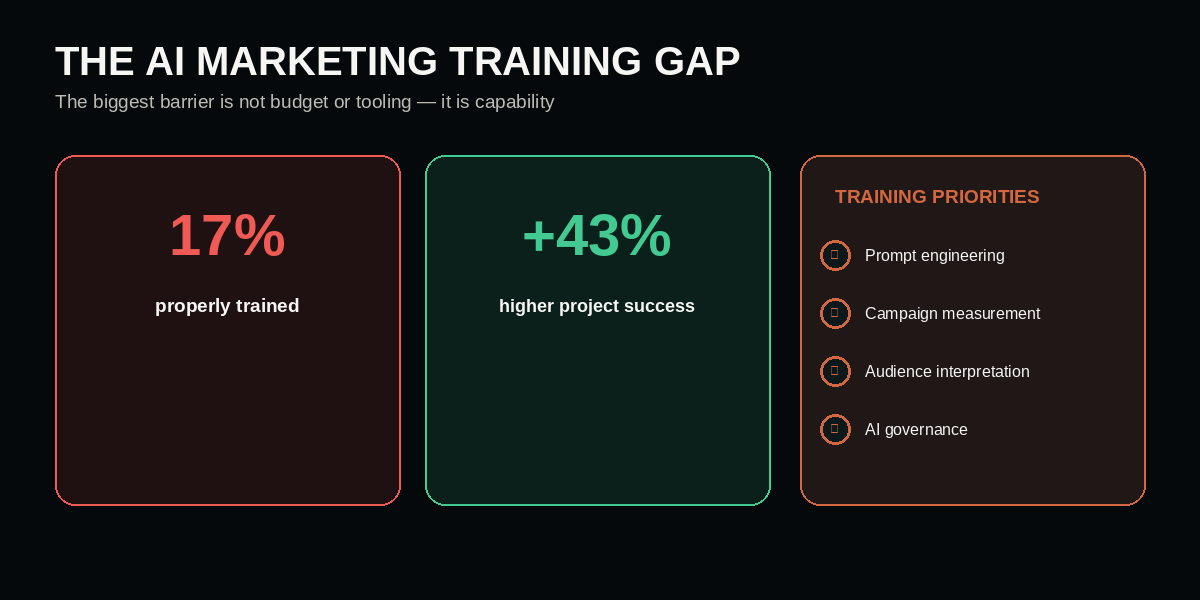
Which AI Marketing Skills Does the Team Need?
| Training Area | Why It Matters | Minimum Team Requirement |
|---|---|---|
| Prompt engineering for marketing | Turns generic output into audience-specific, brand-aligned, channel-ready drafts and analysis. | Every content, social, email, and campaign team member using AI tools. |
| Campaign measurement setup | Separates AI-assisted performance from normal channel movement and makes ROI defensible. | Paid-media managers, lifecycle owners, analysts, and marketing operations. |
| Audience-data interpretation | Prevents teams from accepting model recommendations without understanding context, bias, or strategic relevance. | Strategists, account managers, CRM owners, and segmentation leads. |
| AI marketing governance | Defines where AI augments or replaces decisions, protects brand voice, and controls audience-data use. | Marketing leadership plus legal, privacy, and compliance owners. |
AI recommendations are not automatically correct because they are generated from more data. The OECD AI Principles emphasise transparency, robustness, accountability, and human-centred values. High-impact audience, budget, and positioning decisions still require accountable human review.
AI Marketing Optimization Checklist
| # | Domain | What to Check | Pass Condition |
|---|---|---|---|
| 1 | Investment sequence | Budget follows content drafting, personalisation, and targeting dependencies rather than equal allocation. | Investment order reflects expected return, data readiness, and measurement capability. |
| 2 | Paid campaigns | AI bidding and budget pacing are active on suitable search and social campaigns. | Performance is compared against a documented manual or pre-AI baseline. |
| 3 | Paid campaigns | Multiple creative variants are tested at a pace the manual team could not sustain. | Testing velocity increases without losing brand or offer consistency. |
| 4 | Send-time and subject-line optimization are used on appropriate campaigns. | Open, click, conversion, unsubscribe, and revenue metrics are benchmarked before and after. | |
| 5 | Personalisation | Segments use behaviour and intent, not only demographic fields. | Messages and offers vary meaningfully by observed needs and lifecycle stage. |
| 6 | Distribution | Scheduling and repurposing use performance data while the editorial calendar remains human-led. | Channel timing improves without creating repetitive or off-brand publishing. |
| 7 | Audience intelligence | Segments and predictive models are refreshed from current behaviour. | Intent, lookalike, churn, and LTV models have clear owners and review cadence. |
| 8 | Measurement | Attribution connects AI-assisted activity to pipeline and revenue. | AI marketing ROI and cross-channel effects are reported separately and together. |
| 9 | Training | Everyone using AI has completed role-specific training. | Completion, skill application, and project outcomes are documented. |
What Is the Best Implementation Sequence?
Document the baseline
Record current channel costs, conversion rates, production time, campaign velocity, audience quality, and revenue contribution before deploying AI.
Prioritise the application
Begin with the highest-return use case that has clean inputs, a clear owner, and an objective output.
Define human decision rights
Specify which budget, audience, message, brand, compliance, and escalation decisions cannot be made automatically.
Run a controlled pilot
Limit the first deployment to a measurable campaign, segment, or channel and review every exception.
Measure channel and halo impact
Evaluate direct campaign results plus changes in branded search, content engagement, audience quality, and downstream performance.
Train before scaling
Turn pilot learning into documented prompts, measurement rules, governance standards, and role-specific training.
How Should AI Marketing Performance Be Measured?
| Metric | What It Reveals | Measurement Method |
|---|---|---|
| Incremental campaign ROI | Whether AI creates value beyond normal channel movement. | Compare against pre-AI, holdout, or matched-campaign baselines. |
| Customer acquisition cost | Whether targeting and creative optimization reduce waste. | Measure qualified acquisition cost, not only platform-reported conversions. |
| Creative testing velocity | Whether AI expands learning speed without lowering quality. | Track variants tested, winning insights, production hours, and reuse across channels. |
| Audience quality | Whether segmentation improves conversion, retention, and lifetime value. | Compare cohorts by intent, qualification, repeat activity, and revenue quality. |
| Cross-channel halo | How improvement in one channel changes brand search, organic CTR, email, direct, and paid efficiency. | Review channel trends together and annotate major AI-assisted campaigns and distribution periods. |
| Training effectiveness | Whether skills translate into better campaign outcomes and safer adoption. | Compare trained and untrained teams on quality, speed, errors, and ROI. |
Frequently Asked Questions
Which AI marketing application delivers the highest ROI?
How much better do AI-optimized campaigns perform?
What is the cross-channel halo effect?
Why are most teams not capturing the full return?
Should AI control the full paid-media budget?
How should a small marketing team begin?
Key Takeaways
- AI marketing optimization improves targeting, relevance, timing, distribution, and campaign performance.
- Sequence investments instead of distributing budget evenly across applications.
- Paid, email, content distribution, and audience intelligence should operate as one connected system.
- The cross-channel halo effect can make total value larger than the sum of isolated channel results.
- AI should handle repetitive optimisation decisions while humans retain strategy, creative direction, governance, and accountability.
- Measurement must begin before deployment and include both direct channel results and compound effects.
- The primary barrier is capability: role-specific training determines whether AI remains a tool or becomes an operating advantage.

About the Author
Marcus Hibbert is the founder of AI Recommended, a leading Generative Engine Optimisation (GEO) agency helping UK B2B technology companies become the trusted recommendation across ChatGPT, Google AI Mode, AI Overviews, Gemini, Claude, Perplexity and Microsoft Copilot whenever decision-makers search for products, services and solutions.
Connect with Marcus on LinkedIn.
Request an AI Optimisation Audit
Discover how AI platforms describe, cite and recommend your brand across the prompts your ideal buyers use—and uncover opportunities to become AI's trusted recommendation.
By submitting this form, you’re requesting an Artificial Intelligence Optimisation (AI Optimisation) audit for your brand.

.png)